

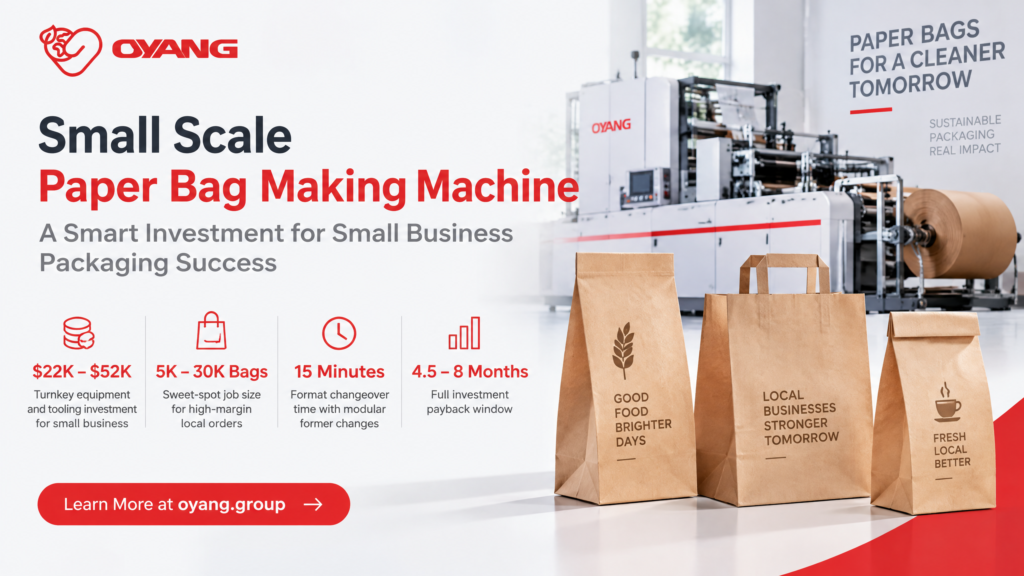
Investing in a small scale paper bag making machine (internationally sourced as a paper bag making machine small scale, small business paper bag manufacturing machine, or paper bag making machine for small business) offers commercial packaging entrepreneurs an agile path to enter regional packaging markets at an accessible turnkey investment of $22,000 to $52,000 USD. Built specifically for on-demand local orders ranging from 5,000 to 30,000 bags—serving regional retail bakeries, pharmacy chains, and fast-food eateries—a standardized compact platform like the OYANG 16C V-Bottom Series or OYANG 16B SOS Converter converts 35 to 120 GSM kraft, greaseproof, and coated paper stock at velocities of 150 to 450 bags/min. By eliminating multi-hour tooling swaps through 15-minute modular former changes, a lean small-business converting cell delivers gross profit margins of 32% to 48% and achieves full capital payback within 4.5 to 8 months of commissioning.
The Lean Commercial Model: Winning Local Short-Run Packaging Contracts
Large-scale industrial packaging conglomerates operate high-capacity lines that run 180 to 220 bags/min. Because their setup and format changeover times span 2 to 4 hours, these enterprise plants require minimum order quantities (MOQs) of 100,000 to 500,000 bags per SKU. This dynamic creates an underserved regional market:
- The Local Market Gap: Regional artisan bakeries, independently owned pharmacy groups, sandwich shops, and boutique coffee roasters need batches of 5,000 to 25,000 bags per month. Enterprise packaging plants reject these small orders or quote high unit prices ($0.035–$0.050 USD per unprinted food pouch) accompanied by 6-to-8 week delivery lead times.
- Agile Production Economics: A paper bag making machine for small business operates with low mechanical inertia and rapid mechanical repositioning. Swapping a forming tongue on an OYANG 16C takes an operator less than 15 minutes, allowing a small business converting shop to run three distinct client orders in a single 8-hour shift.
- Pricing Power & Margin Premium: Because small-business converters deliver finished, branded bags within 48 to 72 hours, local food clients willingly pay wholesale rates of $0.022 to $0.032 USD per bag (a 40% margin premium over bulk commodity contracts), providing strong per-hour machine margins.
For deeper insight into how continuous web feeds, draw rollers, and rotary knives synchronize mechanically, review our foundational guide on how does a paper bag machine work: Mechanics and workflow.
Startup Machinery Selection & Commercial Quotation Matrix
The following matrix outlines machinery options for small business entrepreneurs, balancing paper bag making small machine price against targeted bag styles:
| Machine Model & Type | Target Local Products | Production Velocity | FOB Factory Price | Turnkey Setup CapEx |
|---|---|---|---|---|
| OYANG 16C-Base Compact V-Bottom Unit | Bakery baguettes, pharmacy pill pouches, fry bags | 300 – 500 bags/min | $18,000 – $24,000 USD | $28,000 – $34,000 USD |
| OYANG 16C-Print V-Bottom + 2-Color Flexo | Branded bakery packaging, takeaway pouches | 250 – 400 bags/min | $28,000 – $36,000 USD | $38,000 – $48,000 USD |
| OYANG 16B-Compact Semi-Auto SOS Square Bottom | Self-standing food delivery sacks, coffee bean bags | 60 – 100 bags/min | $38,000 – $48,000 USD | $49,000 – $59,000 USD |
| Auxiliary Addition: ONL-HFA Flat Handle Paster (Optional) | Adds carrier handles to plain SOS bags on-demand | 35 – 45 bags/min | $12,000 – $16,500 USD | $15,000 – $19,500 USD |
For detailed insights into serrated cutoff mechanics and high-speed web handling on compact V-bottom platforms, study our technical resource on V-bottom paper bag making machines: Rotary serrated cutoff and food packaging guide.
Engineering Video: Agile V-Bottom Converting for On-Demand Food Sacks
Observe continuous web unwinding, inline 2-color flexographic printing, and rotary knife cutoff in this production run:
Video 1: Commercial food and bakery pouch converting running on a high-speed compact sharp-bottom machine line.
Light-Asset Workshop Footprint & Single-Operator Logistics (40 to 80 m2)
Small businesses must manage overhead tightly. Commercial rent can quickly diminish operating profit if a factory is oversized. An agile converting cell functions smoothly in a 40 to 80 m2 commercial unit:
1. Operational Workflow (Single Technician Setup)
A modern compact machine like the OYANG 16C requires only one primary machine operator. The unwind roll shaft features pneumatic chucks that load a 300 kg master roll in under 3 minutes using a manual roll-lifter truck. Finished bags automatically stream onto a conveyor table equipped with a pneumatic batch counter, enabling the operator to pack bags directly into corrugated cartons without halting production.
2. Low Utility Connection Demands
Converting lines running on 380V/3-phase power consume between 8.5 and 13.5 kW, keeping electrical installation expenses minimal ($800–$1,800 USD). A quiet, cabinet-enclosed 5.5 kW rotary screw air compressor with an integrated refrigerated dryer fits in a corner, providing clean air (0.7 MPa) for the web-guiding EPC sensors and glue valves.
3. Raw Paper Working Capital & Storage Efficiency
Rather than storing 40 tons of paper, a lean startup maintains a rolling stock of 5 to 8 tons of standard paper reels (45 GSM white bleached kraft for pharmacies, 50 GSM brown rib kraft for bakeries, and 60 GSM greaseproof paper for fast-food burgers). Staged across 15 m2 on standard euro pallets, this stock ties up less than $6,000 USD in working capital while supporting two weeks of on-demand converting.
For comprehensive plant cash flow modeling, break-even timelines, and factory square-meter utilization strategies, review our business setup analysis on paper bag manufacturing business setup: Complete CapEx & ROI guide.
Short-Run Batch Financial Model: 15,000 Bakery Bags Order
The operational budget below reflects actual costs and profit for a small converting business executing a rush order of 15,000 custom 2-color printed bakery bags (Size: 180 × 80 × 280 mm, 50 GSM bleached kraft) running on an OYANG 16C with inline flexo printing:
| Cost / Revenue Element | Consumption / Operating Metric | Batch Financial Total (USD) |
|---|---|---|
| Paper Reel Stock (50 GSM Bleached) | 118.5 kg raw kraft paper (including 1.5% setup scrap) | $106.65 USD ($900/ton) |
| Water-Based PVAc Adhesive & Ink | 2.5 kg seam/bottom cold glue + 1.2 kg water-based flexo ink | $11.80 USD |
| Direct Power & Air Utility | 11.5 kWh electric utility (1.2 hours run time @ 250 BPM) | $1.50 USD ($0.13/kWh) |
| Direct Operator Labor Overhead | 1.5 hours total time (includes 15-min former change + run) | $22.50 USD ($15.00/hr) |
| Corrugated Outer Packaging Boxes | 15 shipping cartons (1,000 bags/box) + tape | $18.00 USD ($1.20/box) |
| Total Batch Manufacturing Cost | 15,000 Finished Custom Printed Bags | $160.45 USD ($0.0107 / bag) |
| Wholesale Contract Invoice Value | Invoiced @ $0.0220 USD per bag (Fast 48-hr local delivery) | $330.00 USD |
| Net Gross Profit (Single 1.5-Hr Run) | 51.3% Gross Operating Margin | +$169.55 USD Net Cash Margin |
This batch economic breakdown highlights why lean converting operations succeed: completing two modest short-run jobs per day generates $300 to $400 USD in daily gross profit ($7,200–$9,600 USD per month). Against a total equipment lease or startup CapEx of $32,000 USD, a small-business operator comfortably amortizes the machine within 4.5 to 6.5 months.
To calculate exact paper roll grammage, adhesive consumption, and direct labor allocations across these bag formats, consult our comprehensive guide on paper bag manufacturing cost: Unit cost and pricing guide.
Related Technical Guides & Converting Resources
- → V-Bottom Paper Bag Making Machine: Food Packaging Guide: Technical analysis of rotary serrated cut-off knives, greaseproof substrate handling, and high-speed bakery pouches.
- → Paper Bag Manufacturing Business Setup & ROI Guide: Strategic roadmap covering break-even modeling, factory layout footprints, and paper inventory working capital.
- → Paper Bag Manufacturing Cost: Unit Cost & Pricing Guide: Cost modeling across substrates, adhesive consumption, and inline versus offline handle assembly.
- → How Does a Paper Bag Machine Work? Mechanics & Workflow: Kinematic breakdown of roll unwinding, continuous tube formation, and rotary bottom folding.
Frequently Asked Questions (FAQ)
What is the total capital expenditure required to start a small-scale paper bag business?
A complete small-scale converting startup requires a total turnkey capital investment between $22,000 and $52,000 USD. This covers an agile compact industrial machine (such as the OYANG 16C V-bottom platform), ocean freight and customs duties, a small rotary screw air compressor, workshop electrical wiring, and 30 days of initial raw kraft paper reel inventory.
Why are V-bottom machines recommended over square-bottom machines for small business startups?
V-bottom machines feature lower machinery purchase costs ($18,000 to $28,000 USD vs. $40,000 to $120,000+ USD for square-bottom units), use simpler former plate tooling that allows 15-minute format changeovers, run at higher operating speeds (up to 450 bags/min), and serve high-volume local cash-flow markets such as retail bakeries, pharmacies, and fast-food eateries.
How many workers are needed to operate a small business paper bag converting cell?
A compact industrial paper bag converting cell requires only one primary technician. The operator loads raw master reels via pneumatic roll lifters, oversees adhesive levels and tension settings, and packs automatically counted, finished bags into shipping cartons directly from the exit delivery conveyor.
How fast is the return on investment (ROI) for a small-scale paper bag production machine?
Because small businesses target local on-demand orders (5,000 to 25,000 bags) that command high gross profit margins of 32% to 48%, a single-shift workshop running 20 to 22 days per month typically amortizes the initial machine investment within 4.5 to 8 months.