

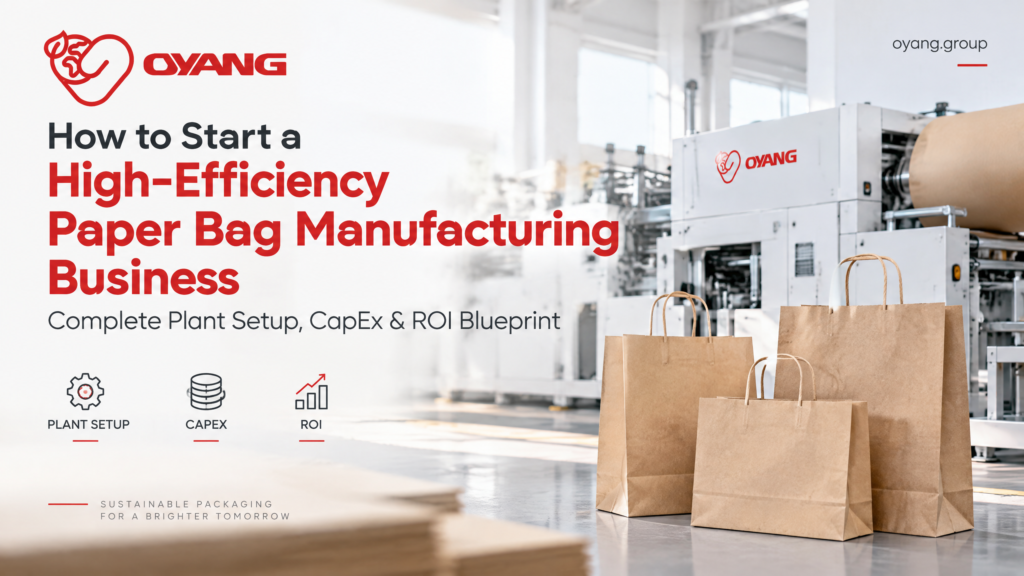
How to Start a Paper Bag Company: Complete Industrial Plant Setup, CapEx & Production Guide
Market Dynamics & Economics: How Much Profit Does a Paper Bag Business Make?
Accelerating worldwide legislative bans on single-use plastics have turned paper carrier bags from an elective sustainable option into a mandatory consumable across major supermarkets, fashion retailers, bakeries, and food delivery platforms. For entrepreneurs asking how to open a bag business or how to start a bag company in this transition period, market fundamentals are underpinned by strong structural demand.
In commercial production, gross profitability is governed by the conversion margin—the difference between kraft paper reel raw material costs ($750–$1,100 per metric ton) and fabricated finished bag selling prices. For a standard grocery square-bottom (SOS) bag without handles (280 × 150 × 300 mm, 70 gsm natural kraft), the unit manufacturing cost averages $0.024–$0.038. Sold at wholesale rates of $0.045–$0.065, operations generate gross margins between 35% and 45%, leaving a net factory profit margin of 18%–25% after power, adhesive, direct labor, and equipment depreciation.
To model your variable line costs, power expenses, and wholesale price points down to fractions of a cent, review our engineering cost breakdown on how much does it cost to produce a paper bag.
Plant Infrastructure Engineering: Floor Layout, Pneumatics, and Power Utility Sizing
Substandard workshop design is the primary contributor to web tension instability, paper snapping, and micro-stoppages. Based on engineering deployments from OYANG’s 130,000 m² manufacturing base, industrial bag plants must be engineered around specific parameters:
- Factory Footprint & Clear Height: A single continuous line requires 350 to 500 m² with a clear overhead height of ≥ 4.5 meters to support overhead hoists for 1.2-to-1.5-ton paper parent rolls. A multi-line setup (3 to 5 automated lines) requires 1,200 to 2,500 m² to integrate buffer zones and finished pallet staging.
- Electrical Utility Load: Industrial 3-phase 380V ± 10%, 50/60 Hz. A fully integrated line with inline 4-color flexo printing and twisted rope handle forming demands a connected load of 35 kW to 65 kW. Voltage stabilizers are mandatory in areas where line fluctuations exceed ± 7%.
- Pneumatics & Air Quality: Stable continuous line pressure of 0.6 to 0.8 MPa at ≥ 1.2 m³/min delivery rate per machine. Coalescing micro-filters and refrigerated dryers are strictly required to protect pneumatic brakes and high-speed solenoid valves from oil and moisture fouling.
- Atmospheric Control: Paper rolls are highly hygroscopic. Plant relative humidity must be regulated within 50% to 65% at 20°C–26°C. Dry air induces static clinging and web edge curling, whereas high humidity compromises paper tensile strength, leading to web breaks above 150 m/min.
Linear Production Logistics Flow (Zero-Bottleneck Architecture)
Raw Reel Unwinding & Overhead Loading → Multi-Stage Web Guiding (EPC) → Inline Flexo Web Printing → Tube Forming & Bottom Pasting → Handle Application → High-Speed Rotating Knife Cutoff → Bottom Gluing & Compacting Drum → Automated Conveyor Counting & Stacking.
CapEx Breakdown: Machine Selection Matrix for Starting a Bag Business
Machinery procurement accounts for 60%–75% of startup capital. How much you can use to start a bag business depends on whether you focus on small regional food delivery runs or enterprise retail shopping bags:
| Startup Tier | Recommended Machinery Line | Rated Conversion Speed | Primary Commercial Applications | Typical CapEx (USD) |
|---|---|---|---|---|
| Tier 1: Semi-Auto Entry (Small Business) | Semi-Automatic Roll-Fed SOS Machine (OYANG 16B) | 80–120 bags/min | Bakery sacks, fast-food takeaway bags without handles | $45,000 – $75,000 |
| Tier 2: Fully Automatic Standard | Automatic SOS Machine with Inline Twisted Handle (OYANG 16A) | 130–180 bags/min | Retail shopping bags, department stores, apparel packaging | $110,000 – $190,000 |
| Tier 3: High-Speed Agile Setup | Auto Size-Change Rapid Conversion Line (TECH-18) | 180–220 bags/min (2-min size change) | Multi-SKU on-demand batch runs, rapid contract packaging | $180,000 – $280,000 |
| Tier 4: Enterprise Integrated | High-Speed Line with Inline Printing & Packaging (SG600) | Up to 240+ bags/min | Large FMCG grocery chains, Tier-1 global fast-food brands | $260,000 – $450,000+ |
How to Start a Packaging Business in India & Regional Emerging Markets
Following national single-use plastic restrictions across South Asia and the Middle East, starting a packaging business in India demands adherence to state environmental frameworks (such as State Pollution Control Board CTE/CTO consents) and BIS standards (IS 16908 for food contact packaging).
Engineering for Recycled Agro-Kraft Substrates
Domestic paper mills in industrial hubs like Gujarat, Maharashtra, and Tamil Nadu frequently supply agro-based recycled kraft reels (45–100 GSM) with variable burst factors (BF 16 to 24). To prevent tear-outs at high speeds, machines must feature sensitive dancer-arm closed-loop tension regulation rather than fixed mechanical friction brakes, keeping roll stretch below 0.05% during unwind.
How Do I Start My Own Tote Bag Business? High-End Paper vs. Nonwoven Lines
Entrepreneurs researching how to start my own tote bag business or retail shopping brand must decide between two primary industrial pathways:
- Heavyweight Retail Paper Tote Bags: Utilizes virgin kraft (120–160 GSM) on lines like the SMART-17 AS Automatic Flat Handle Machine, producing bags with flat handles folded neatly inside the rim to maximize food-service stacking or boutique luxury presentation.
- Ultrasonic Reusable Eco-Tote Bags: Utilizes PP spunbond fabric on the OYANG 20 Nonwoven Box Bag Machine, yielding heavy-duty reusable tote bags capable of carrying 15–20 kg. For converters targeting pristine brand aesthetics without exterior fold lines, review our technical guide on how to make a professional paper bag.
Commercial Distribution: How to Sell Paper Bags B2B and Online
A high-OEE conversion plant requires a balanced order portfolio to maintain continuous line operation without excessive inventory buildup:
- High-Volume Industrial Contracts (70% Allocation): Direct supply agreements with supermarket chains, retail food brands, and logistics distributors. These orders run standard SKUs in runs of 100,000+ units, guaranteeing base capacity utilization.
- E-Commerce & Digital Web-to-Print (30% Allocation): How to sell paper bags online effectively relies on combining web-to-print portals with low minimum order quantity (MOQ) flexographic capabilities. Utilizing rapid size-change bag makers like the TECH-18 allows digital converters to aggregate daily online custom-print orders (batches of 1,000–5,000 units), grouping them sequentially with under-2-minute setup changeovers to achieve short-run profitability.
OYANG Engineering Practice: Precision Manufacturing for Long-Term Operating Stability
High-speed roll-fed converting machinery faces extreme cyclic stress. Structural vibrations at 200+ bags/min cause glue splattering, register drift, and premature bearing wear. Within OYANG’s 130,000 m² production facilities, critical machine side-wall panels, rotating knife assemblies, and bottom folding cylinders are machined using Japanese MAZAK and OKUMA CNC multi-axis centers to tolerances of ≤ 0.015 mm.

Figure 1: OYANG TECH-18 roll-fed paper bag production system featuring rapid recipe recall and 2-minute automated size changeover.
This structural precision guarantees true dynamic balance during continuous operation. Integrated with multi-axis bus-controlled servo architecture (independent servo drives for paper feeding, blade cutoff, and bottom disc positioning), OYANG machines maintain web scrap rates below 1.2% even through rapid acceleration cycles.
Download Resource: Review detailed technical layouts, electric consumption data, and footprint drawings in the OYANG Paper Bag Machine Solution Brochure (PDF).
Video Demonstration: Watch high-speed automated forming and 2-minute bag size changeovers on the TECH18 Automated Paper Bag Machine Operation Video.
Related Engineering Guides & Technical Resources
- Industrial Execution Blueprint: How to Start Making Paper Bags (Plant Startup Guide)
- Premium Luxury Packaging: Great 4.0 Sheet-Fed Non-Crease Paper Bag Machine Architecture
- Raw Material Preparation: ONL-SL High-Speed Paper Roll Slitting & Rewinding Systems
- Secondary Converting: Automatic Round Rope Paper Handle Pasting Line Integration
Frequently Asked Questions (FAQ)
How can I start a bag company with reliable ROI?
To start a bag company with predictable ROI, secure long-term purchase agreements with local supermarkets or bakeries, install a multi-servo roll-fed SOS paper bag machine (such as the OYANG 16B or TECH-18), maintain scrap rates below 1.2% through automated edge-guiding systems, and maintain 350 to 500 m² of dry factory space with 380V three-phase electrical power.
How much does it cost to start a paper bag manufacturing business?
Starting an industrial paper bag manufacturing plant typically requires an investment of $60,000 to $100,000 for a semi-automatic roll-fed line, and between $180,000 and $450,000 for a high-speed, fully automatic square-bottom line with inline printing and handle applicators. Total setup costs include primary machinery, raw paper roll inventory, auxiliary slitting/packaging units, and factory utility installations.
How much profit does a paper bag manufacturing business make?
A properly managed paper bag manufacturing plant generates average gross profit margins of 30% to 45% and net profit margins of 15% to 28%. Profitability depends on machine OEE (≥ 85%), bulk raw paper purchasing agreements, low paper web scrap rates (≤ 1.5%), and the proportion of high-value custom printed or handle-applied bags.
What machinery is needed to open a paper bag company?
A standard commercial paper bag line requires a roll-fed square-bottom (SOS) paper bag machine, an inline or offline flexographic printing machine, a paper roll slitting and rewinding machine, an automatic paper rope handle making and pasting machine, and an automatic end-of-line bag bundling and packing machine.
How to start a packaging business in India compliant with plastic bans?
Starting in India requires obtaining Consent to Establish (CTE) from the State Pollution Control Board, sourcing domestic agro-kraft paper reels (45 to 100 GSM), and selecting roll-fed bag machinery with closed-loop tension control systems to process irregular tensile strength paper rolls without frequent web breaks.
How do I start my own tote bag business?
To start a tote bag brand, choose between heavy kraft paper carrier bags (120 to 160 GSM) using inline flat-handle folding machines, or reusable nonwoven box tote bags using ultrasonic box bag making lines. Position the business to supply retail fashion brands, boutique grocers, or corporate promotional merchandise.
How to sell paper bags online and secure B2B buyers?
Converters can sell standard unprinted kraft paper bags through B2B e-commerce platforms like Amazon Business and specialized packaging portals, while targeting 70% of total plant volume via direct annual contracts with retail supermarkets, restaurant chains, and courier distribution centers. Providing online web-to-print custom branding allows plants to capture premium pricing on low-volume orders.