

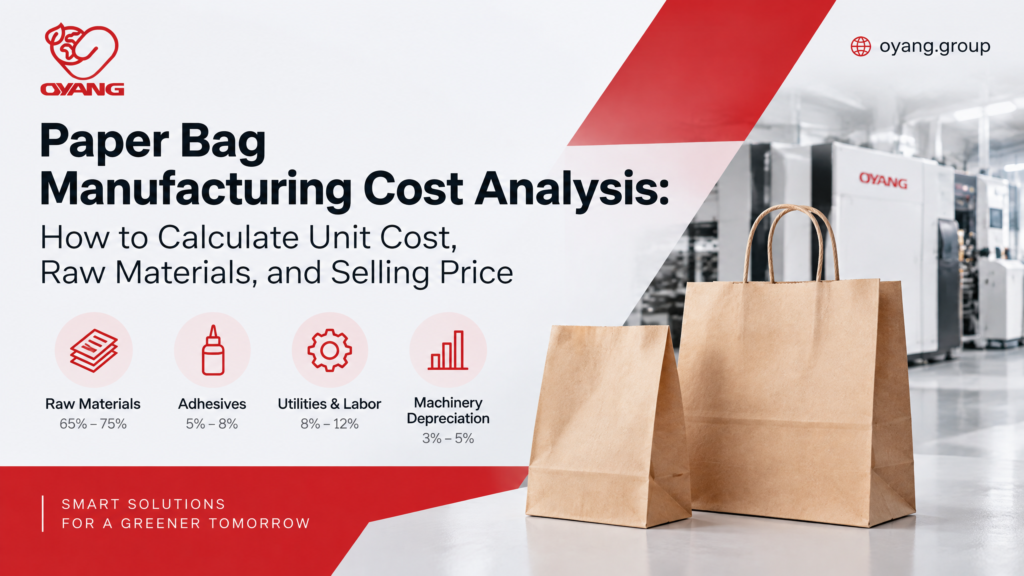
Paper Bag Manufacturing Cost Analysis: How to Calculate Unit Cost, Raw Materials, and Selling Price
The Industrial Unit Cost Equation: Engineering Breakdown
Converting raw kraft paper rolls into commercial carrier bags requires precise aggregation of raw materials, energy, tooling, and labor overheads. In plant floor engineering, the total unit production cost (Cunit) is calculated using the following multi-variable formula:
Where each parameter reflects verified workshop operating constants:
- Mpaper (Raw Paper Reel Cost): Calculated by: Unfolded Area (m²) × Grammage (g/m²) × [Kraft Paper Price Per Ton / 1,000,000].
- αwaste (Scrap Factor): Material wastage during line acceleration, reel splicing, and edge trimming. On precision servo-driven lines, α ≤ 0.015 (1.5%), whereas poorly calibrated mechanical shaft lines routinely exceed 4.0%.
- Mglue (Adhesive Consumption): Water-based cold PVA glue for longitudinal seams and bottom folds (0.8–1.5 g solid weight per bag), plus EVA hot-melt glue for handle patch affixing (0.3–0.5 g per handle set).
- Mhandle (Handle Assembly): Paper rope cord plus kraft patch reel material cost. Applicable exclusively to SOS carrier bags with twisted or flat paper handles.
- Mink (Water-Based Flexo Inks): Consuming 1.2 to 2.5 g/m² depending on anilox transfer volume and graphic coverage (e.g., 15% text logo vs. 100% full-surface flooding).
- Epower + Llabor (Utility & Direct Labor): Variable per line based on motor kilowatt load, local electric tariff ($/kWh), and shift crew staffing (1 lead technician and 1 packaging operator per line).
- Dmachine (Straight-Line Depreciation): Equipment CapEx amortized over an operational life of 5 to 8 years across verified annual bag counts.
Unit Cost Comparison: SOS Square-Bottom vs. V-Bottom Sharp-Bottom Bags
The economic profile of a bag factory varies dramatically depending on whether the production runs fast-food grocery sacks or structural shopping bags. Below is a detailed cost matrix based on typical volume runs (100,000 bags) under verified factory parameters:
| Cost Variable / Component | V-Bottom Sharp-Bottom Bag Bakery / Greaseproof (200×120×300mm, 50 gsm) | SOS Square-Bottom Bag (No Handle) Supermarket Sacks (280×150×320mm, 70 gsm) | SOS Shopping Bag (Twisted Handle) Retail Apparel (320×180×420mm, 120 gsm) |
|---|---|---|---|
| Paper Reel Raw Material ($850/ton) | $0.0102 | $0.0215 | $0.0468 |
| Adhesives (Water-based Cold + Hot-melt) | $0.0011 | $0.0022 | $0.0058 |
| Handle Attachment (Twisted Paper Rope + Patch) | $0.0000 (N/A) | $0.0000 (N/A) | $0.0145 |
| Flexo Printing Ink (2-Color Brand Logo) | $0.0014 | $0.0021 | $0.0035 |
| Servo Electricity ($0.12/kWh) | $0.0006 | $0.0012 | $0.0021 |
| Direct Labor & Machine Depreciation | $0.0018 | $0.0032 | $0.0054 |
| Total Net Unit Manufacturing Cost | $0.0151 | $0.0302 | $0.0781 |
| Recommended Wholesale Price (25%–35% Margin) | $0.0210 – $0.0235 | $0.0420 – $0.0465 | $0.1080 – $0.1200 |
Pricing Strategy: How Much to Charge for Paper Bags in B2B Tendering
Securing profitable wholesale orders requires a disciplined pricing architecture that balances scale-volume commitments against rapid-changeover customized runs:
- Tier 1: Annual High-Volume Contracts (> 500,000 units): Target gross margins of 18% to 22%. These foundational contracts absorb base factory depreciation and keep converting lines running at continuous rated output speed.
- Tier 2: Medium Regional Commercial Runs (50,000 to 200,000 units): Target gross margins of 25% to 30%. This segment captures supermarket chains, apparel franchises, and e-commerce distribution centers requiring seasonal re-orders.
- Tier 3: Short-Run Custom Web-to-Print Orders (5,000 to 20,000 units): Target gross margins of 35% to 45%+. Enabled by agile machines with rapid size adjustments, plants charge premium setup and plate fees while delivering fast turnaround times for boutique brands.
The 1.5% Web Scrap Rule: How Machine Engineering Dictates Factory Survival
Because kraft paper accounts for up to 75% of your total product expense, mechanical waste directly dictates business survival. Consider a production facility processing 15 tons of kraft roll daily ($12,750 paper value per day):
An uncalibrated, mechanically loose converting line operating with a 4.5% scrap rate wastes $573.75 of paper daily ($172,125 annually). Conversely, a high-precision multi-servo converting system running at ≤ 1.2% scrap restricts daily material loss to $153.00 ($45,900 annually)—recovering $126,225 per line every single year directly into pre-tax profit.
Scrap reduction cannot be resolved by operator discipline alone; it is fundamentally determined by closed-loop electronic line shaft (ELS) synchronization and structural rigidity across unwinding and cutoff stations.
OYANG Engineering Practice: Lowering Unit Converting Costs Through Precision Machining
To guarantee long-term dimensional repeatability and minimize energy consumption, OYANG manufactures all critical machine frames, rotating knife drums, and bottom paste wheels on Japanese MAZAK and OKUMA CNC multi-axis centers to tolerances of ≤ 0.015 mm.

Figure 1: OYANG 16A roll-fed square-bottom paper bag machine with inline twisted handle making unit operating at high OEE conversion rates.
By eliminating frame harmonic micro-vibrations, lines like the OYANG 16A Automatic Paper Bag Machine maintain glue film thicknesses within ± 0.1 mm, preventing glue dripping, web jams, and unnecessary adhesive waste. Furthermore, multi-axis servo regenerative power systems convert deceleration energy back into drive loops, lowering net electricity costs per bag by up to 14%.
Brochure Download: Access exact electrical specs, motor kW ratings, and air consumption data in the OYANG Paper Bag Machine Solution Brochure (PDF).
Video Insight: Observe real-time continuous handle assembly and high-speed forming on our OYANG 16A Handle Paper Bag Machine Factory Video.
Related Engineering Guides & Technical Resources
Frequently Asked Questions (FAQ)
How much does it cost to produce a paper bag?
The cost to produce one paper bag typically ranges from $0.015 to $0.025 for small flat-and-satchel (V-bottom) food bags, and $0.045 to $0.095 for medium-to-large square-bottom (SOS) shopping bags with twisted handles. Raw kraft paper represents 65% to 75% of the total expense, followed by adhesive (5% to 8%), power and labor (8% to 12%), and machine depreciation (3% to 5%).
How much does it cost to produce one paper bag with handles?
Producing one retail paper bag with twisted or flat handles costs between $0.065 and $0.110. The handle assembly itself—combining twisted paper cord, patch paper, and hot-melt glue—adds approximately $0.012 to $0.018 per unit on top of the base bag converting cost.
How much to charge for paper bags in commercial wholesale?
Paper bag manufacturers charge between $0.040 and $0.065 per unit for standard grocery SOS bags without handles, and $0.100 to $0.160 for retail bags with twisted handles. B2B contract pricing models apply gross profit margins of 18% to 22% for massive multi-container orders and 30% to 40%+ for customized, short-run print batches.
What is the primary factor affecting paper bag manufacturing cost?
Raw paper roll grammage (gsm) and paper grade (virgin kraft vs. recycled testliner) are the primary cost drivers, accounting for up to 75% of total production cost. Machine scrap rate is the critical efficiency factor; running high-precision converting equipment that maintains scrap below 1.5% prevents significant financial losses compared to lower-grade equipment that often exceeds 4% waste.
How to make paper bags for sale profitably?
To manufacture paper bags for sale profitably, plants must operate high-speed automated roll-fed converting machines with an OEE above 85%, minimize paper scrap through closed-loop tension control, source kraft paper reels in bulk mill direct contracts, and integrate inline flexographic printing to capture higher-margin branded packaging orders.