

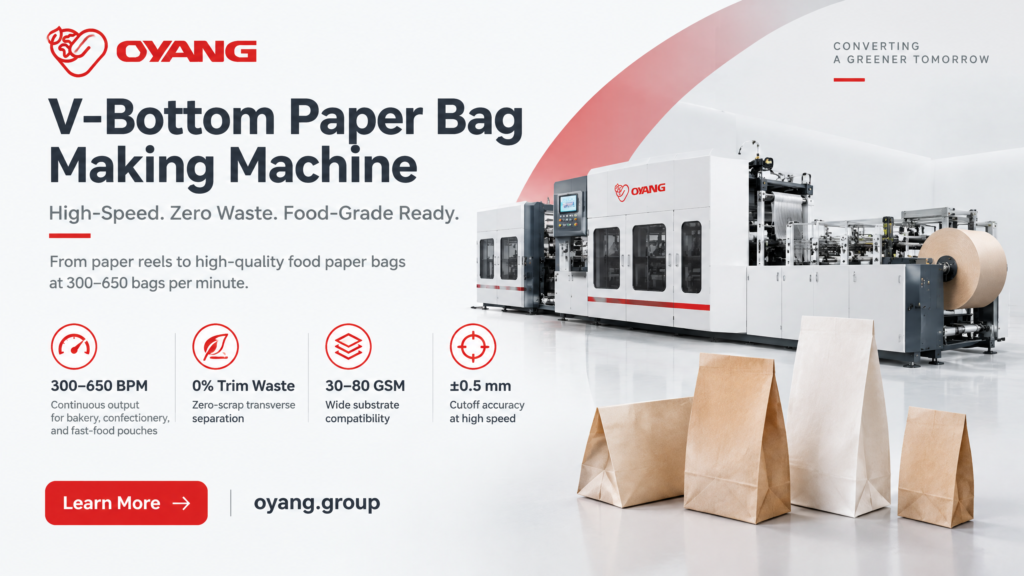
A high-velocity v bottom paper bag making machine (also classified in industrial converting as a sharp bottom paper bag machine or pinch bottom bag making machine) transforms continuous paper reels into flat and gusseted food-grade pouches through a streamlined kinematic sequence: active dancer unwind tensioning, longitudinal seam pasting, forming plow tube folding, continuous rotary serrated cutoff, and rotary wheel bottom gluing with pinch folding. Engineered specifically as a high-output food paper bag making machine, platforms like the OYANG 16C (C330 Series) operate at continuous converting velocities of 300 to 650 bags per minute, handling lightweight 30–80 GSM kraft, coated barrier, and butter paper bag making machine substrates with zero material trim waste and cutoff length tolerances within ±0.5 mm.
Kinematic Principles of High-Speed V-Bottom Pinch Bag Formation
Unlike square-bottom (SOS) sack lines that rely on multi-drum vacuum stations and mechanical opening fingers to form complex hexagonal bases, a v bottom paper bag machine forms its closure by cleanly folding and adhering a single transverse lip. This streamlined mechanical path enables operational speeds up to three times faster than block-bottom machinery.
When operating as a commercial bread bag making machine or fast-food pouch converter, the paper web travels through five continuous, non-stop kinematic stations:
- Tension-Regulated Unwind & Side Scoring: The raw paper roll is unwound with magnetic powder brake or servo dancer regulation, while rotary disc creasers impress side-gusset fold lines.
- Longitudinal Seam Gluing: Cold adhesive is transferred along the outer margin by an adjustable gravure wheel or electronic extrusion gun.
- Former Plate Tube Forming: Adjustable lateral forming wings fold the flat web into a flat tube with internal side gussets.
- Continuous Rotary Serrated Cutoff: A spiral serrated rotary blade cuts across the tube against a hardened anvil cylinder, creating a characteristic feathered pinch edge without removing any scrap material.
- Bottom Gluing, Pinch Folding & Delivery: The tube segment passes a rotary bottom-glue wheel, a high-speed mechanical tucking blade forces the bottom flap into folding nip rollers, and the finished sack exits onto an auto-counting delivery conveyor.
To review how continuous reel-fed kinematics coordinate with servo electronic gearing across different machine architectures, explore our engineering report on how paper bag making machine works: Step-by-step engineering principles.
Critical Station Mechanics: Cutters, Cold Glue Wheels, and Substrate Control
Sustaining linear production at 600 cycles per minute on delicate packaging materials requires precise mechanical clearances. In an industrial food bag making machine, three critical sub-assemblies dictate product quality:
1. Continuous Rotary Serrated Cutoff System
Traditional guillotine or straight-edge shears generate massive shock loads and paper dust at speeds above 300 BPM. Modern food paper bag machine platforms utilize helical-profile rotary serrated knives. The cutting blade enters the paper tube progressively at an angle, slicing individual fibers cleanly across a high-hardness tungsten alloy counter anvil. Because the cut leaves alternating teeth on the upper and lower plies, it forms the extended overlap tab required for bottom folding in a single stroke—completely eliminating paper slug waste.
2. Doctor-Blade Regulated Water-Based Cold Glue Applicators
Food packaging mandates non-toxic, odorless, water-based food-grade PVAc adhesives. However, at peripheral roller velocities exceeding 200 m/min, centrifugal forces cause open glue pots to mist and splatter. OYANG V-bottom lines feature enclosed glue sumps with micrometer-adjustable doctor blades. The doctor blade meters a uniform 0.08–0.12 mm film onto the rotating brass applicator segment, transferring exact adhesive lines onto the bottom flap without droplet throw-off.
3. Low-Inertia Web Handling for Greaseproof & Barrier Substrates
Running slippery greaseproof paper (KIT 5 to KIT 9 rating) or micro-thin PE/PLA extruded substrates on a butter paper bag making machine introduces severe web tracking risks. Standard steel rollers cause slip and registration drift. OYANG equips the web path with dynamically balanced, ceramic-coated low-inertia aluminum guide rollers and high-frequency ultrasonic edge-guide sensors (EPC) to keep lateral web wander within ±0.2 mm even during rapid acceleration ramps.
Engineering Video: C330 High-Speed V-Bottom Converting in Real-Time
Observe the continuous rotary serrated cutter, precision cold glue wheel, and inline film windowing unit running on the OYANG 16C (C330) production platform:
Video 1: Real-time high-speed converting on the OYANG 16C (C330) V-bottom food bag production line.
Field Engineering Diagnosis: Troubleshooting V-Bottom Pinch Bag Defects
When converting greaseproof and barrier papers at rates above 400 BPM, dynamic mechanical imbalances directly impact seam integrity. Use this field diagnostic matrix to rectify shop-floor production defects:
| Converting Defect | Root Mechanical / Kinematic Cause | Standard Workshop Calibration Protocol |
|---|---|---|
| Ragged / Torn Cutoff Edge | Radial clearance between rotary serrated blade and counter anvil exceeds 0.03 mm; dull blade teeth. | Adjust micrometer eccentric bearing blocks to restore blade-anvil interference to 0.015 mm; index or sharpen cutter. |
| Bottom Seam Oil Leakage | Water-based adhesive failing to wet greaseproof coating; cold glue wheel film thickness below 0.06 mm. | Switch to high-wetting modified starch/dextrin adhesive; adjust doctor blade gap to 0.10 mm; increase pinch roller nip pressure. |
| Side Gusset Wrinkling / Drift | Excessive web unwind tension stretching lightweight (35–45 GSM) stock; forming plow wings misaligned. | Decrease dancer pneumatic line pressure from 0.35 MPa to 0.20 MPa; recalibrate forming plate parallel alignment within ≤ 0.1 mm. |
| Adhesive Misting at High Velocity | Adhesive viscosity too low (< 800 mPa·s); glue pot reservoir level excessively high causing turbulent aeration. | Maintain glue viscosity at 1,200–1,800 mPa·s; lower continuous liquid supply level to cover lower 1/3 of the wheel radius only. |
V-Bottom (Sharp Bottom) vs. Square-Bottom (SOS): Technical Sizing Matrix
Package converters must match bag geometry to real-world consumer dispensing and supply chain packaging density. Here is how continuous V-bottom machinery compares to block-bottom SOS lines:
| Technical Parameter | V-Bottom Sharp Bottom Line (OYANG 16C) | Square Bottom SOS Line (OYANG 16B / SMART-17) |
|---|---|---|
| Bag Bottom Profile | Folded pinch-bottom seal (Flat / Side Gusseted) | Self-opening rectangular box bottom |
| Maximum Rated Speed | 300 – 650 bags/min | 150 – 220 bags/min |
| Compatible Paper Grammage | 30 – 80 g/m2 (Lightweight) | 60 – 180 g/m2 (Medium-to-Heavy) |
| Substrate Adaptability | Kraft, greaseproof, glassine, PE coated, butter paper | Virgin kraft, recycled kraft, heavy shopping stock |
| Inline Windowing Option | Available (Rotary die punching + OPP/PET film patch) | Specialized configuration required |
| Primary Packaging Markets | Bakery baguettes, fried snacks, pharmaceutical pouches, donuts | Supermarket grocery sacks, food delivery meals, retail retail carriers |
OYANG Flagship Engineering Platforms for V-Bottom Converting
Operating high-speed rotary cutters at 650 cuts per minute requires exceptional mechanical dampening. Welded sheet-metal machine bodies flex under high-frequency harmonics, causing premature blade edge wear and registration drift. All OYANG machine wall panels are cast from high-density HT250 gray cast iron, thermally conditioned to relieve internal stresses, and precision-machined in climate-controlled MAZAK and OKUMA 5-axis CNC suites within ≤ 0.015 mm tolerances:
OYANG 16C: High-Velocity V-Bottom & Sharp Bottom Converting Line
The OYANG 16C High-Speed V-Bottom Paper Bag Making Machine (C330 Series) is built specifically for global food service converters. It delivers steady converting speeds from 300 to 650 bags/min across bag widths from 80 to 330 mm and cut lengths from 160 to 710 mm. The 16C can be equipped with inline die-cutting transparent window units, inline flexographic printing towers, and micro-perforated bread venting systems.

Figure 1: The OYANG 16C High Speed V-Bottom Paper Bag Making Machine (C330) for food-grade converting.
To understand how roll-fed tension regulation and electronic camming integrate with modern digital HMI platforms, consult our comprehensive guide on the OYANG Paper Bag Machine Guide: High-Speed Smart Packaging Solutions.
For converters evaluating production throughput differences between manual, semi-automatic, and fully automatic lines, review our operational analysis on semi-automatic vs. fully automatic bag machines: Labor vs. automation guide.
To inspect our 130,000 m2 manufacturing campus and Japanese CNC machining infrastructure, read about Ounuo Machinery: High-Precision Eco-Packaging Manufacturing at OYANG Group.
Related Technical Guides & Converting Resources
- → How Paper Bag Making Machine Works: Step-by-step kinematic sequence, servo axis coordination, and bottom-folding mechanics.
- → OYANG Paper Bag Machine Guide: In-depth technical breakdown of the TECH-18 and SMART-17 converting lines, servo kinematics, and inline handle integration.
- → Semi-Automatic vs. Fully Automatic Bag Machines: Labor overhead, format flexibility, and unit break-even comparisons.
- → Ounuo Machinery High-Precision Manufacturing: Explore the Japanese MAZAK and OKUMA 5-axis CNC machining bays powering OYANG Group’s machinery lines.
Frequently Asked Questions (FAQ)
Why does a V-bottom paper bag machine run significantly faster than a square-bottom SOS machine?
A V-bottom machine forms its base using a single continuous pinch fold and rotary glue wheel, whereas an SOS machine requires a complex rotary bottom drum with vacuum suckers, mechanical opening fingers, and multiple scoring cycles to shape a hexagonal base. This streamlined mechanical path allows V-bottom machines to operate at 300 to 650 bags/min, compared to 150 to 220 bags/min for SOS lines.
How does the rotary serrated cutoff mechanism eliminate trim waste?
The helical rotary serrated knife cuts across the continuous tube against a counter anvil in a single synchronized stroke. The interlocking teeth of the serration produce an offset flap on the leading edge of one tube and the trailing edge of the next. This flap provides the overlap needed for bottom folding without punching out or discarding any cross-web material scrap.
Can a sharp bottom paper bag machine handle greaseproof butter paper without tearing?
Yes. Handling delicate 30–45 GSM butter paper requires closed-loop dancer roll tension systems and ceramic-coated, low-inertia aluminum rollers. By restricting web stretch to under 0.02% and damping mechanical acceleration surges, the machine prevents web tears and prevents surface slipping on fluorochemical-free greaseproof coatings.
What type of adhesive is required for fast-food V-bottom packaging?
Fast-food V-bottom packaging requires certified food-grade, water-based PVAc or modified dextrin starch cold adhesives. The glue formulation must have high wet tack (crystallizing within 0.2 to 0.4 seconds under pressure rollers) and resist vegetable oil penetration (KIT 7 or higher barrier compatibility) without emitting volatile organic compounds (VOCs).