

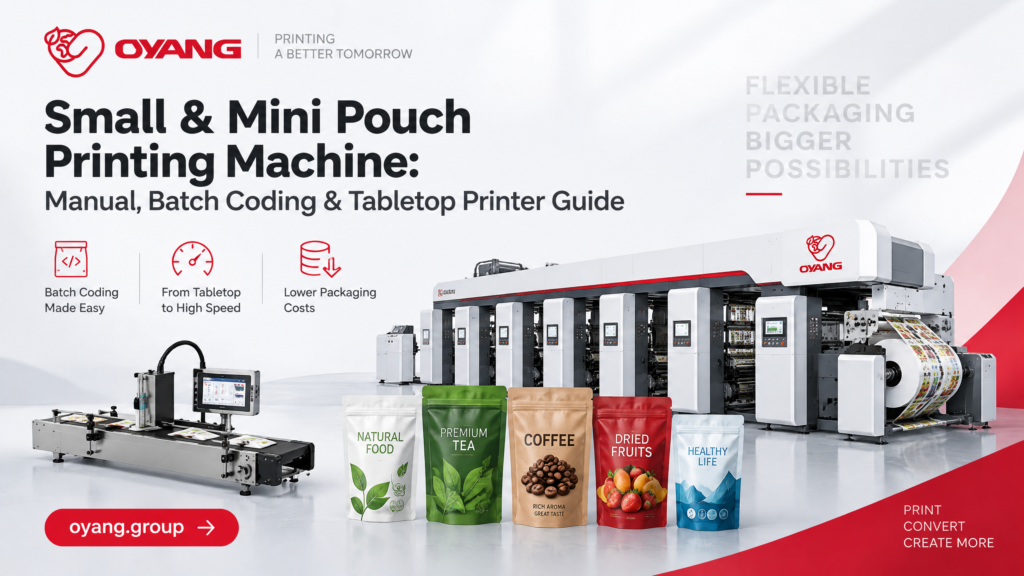
Small & Mini Pouch Printing Machine: Manual, Batch Coding & Tabletop Printer Guide
Designed to resolve throughput bottlenecks, smudged expiry dates, and high unit scrap rates in small-scale packaging, small pouch printing machines bifurcate into tabletop variable batch coders (30–60 pouches/min) and continuous roll-fed narrow-web presses (up to 280 m/min). While a desktop batch printing machine for pouch production applies thermal inkjet (TIJ) or hot-foil stamping for single-color lot codes, scaling to a compact roll-to-roll press with dynamic closed-loop servo tension (±1.0 N stability) enables full-color photographic branding, sub-0.05 mm color registration, and up to 70% lower film conversion costs on multi-layer barrier pouches.
Technical Demarcation: Offline Batch Coders vs. Industrial Roll-Fed Printing
Procurement managers evaluating a small pouch printing machine or mini pouch printing machine must recognize fundamental engineering dividing lines. Sourcing the wrong equipment category creates permanent labor bottlenecks or wasted capital investment:
- Tabletop Thermal Inkjet & Stamping Systems: Often labeled as a manual pouch printing machine, pouch stamping machine, or automatic pouch date printing machine, these friction-fed conveyor units print static expiration dates, barcodes, and two-line batch codes onto pre-formed flat pouches. Operating at 20 to 60 pouches per minute, they use solvent-based quick-drying cartridges (e.g., HP 2.5 TIJ technology). They cannot print full-bleed graphics, are mechanically limited to single-color marking, and require manual hopper replenishment.
- Industrial Compact Web Presses: Known as a small rotogravure printing machine or central impression web press, these lines convert master film coils (BOPP, PET, laminated foil) before pouches are formed. Printing 4 to 8 photographic colors at speeds exceeding 200 m/min, they integrate active drying hoods and multi-axis servo tension control, slashing per-unit packaging material costs by eliminating manual feeding.
- Thermal Lamination & Craft Finishing Units: Sourced under queries like photo pouch printing machine or pouch photo printing machine, these tabletop devices apply thermal encapsulation film onto paper cards or digital prints. They are office lamination tools, completely separate from industrial flexible packaging conversion.
The Batch-to-Roll Economic Transition Rule
Economic Break-Even Volume = Setup Scrap Cost ÷ (Pre-Formed Pouch Cost − Roll-Fed Pouch Material Cost)
Engineering Proof: Pre-formed three-side seal or stand-up barrier pouches cost between $0.08 and $0.15 each from external converters. Producing the same pouch in-house from printed roll stock costs approximately $0.025 to $0.040. Once a manufacturing plant surpasses 5,000 pouches per production batch, the cost savings of roll-fed printing and inline pouch conversion fully offset initial setup waste within four months of operation.
Ink Adhesion & Substrate Physics Across Small-Format Printing
Whether deploying an offline pouch printer machine or a high-speed web press, applying durable ink layers onto non-porous polymer barriers requires strict adherence to physical surface criteria:
1. Ink Rub Resistance on Gloss Poly & Aluminum Pouches
Tabletop TIJ batch coders utilize ethanol or MEK-based inks. When printed on non-corona-treated OPP or glossy PET pouches, the surface energy is below 34 dynes/cm. This causes poor ink wetting; printed date codes wipe off under friction during carton transit. In contrast, an industrial press utilizes inline high-frequency corona discharge to elevate surface dyne levels to ≥ 42 dynes/cm, ensuring 100% cross-hatch tape-test adhesion under ASTM D3359 standards. Converters troubleshooting print performance can refer to our guide on what rotogravure printing is and how ink transfer mechanics operate across flexible barrier substrates.
2. Feeding Friction & Static Jams on Pre-Formed Pouches
Manual and semi-automatic pouch feeders frequently misfeed due to electrostatic cling on thin LDPE pouches or zipper bulge unevenness on pre-made stand-up pouches. When a feeder pulls multiple pouches simultaneously, batch dates print across the sealing flange rather than the designated imprint window. Continuous roll-fed systems bypass this feed vulnerability entirely by processing uniform, tensioned webs through automated edge-position control (EPC) systems.
Equipment Selection Matrix: Small-Scale Marking vs. High-Output Web Conversion
| Technology Class | Substrate Feed Format | Rated Velocity / Output | Connected Power | Optimal Production Scenario |
|---|---|---|---|---|
| Manual Stamping / Hot Foil | Pre-formed single pouches | 15 – 30 pouches/min | 0.3 – 0.8 kW | R&D sampling; production runs < 1,000 units/day |
| Automatic Conveyor TIJ Coder | Pre-formed flat pouches | 40 – 90 pouches/min | 0.5 – 1.5 kW | Variable expiration dates, QR codes & LOT tracking |
| Compact ELS Rotogravure Press | Continuous master film roll | 180 – 280 m/min | 95 – 140 kW | Photographic full-bleed branding; runs ≥ 5,000 units |
OYANG Engineering Foundation: Industrial Precision Behind Continuous Converting
When scaling from manual offline marking to industrial continuous web conversion, converters require rigid structural engineering to prevent web wander and registration hunting. Plant managers evaluating technological options often compare rotogravure vs flexo printing economics to identify the ideal transition point between plate lead times and long-run consistency.
Inside OYANG’s 130,000 m² production complex, all frame structures, bearing saddles, and precision guide assemblies for the EASYPRINT 3.0 ELS Rotogravure Printing Machine are processed on Japanese MAZAK and OKUMA 5-axis CNC machining centers.

Figure 1: The OYANG EASYPRINT 3.0 ELS Rotogravure Press (280 m/min) engineered for rapid job turnarounds and automated tension decoupling across flexible pouch films.
Video 1: Machine demonstration of the OYANG EASYPRINT 3.0 ELS line, exhibiting continuous web stability, rapid shaftless cylinder locking, and uniform inking.
By machining structural mounting faces to a datum tolerance of ≤ 0.015 mm, roller parallelism eliminates lateral web skew. Printed rolls advance smoothly into automated pouch-forming lines—including the OYANG 650S High Speed 3-Side Seal Pouch Making Machine and the OYANG 650SZ High-Speed Stand-Up Pouch Making Machine—allowing expanding brand owners to transition from manual batch coders to complete in-house packaging automation.
Related Technical Guides & Converting Resources
- → What is Rotogravure Printing and How It Works? Core Principle Guide: Review the fluid dynamic transfer cycle, doctor blade shearing mechanics, and drying physics.
- → Rotogravure vs. Flexo: 4 Printing Types Compared: An engineering comparison of tooling costs, dot reproduction limits, and production profitability break-evens.
- → Disadvantages of Rotogravure: 5 Bottlenecks & Solutions: In-depth analysis of cylinder tooling lead times and how ELS automation mitigates traditional changeover waste.
- → Rotogravure Cylinders: Process & Maker Guide: Technical breakdown of copper plating, electromechanical engraving cells, and hard chrome surface tolerances.
Frequently Asked Questions (FAQ)
What is a small pouch printing machine?
A small pouch printing machine generally refers to a tabletop thermal inkjet (TIJ) or hot-stamping batch coder engineered to apply date codes, batch numbers, and barcodes onto pre-formed flat pouches at speeds between 20 and 60 pieces per minute.
Can a mini pouch printing machine print full-color brand graphics?
No, tabletop mini batch coders are restricted to single-color alphanumeric text and small 2D codes. Printing full-color high-resolution brand packaging requires a compact continuous roll-fed printing press utilizing rotogravure or flexographic print stations.
How does an automatic pouch date printing machine ensure ink adhesion on glossy film?
It uses quick-drying solvent-based ink cartridges (such as MEK or ethanol formulations) that cure within 1 to 3 seconds on non-porous film surfaces, preventing ink smudging during handling.
When should a packaging manufacturer transition from batch coders to a web press?
A manufacturer should transition to a roll-fed printing press when single batch sizes consistently exceed 5,000 pouches, as the lower cost of raw roll-stock film reduces unit packaging overhead by up to 70% compared to purchasing pre-formed pouches.