

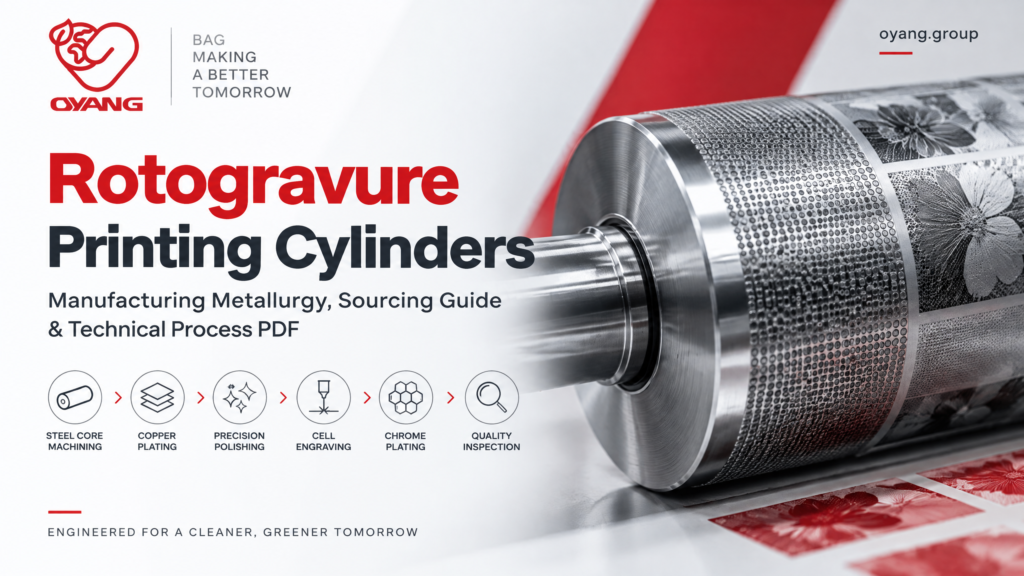
Rotogravure Printing Cylinders: Manufacturing Metallurgy, Sourcing Guide & Technical Process PDF
Step-by-Step Metallurgy: How Rotogravure Printing Cylinders Are Manufactured
Producing an intaglio cylinder capable of transferring fluid ink uniformly without misting or doctor blade streaking requires strict metallurgical and dimensional tolerances at each processing stage:
Stage 1: Seamless Steel Core Machining & Dynamic Balancing
Fabricated from high-tensile seamless cold-drawn steel pipes (such as ST52 or 45# carbon steel) with wall thicknesses of 18–25 mm. Flanged journal shafts are precision-welded, stress-relieved via thermal annealing, and turned on CNC cylindrical grinding lines. The core undergoes dual-plane dynamic balancing to ISO 1940 Grade G2.5 standards to eliminate harmonic resonance at high rotational speeds.
Stage 2: De-Chroming & Electrolytic Copper Plating
Re-used cylinders have worn chrome layers chemically stripped. The core receives a thin nickel strike layer (3–5μm) for adhesion, followed by an acid copper plating bath yielding a 200 to 300μm electrolytic copper layer. The copper bath incorporates organic hardening brighteners to maintain hardness strictly between 200 and 220 HV (Vickers)—essential for clean diamond stylus cutting without tearing.
Stage 3: High-Precision Precision Polish & Pre-Engraving Lapping
The copper-plated cylinder is ground using multi-stone oscillating polishing heads (grades 600 through 2000 mesh) to achieve geometric circularity within ±0.005 mm and an ultra-smooth surface finish with a roughness average of Ra ≤ 0.03μm.
Stage 4: Electromechanical (EME) vs. Direct Laser Cell Engraving
Digital graphic raster files are transferred to physical cells via two primary industrial technologies:
• Electromechanical Engraving (Diamond Stylus): A natural diamond stylus oscillates at 4,000 to 8,000 Hz, chiseling inverted pyramid or diamond-shaped ink cavities (cell depths from 5μm in highlights up to 45μm in heavy shadow solids).
• Direct Fiber Laser Ablation: Direct laser beams evaporate zinc or specialized copper layers, generating circular, flat-bottom micro-cells up to 12,000 LPI with sharper dot walls for micro-text and security features.
Stage 5: Electrolytic Hard Chrome Plating (Wear Resistance)
Because soft copper would wear down within a few thousand meters under doctor blade friction, the engraved cylinder is electroplated with an 8 to 12μm layer of functional hard chromium. This elevates the cylinder’s surface hardness to 950–1050 HV with a controlled microscopic crack network that helps retain trace lubrication fluids.
Stage 6: Final Chrome Finishing & Optical Cell Inspection
A final micro-polishing pass removes chrome burrs around cell apertures. Video microscopes inspect cell volume, cell depth, and channel geometry. The completed cylinder is verified for diameter consistency (within ±0.010 mm across the entire face width) before waterproof wrapping and wooden crating.
Quality Control Benchmarks: Dimensional Tolerances for High-Speed Lines
On high-speed gravure converting lines operating at 300 to 400 m/min, cylinder dimensional imperfections multiply into operational failures. The matrix below defines mandatory factory acceptance criteria:
| Engineering Parameter | Permissible Tolerance Window | Measurement Standard | Operational Risk if Exceeded |
|---|---|---|---|
| Radial Runout (TIR) | ≤ 0.010 mm (≤ 10μm) | Dial indicator on cylinder center & journals | Doctor blade chattering, print banding, and uneven impression pressure across web. |
| Cylinder Face Parallelism / Taper | ≤ 0.015 mm across full length | Precision micrometer cross-check | Uneven web tension profile causing lateral film tracking drift and color misregistration. |
| Hard Chrome Layer Hardness | 950 – 1050 HV (Vickers) | Micro-hardness tester | Below 900 HV: rapid chrome wear from abrasive TiO2 inks; above 1100 HV: chrome micro-chipping. |
| Base Copper Layer Hardness | 200 – 220 HV | Micro-hardness tester | Burred cell openings during stylus cutting, leading to incomplete ink wiping and background fogging. |
| Dynamic Balance Quality | ISO 1940 Grade G2.5 | Dynamic dual-plane balancing bench | Severe machine vibration at >300 m/min, leading to premature bearing failure and gear wear. |
Who Are the Manufacturers of Rotogravure Printing Cylinders in India?
India is one of the world’s most dynamic flexible packaging and converting markets. Due to the high initial capital investment required for automated plating and laser engraving lines ($1.5M to $4M USD per facility), most small-to-medium packaging converters outsource cylinder fabrication to specialized engraving trade houses.
Key industrial rotogravure cylinder manufacturers supporting the Indian subcontinent and export trade include:
- Uflex Limited (Cylinders Division): With advanced electro-mechanical and direct fiber laser engraving infrastructure (Noida, Uttar Pradesh), Uflex is India’s largest cylinder producer, manufacturing over 300,000 cylinders annually for multinational FMCG packaging.
- Montage Enterprises: A major supplier of high-precision electronic engraved gravure cylinders and embossed rollers catering to flexible packaging, pharmaceutical foils, and decorative laminate converters.
- Kiran Gravures: Renowned specialist trade engraver located in Western India (Gujarat industrial cluster), offering high-definition electromechanical cylinder cutting with quick regional turnaround.
- Balaji Chemiprint: Specializes in chemical and electromechanical cylinder manufacturing for flexible barrier laminates, textile transfer rolls, and shrink sleeve conversion.
- Regional Trade Houses & Tooling Hubs: Extensive cylinder engraving networks across Faridabad, Ahmedabad, Mumbai, and Hyderabad maintain standard delivery lead times of 4 to 8 business days for standard 8-color sets, with rush services available in 48 to 72 hours for critical press re-runs.
OYANG Engineering Practice: Pneumatic Shaftless Cylinder Chucking & ELS Direct Drive
Even with high-precision cylinders, poor machine mounting setups introduce dynamic runout, resulting in color registration drift. Traditional shafted cylinders require manual shaft threading and heavy mechanical locknuts, creating mechanical tilt and slow changeovers.

Figure 1: OYANG HONOR 4.0 ELS Rotogravure Press: featuring dual-side pneumatic shaftless cylinder chucking mandrels and independent AC servo direct drive.
On the OYANG HONOR 4.0 ELS Rotogravure Press, cylinder handling is automated:
- Shaftless Pneumatic Cone Chucking: Cylinders are clamped via hardened steel taper mandrels under regulated pneumatic pressure, eliminating journal tilt and centering the cylinder within ≤ 0.008 mm of true axis.
- Cylinder Changeover Trolley Integration: Pre-loaded cylinder carts allow full 8-color cylinder and ink pan exchanges within 30 minutes.
- ELS Permanent-Magnet Direct Drive: Eliminates gear couplings, ensuring that cylinder rotational phase syncs directly with upstream and downstream web tension controllers.
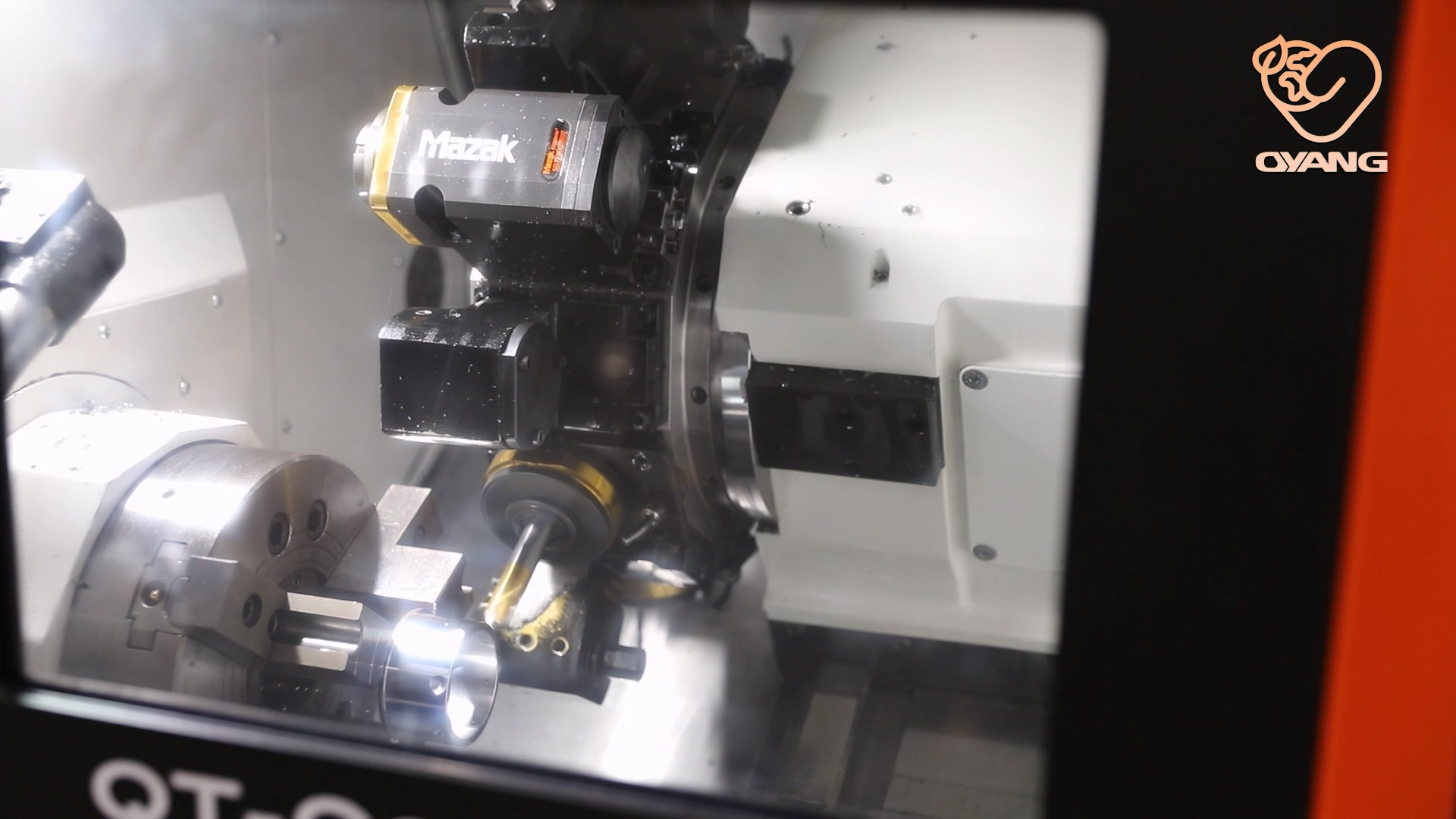
Figure 2: Cylinder clamping carriages and heavy wall housings milled on Japanese OKUMA multi-axis CNC machines inside OYANG’s 130,000 m² production complex.
All machine frames and clamping carriages are processed on Japanese MAZAK and OKUMA CNC centers to geometric tolerances of ≤ 0.015 mm, eliminating vibration chattering during high-speed runs up to 400 m/min.
Can You Provide a PDF Explanation of the Rotogravure Printing Process?
Yes. OYANG provides a comprehensive, engineering-level whitepaper and equipment catalog covering cylinder anatomy, doctor blade hydrodynamics, multi-zone drying tunnel physics, and tension loop calculations for flexible barrier films.
* Document contains machine dimensions, electrical schematics, air plenum velocity profiles, and complete cylinder diameter matrices.
Related Printing & Converting Systems
Frequently Asked Questions (FAQ)
Who are the manufacturers of rotogravure printing cylinders in India?
Leading rotogravure printing cylinder manufacturers in India include Uflex Limited (Cylinder Division), Montage Enterprises, Kiran Gravures, and Balaji Chemiprint, along with regional engraving hubs across Gujarat, Maharashtra, and Uttar Pradesh supplying domestic and international packaging converters.
Can you provide a PDF explanation of the rotogravure printing process?
Yes, you can download the engineering whitepaper and technical solution guide directly through the OYANG Rotogravure Printing Machine Solution Brochure (PDF) link provided on this page, which contains complete equipment specifications, cylinder kinematics, and drying diagrams.
What is the thickness of the copper and chrome layer on a rotogravure cylinder?
A standard rotogravure cylinder features an electrolytic base copper layer of 200 to 300 micrometers (hardness 200–220 HV) for precision diamond cutting, and an outer surface-hardened chrome layer of 8 to 12 micrometers (hardness 950–1050 HV) for doctor blade wear resistance.
What is the maximum permissible radial runout for high-speed rotogravure cylinders?
For modern high-speed printing presses operating at 300 to 400 m/min, the total indicated radial runout (TIR) must not exceed 0.010 mm (10 micrometers) across the cylinder body and journal bearings to prevent doctor blade chattering and optical print banding.
How many linear meters can a hard-chromed rotogravure cylinder print before re-chroming?
Under optimal doctor blade pressure and properly filtered ink viscosity (14–18 seconds Ford Cup #4), a hard-chromed rotogravure cylinder typically yields a production lifespan of 2,000,000 to over 5,000,000 linear meters before requiring chemical stripping and re-chroming.