

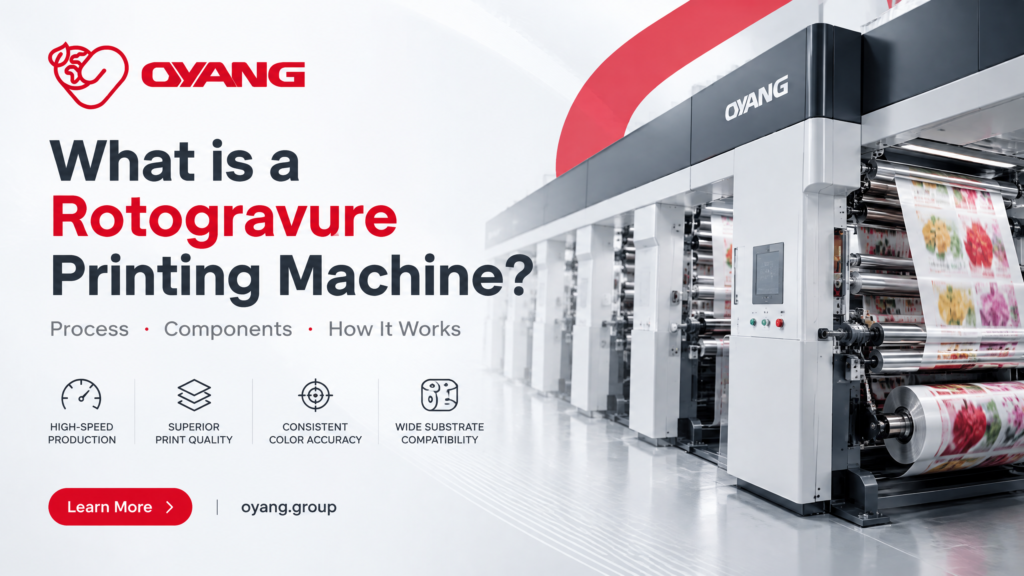
Rotogravure printing (commonly called roto printing) is an industrial intaglio rotary process where high-speed fluid ink is directly transferred from recessed microscopic cells engraved onto a chrome-plated steel cylinder onto a flexible web substrate under hydraulic impression pressure. Running at industrial speeds up to 400 m/min, the process delivers unmatched ink density, tonal depth, and continuous repeat consistency across non-porous BOPP, PET, and aluminum barrier laminates.
What is a Rotogravure Printing Machine?
An industrial rotogravure printing machine is a multi-station, web-fed continuous production press engineered for high-volume conversion. Unlike relief systems (flexography) or planographic processes (lithographic offset), a gravure press relies on a direct fluid transfer mechanism. Each color unit operates as an autonomous fluidic and mechanical system comprising an ink fountain, an electromechanically engraved cylinder, a counter-acting precision doctor blade assembly, a rubber-sheathed impression roller, and an ultra-efficient drying tunnel.
Modern high-efficiency conversion operations categorize gravure machinery primarily by drive architecture:
- Mechanical Line-Shaft Drives: Older topologies relying on longitudinal drive shafts, bevel gears, and differential gearboxes. They suffer from mechanical backlash, torsional vibration, and slow color registration response during speed transitions.
- Electronic Line Shaft (ELS) Systems: Direct-drive configurations where each cylinder station is powered by independent AC synchronous servo motors synchronized via high-speed industrial motion control buses. ELS eliminates mechanical backlash and reduces start-up substrate waste during job changes by over 60%.
The Mechanics of Fluid Dynamics: What Happens During Gravure Printing?
The phrase “what happens during gravure printing” describes a high-speed cyclic micro-fluidic process that repeats thousands of times per minute across every single print station. This cycle operates through four consecutive, interlocked stages:
Stage 1: Fluid Ink Flooding and Cell Cavitation
The engraved cylinder partially submerges into an open ink trough or receives ink from a pressurized closed-chamber inking applicator. Low-viscosity solvent-based or water-based ink (standardized between 14 to 18 seconds via a Ford Cup #4) floods the cylinder surface. Dynamic hydrodynamic pressure forces the fluid ink into millions of microscopic pyramidal or quadrangular cells engraved deep into the cylinder’s copper layer.
Stage 2: Precision Doctor Blade Shearing
Before reaching the impression zone, an oscillating steel doctor blade (typically 0.15mm to 0.20mm thick Swedish strip steel with a lamella profile) shears away all residual ink from the non-image lands (the outer polished chrome surface). The contact angle is maintained rigidly between 55° and 65° under calibrated pneumatic loading. This leaves fluid ink exclusively inside the recessed micro-cells, ensuring clean highlights and zero background fogging (scumming).
Stage 3: Substrate Contact and Ink Transfer (Nip Mechanics)
The moving substrate (such as 12μm PET or 20μm BOPP) enters the printing nip between the engraved cylinder and a high-durometer impression roller (typically 75–85 Shore A polyurethane). Under linear hydraulic or pneumatic loads reaching 15 to 30 N/mm, intimate molecular contact is created between the film and the cylinder cells. Ink transfers to the substrate driven by capillary action, electrostatic charge distribution, and surface tension differentials.
Stage 4: Flashing, Thermal Drying, and Solvent Desorption
Immediately after the nip separation, the printed web enters an aerodynamic drying hood. High-velocity heated air nozzles (reaching 30 to 45 m/s) strip away the boundary air layer on the wet ink film. The volatile carrier solvents evaporate rapidly without trapping solvent molecules inside the polymer chains, preparing the ink layer for subsequent overprinting in the next color unit within fractions of a second.
Core Engineering Components of an Industrial Rotogravure Station
| Sub-Assembly | Material / Structural Standard | Operational Tolerance | Primary Conversion Function |
|---|---|---|---|
| Engraved Cylinder | Seamless steel tube + Ballard copper + hard chrome layer (8–12μm, 950–1050 HV) | Radial run-out ≤ 0.010 mm | Carries dot structures ranging from 70 to 120 lines/cm (175–300 LPI) |
| Oscillating Doctor Blade | Hardened spring steel (1.20–1.30% carbon content) with precision ground bevel | Oscillation stroke: 8–12 mm; Frequency: 1.0–1.5 Hz | Wipes non-image ink clean; prevents cylinder scoring and ink spitting |
| Impression Roller | Solid forged steel core covered with synthetic NBR or Polyurethane elastomer | Dynamic deflection ≤ 0.015 mm across 1300 mm width | Applies stable, uniform nip pressure to drive complete ink evacuation from cells |
| Air Velocity Drying Tunnel | SUS304 internal lining with negative pressure chamber seal | Air jet speed: up to 45 m/s; Temperature control: ± 1.0°C | Maximizes solvent removal while preserving physical web stability against stretch |
| Closed-Loop Servo Infeed | AC synchronous permanent magnet direct-drive servo motors | Tension stability ≤ ± 2.0 N across 400 m/min transitions | Decouples unwind tension from print station nip dynamics to eliminate misregistration |
OYANG Engineering Practice: Eliminating Dynamic Registration Drift at 400 m/min
When converting extensible films such as 12μm BOPP, 15μm BOPA, or multi-layer barrier co-extrusions, the primary bottleneck in rotogravure printing is tension instability caused by frame vibration and heat dissipation distortion. Mechanical gear play in traditional line-shaft presses causes color registration drift exceeding ±0.25mm during acceleration and deceleration phases.
To resolve this structural deficiency, OYANG engineers the HONOR 4.0 ELS Rotogravure Printing Machine with high-stiffness solid cast-iron side frames. All bearing housing bores and locator guide surfaces are machined on Japanese MAZAK and OKUMA CNC flexible manufacturing systems in a single setup, guaranteeing absolute frame parallelism within a tolerance of ≤ 0.015mm.

Figure 1: The OYANG HONOR 4.0 ELS Rotogravure Printing Press delivering 400 m/min continuous web speeds with longitudinal and transverse registration accuracy within ±0.05mm.
By pairing individual servo drive spindles with high-frequency optical registration sensors and an ultra-responsive dancer tension loop, dynamic longitudinal register accuracy is held strictly within ±0.05 mm throughout production runs. Furthermore, downstream integration with precision converting lines—such as the OYANG 650QSB Flat Bottom Pouch Making Machine—ensures seamless roll-to-pouch manufacturing with minimal scrap.
Related Engineering Guides & Technical Resources
- → Flexographic vs. Rotary Printing Process Analysis: CI vs. Stack Topologies: Review web tension paths, registration limits, and substrate elasticity across modern packaging runs.
- → Packaging Printing Machine Selection Guide: Types, Speeds & Manufacturer Standards: Compare initial machinery capital expenditure, ink curing technologies, and cost per impression.
- → OYANG HONOR 3.5 PLUS ELS Rotogravure Printing Press Specifications: Technical data on 10-color flexible packaging configurations running at speeds up to 400 m/min.
Frequently Asked Questions (FAQ)
What is rotogravure and how does it work?
Rotogravure is an industrial intaglio rotary printing process where fluid ink is metered into microscopic engraved cylinder cells, scraped clean on the non-image lands by an oscillating doctor blade, and transferred directly onto a moving web substrate via high impression roller nip pressure followed by forced hot-air convective drying.
What is a rotogravure printing machine?
A rotogravure printing machine is a continuous roll-to-roll multi-unit production system comprising unwinders, precision inking reservoirs, heavy-duty doctor blade systems, engraved steel cylinders, impression assemblies, aerodynamic drying chambers, and rewinders, designed to produce million-meter packaging runs with consistent optical density.
What is roto printing?
Roto printing is the common industrial abbreviation for rotogravure printing, designating rotary cylinder printing systems specifically utilized in high-volume flexible packaging, decorative laminates, security paper, and barrier foil manufacturing.
What happens during gravure printing?
During gravure printing, the engraved cylinder is flooded with low-viscosity ink, an oscillating steel doctor blade precisely shears surplus ink off non-image surfaces, the substrate is compressed against the cylinder cells inside the nip zone to pull ink onto the web, and heated airflow desorbs carrier solvents before the web reaches the next print station.