350x97.png)
350x97.png)
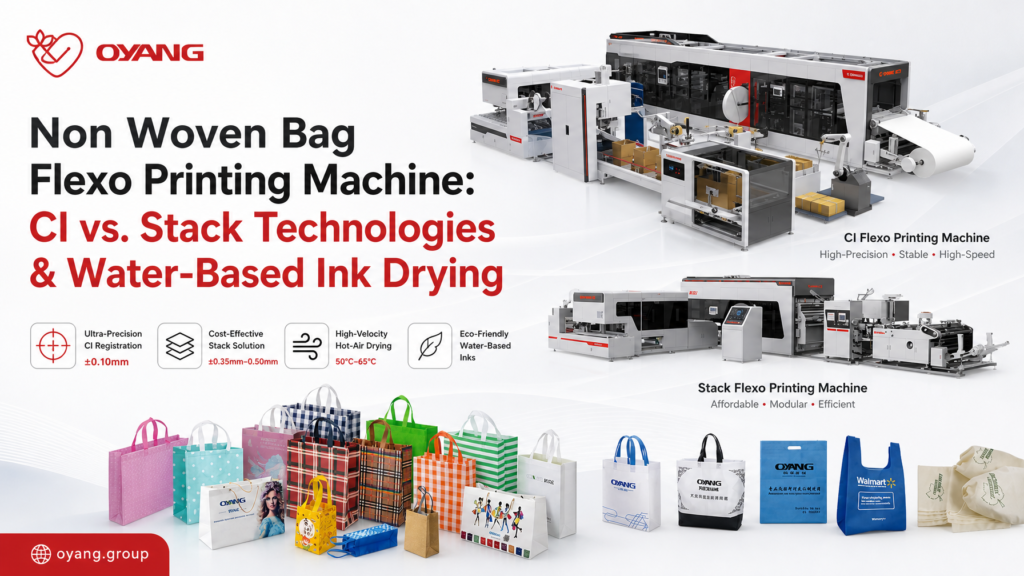
Non Woven Bag Flexo Printing Machine: CI vs. Stack Technologies & Water-Based Ink Drying
A specialized non woven bag flexo printing machine converts porous polypropylene (PP) spunbond rolls using eco-friendly water-based inks at operating speeds up to 150 m/min. While modular stack-type printers deliver an economical solution with registration tolerances of ±0.35mm to ±0.50mm, Central Impression (CI) satellite platforms achieve ±0.10mm ultra-precision registration by supporting the extensible fabric roll against a temperature-controlled central steel drum. Modern configurations utilize high-velocity impingement hot-air drying tunnels (50°C–65°C) to prevent web stretching, ink offsetting, and roll telescoping during inline bag converting.
Color-to-color register accuracy on OYANG Central Impression (CI) flexo lines.
Maximum continuous printing velocity on 30–120 g/m² nonwoven substrates.
Targeted impingement drying temperature window to eliminate thermal shrinkage.
Web elongation control via closed-loop multi-motor servo taper tensioning.
Stack-Type vs. Central Impression (CI): Architectural Comparison
Nonwoven fabric presents complex printing challenges compared to paper or rigid films. Because spunbond PP exhibits high transverse stretch under thermal and tensile loads, web path length between color stations determines final print registration.
1. Central Impression (CI) Drum Topology: Zero Web Distortion
In a Central Impression architecture (such as the OYANG YTC Series), the nonwoven web is mechanically clamped against a single, high-precision precision-ground central drum (typically 1.6m to 2.0m diameter) by pneumatic nip rollers. All 4 to 6 color decks are positioned radially around this drum. Because the fabric never releases contact with the drum surface as it transfers from station to station, unsupported web span is effectively zero. This design entirely prevents tension-induced elongation, enabling crisp 133–150 LPI halftone printing with a registration tolerance of ±0.10mm, even on ultra-light 30 g/m² extensible fabrics.
2. Stack-Type Modular Decks: Flexibility vs. Cumulative Web Stretch
In a Stack-Type configuration (such as the OYANG YTB Series), individual color stations are stacked vertically in pairs. The nonwoven web travels across independent guide rollers between each printing nip. Over a 4-color run, the unsupported web span can reach 4 to 6 meters. Because tension fluctuates as the web encounters ink viscosity drag and heated inter-station drying air, mechanical stretch causes color registration to vary by ±0.35mm to ±0.50mm. Stack flexo remains highly cost-effective for bold typography, commercial vector logos, and spot-color grocery bag printing where microscopic dot alignment is not mandatory.
| Engineering Parameter | Stack-Type Flexo (OYANG YTB) | CI Satellite Flexo (OYANG YTC) | Inline Bag Converting Fit |
|---|---|---|---|
| Color Registration Accuracy | ±0.35mm to ±0.50mm | ±0.10mm (Micro-dot precision) | CI preferred for complex photographic artwork |
| Substrate Grammage Range | 50–120 g/m² (Rigid nonwoven) | 30–120 g/m² (Lightweight & elastic) | CI handles thin, stretchy substrates seamlessly |
| Max Production Speed | 60–100 m/min | 120–150 m/min | CI matches high-speed roll feeds |
| Ceramic Anilox Screen | 200–400 LPI (Standard volume) | 400–800 LPI (Laser-engraved) | CI supports fine dot halftone reproduction |
| Capital Investment Bracket | $25,000 – $48,000 USD | $75,000 – $130,000 USD | Stack fits entry/mid-tier converters |
Water-Based Ink Drying Tunnel Dynamics on Spunbond Polypropylene
Flexographic printing on nonwoven shopping bags mandates non-toxic, odor-free, VOC-compliant water-based inks. However, water possesses a high latent heat of vaporization ($$2260\text{ kJ/kg}$$) and polypropylene fibers cannot absorb liquid like cellulose paper. Rapid evaporation requires optimized aerodynamic engineering.
1. The Thermal Shrinkage Ceiling: Strict 65°C Limit
Polypropylene spunbond nonwovens experience crystalline softening and dimensional shrinkage when substrate temperatures exceed 70°C. If drying tunnel air is heated beyond 68°C, web width contracts irregularly, distorting print geometry and causing wrinkles at the rewinder or inline bag tube former. OYANG drying systems utilize PID-modulated inter-color and bridge drying tunnels maintaining air temperatures strictly between 50°C and 65°C.
2. High-Velocity Air Impingement: Breaking the Boundary Layer
Because thermal energy cannot be increased arbitrarily, ink water content must be driven off mechanically by high kinetic energy airflow. Specially engineered slot-nozzle air knives deliver air velocities of 18 to 24 m/s directly onto the printed web. This breaks the stagnant boundary vapor layer, accelerating moisture flashing within a compact 1.2-meter inter-station tunnel. Exhaust air volume is balanced via frequency-controlled blowers to prevent volatile vapor saturation and eliminate roll blocking.
Inline Converting vs. Offline Roll-to-Roll Printing Topology
Converters must determine whether to couple the flexo printer directly with the bag making line (Inline) or operate the printing and bag conversion as disconnected batch processes (Roll-to-Roll):
| Operational Dimension | Inline Printing System (Flexo + Bag Machine) | Offline Roll-to-Roll (Rewind to Storage) |
|---|---|---|
| Work-in-Progress (WIP) Inventory | Zero WIP; fabric goes directly from raw roll to finished bag | High WIP; printed rolls must cure and queue in warehouse |
| Operator Footprint | 1–2 operators control printing and bag forming | 3–4 operators (separate printing and bag making crews) |
| OEE Vulnerability | High coupling; printer stops halt bag making | Decoupled; machine failure does not stop downstream line |
| Tension Buffer Architecture | Requires dynamic dancer accumulator & photo-eye tracker | Closed-loop surface center rewinder with load cells |
| Best Commercial Fit | Standardized high-volume orders (e.g. supermarket bags) | Multi-SKU printing with diverse finishing formats |
OYANG Flexographic Printing Equipment Platforms
Manufactured inside OYANG’s 130,000&mflat; smart manufacturing base with Japanese MAZAK and OKUMA 5-axis CNC lines, our flexo printers guarantee dynamic cylinder concentricity of ≤ 0.008mm for vibration-free web handling:

OYANG YTC-41200: 4-Color CI Satellite Flexo
Central Impression flagship printer engineered for premium nonwoven bags and extensible films. Delivers ±0.10mm register accuracy at speeds up to 150 m/min.
- Drum Construction: Chromium-plated double-wall temperature drum
- Registration Accuracy: ±0.10mm continuous
- Drying System: High-efficiency hot air impingement tunnel

OYANG YTC-61200: 6-Color CI Satellite Flexo
High-end 6-color configuration enabling full CMYK halftone printing plus two corporate spot colors. Ideal for luxury nonwoven box bag converters.
- Color Capability: 6 Colors around central impression cylinder
- Drive System: Closed-loop servo sync with motorized register
- Max Web Width: Up to 1200mm

OYANG YTB Series: 2/4/6-Color Stack Flexo
Robust, cost-effective modular stack printer designed for nonwoven rolls and paper webs. Provides quick job changeovers and low capital entry.
- Configuration: 2, 4, or 6 modular color stations
- Max Speed: 80–100 m/min
- Operation: Standalone roll-to-roll or inline with bag line
Video Demonstration: 4-Color Flexographic Nonwoven Printing Workflow
Frequently Asked Questions (FAQ)
Configure Your Nonwoven Printing & Converting Line
Speak directly with OYANG flexographic engineers. Get custom roll width calculations, drying tunnel heat balances, and inline integration schematics tailored to your plant footprint.
Download Printing & Converting Brochure (PDF)