

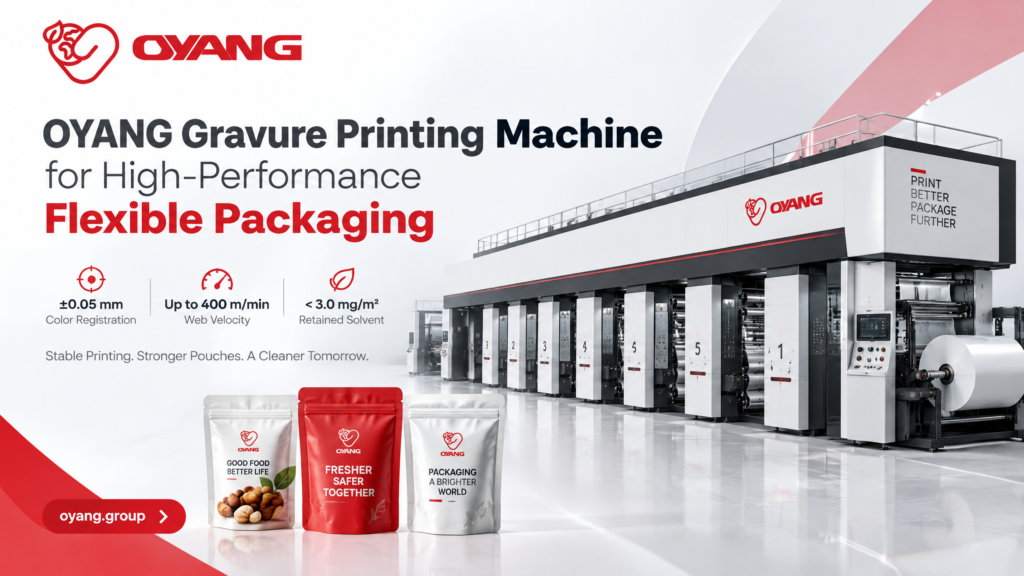
Designed to eliminate web curling, seal puckering, and toxic solvent entrapment in multi-layer food barrier pouches, OYANG’s flexible packaging pouch printing machine integrates seven-zone closed-loop Electronic Line Shaft (ELS) direct-drive servos with aerodynamically isolated drying tunnels. Engineered for continuous roll-to-roll converting across stand-up pouches, zipper bags, and 8-side seal flat-bottom bags, this industrial food packaging printing machine operates at web velocities up to 400 m/min, maintaining color registration strictly within ±0.05 mm while driving retained solvent levels below 3.0 mg/m² across BOPP, PET, BOPA, and laminated paper-poly webs.
Downstream Converting Alignment: Why Printing Accuracy Dictates Pouch Seal Integrity
In high-barrier pouch manufacturing, defects observed on pouch lines—such as zipper misalignment, cosmetic film tunneling, and gusset leakage—rarely originate on the pouch-making machine itself. Instead, they stem from uneven tension histories and thermal stretch induced during primary web printing on an unstable pouch roll printing machine:
- Residual Elastic Strain & Seal Distortion: When outer substrates (e.g., 12 μm PET or 18 μm BOPP) are pulled under fluctuating web tension through hot drying tunnels, differential stress locks into the polymer chains. When laminated to sealant PE/CPP and cut on a zipper pouch printing machine line, these internal stresses release around hot sealing jaws, producing warped seals and leaky hermetic joints.
- Optical Eye-Mark Drift: Automatic stand-up pouch makers feed film based on printed optical tracking marks. A pitch variation of just ±0.3 mm causes zipper applicators and bottom punchers to drift out of phase, leading to high scrap volumes on high-speed forming lines.
High-Speed Pouch Web Production Capacity Formula
Shift Output (Pouches) = (Print Velocity × 60 × Shift Hours ÷ Pouch Repeat Length) × Conversion Yield (%)
Factory Benchmark: Running an OYANG ELS web press at 350 m/min on a 200 mm stand-up zipper pouch repeat with 88% overall conversion yield delivers approximately 92,400 pouch equivalents per hour. This massive web volume continuously feeds multiple downstream converting lines while keeping raw film setup waste under 35 meters per reel transition.
Substrate Dynamics Across Flexible Pouch Laminates
Running flexible webs across a versatile printing pouch machine requires mechanical adaptability across non-porous plastics, aluminum foils, and paper-plastic composites:
1. Retort & Vacuum Barrier Films (BOPA / Nylon & PET)
Bi-axially Oriented Polyamide (BOPA) is notorious for moisture absorption, swelling up to 3% in humid environments and triggering severe lateral expansion inside drying tunnels. OYANG’s flexible packaging printing machine utilizes ultra-short inter-color web runs, independent web edge guides (EPC), and segmented chill rollers to suppress hygroscopic deformation before ink overprinting.
2. Polyethylene & Polypropylene Pouch Webs (LDPE / CPP)
When operating as a poly pouch printing machine or polythene pouch printing machine on extensible heat-sealable layers, excessive line pull permanently deforms the web. Low-inertia carbon-fiber dancer rollers and micro-stepping servo drivers isolate web tension within a strict 20–35 N/m window, preventing transverse neck-in.
3. Sustainable Paper-Polymer Composites
In high-end eco-friendly packaging, a dedicated paper pouch printing machine converts 40–80 g/m² kraft paper laminated with thin barrier coatings. These hybrid webs require adaptive tension profiles to accommodate high tensile stiffness in the machine direction (MD) while maintaining gentle surface contact to avoid fiber fracturing.
Technical Matrix: Substrates & Engineering Controls in Food Pouch Converting
| Packaging Application | Substrate Structure | Operating Tension | Drying Profile | Critical Quality Metric |
|---|---|---|---|---|
| Stand-Up Food Pouch (Doypack) | 12 μm PET / 15 μm AL / 60 μm PE | 40 – 70 N/m web | 55 – 65°C (Air speed 38 m/s) | Register ≤ ±0.05 mm; solvent ≤ 3.0 mg/m² |
| Retort Stand-Up Zipper Pouch | 15 μm BOPA / 9 μm AL / 70 μm RCPP | 50 – 85 N/m web | 60 – 70°C (Air speed 42 m/s) | Zero delamination under 135°C thermal sterilization |
| Flat-Bottom Coffee Bag (8-Side Seal) | 19 μm Matte BOPP / 7 μm AL / 80 μm PE | 45 – 75 N/m web | 50 – 60°C (Air speed 35 m/s) | High optical matte density without gloss scuffing |
| Bio-Degradable Paper Pouch | 50 g/m² Kraft / 30 μm PLA Barrier | 70 – 120 N/m web | 45 – 52°C (Air speed 30 m/s) | Preserves fiber tensile strength; zero blister bubbles |
OYANG Engineering Practice: Heavy-Duty CNC Manufacturing Foundation
When converting multi-layer barrier web rolls at line speeds up to 400 m/min, microscopic mechanical vibrations cause doctor blade skipping, generating horizontal ink streaking and color haze across delicate process halftones.
Inside OYANG’s 130,000 m² production complex, all cast-iron side frames, bearing housings, and precision doctor blade slide assemblies for the HONOR 4.0 ELS Rotogravure Printing Machine and HONOR 3.5 PLUS ELS Rotogravure Printing Machine are processed on Japanese MAZAK and OKUMA 5-axis CNC machining centers.

Figure 1: The OYANG HONOR 4.0 ELS Rotogravure Press (400 m/min, ±0.05mm register precision) engineered for high-barrier food and pharma flexible packaging roll conversion.
Video 1: Walkthrough of OYANG’s ELS rotogravure printing line showing high-speed web path stability, precision inking, and aerodynamic drying hoods for food-grade converting.
By executing all boring and planar surface machining in a single clamping setup, structural locating tolerances are maintained rigidly to ≤ 0.015 mm. This mechanical foundation ensures that our ELS servo bus maintains longitudinal and transverse color register accuracy within ±0.05 mm during continuous flying splices at full operating velocity.
To achieve complete roll-to-pouch manufacturing efficiency, pre-printed barrier rolls feed directly into high-speed converting machinery, including the OYANG 650SZL High-Speed Stand-Up Zipper Pouch Making Machine and the OYANG 650QSB Flat Bottom Pouch Making Machine, delivering flat, wrinkle-free pouches with zero seal leakage.
Related Technical Guides & Converting Resources
- → What is Rotogravure Printing and How It Works? Core Principle Guide: Review the fluid dynamic transfer cycle, doctor blade shearing mechanics, and drying physics.
- → Rotogravure vs. Flexo: 4 Printing Types Compared: An engineering comparison of tooling costs, dot reproduction limits, and production profitability break-evens.
- → Disadvantages of Rotogravure: 5 Bottlenecks & Solutions: In-depth analysis of cylinder tooling lead times and how ELS automation mitigates traditional changeover waste.
- → Rotogravure Cylinders: Process & Maker Guide: Technical breakdown of copper plating, electromechanical engraving cells, and hard chrome surface tolerances.
Frequently Asked Questions (FAQ)
What is a flexible packaging printing machine?
A flexible packaging printing machine is a continuous roll-to-roll press configured to print photographic multi-color designs, barcode markings, and barrier lacquers onto thin polymeric films, aluminum foils, and paper composites prior to lamination and pouch forming.
How does a food packaging printing machine guarantee low solvent retention?
It uses high-efficiency dual-chamber drying tunnels with nozzle air velocities up to 45 m/s and continuous air exhaust volume balancing, stripping volatile organic compounds (VOCs) to maintain total residual solvent levels strictly below 3.0 mg/m².
Why is tension control critical on a zipper pouch printing machine?
Web tension fluctuations cause uneven film stretching during printing and drying, which releases as seal puckering and zipper profile misalignment when the laminated roll is converted on high-speed pouch-making machines.
Can a packing pouch printing machine handle sustainable barrier papers?
Yes, an industrial pouch roll printing press with closed-loop ELS direct servos dynamically adjusts tension curves to accommodate higher machine-direction tensile stiffness in kraft papers while preventing surface micro-cracking across barrier polymer coatings.