

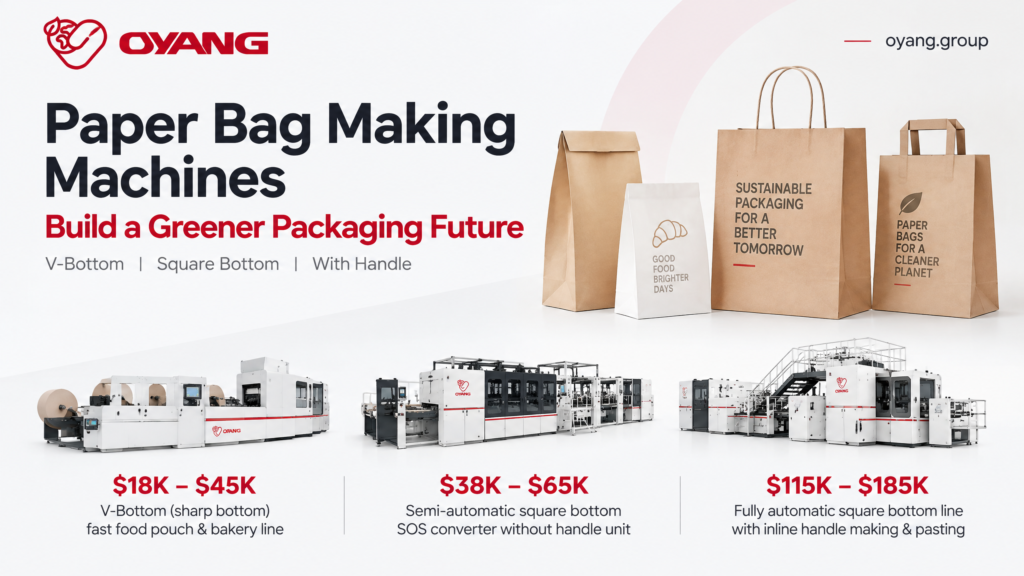
The factory-direct square bottom paper bag making machine price (internationally benchmarked as square bottom paper bag machine price or shopping bag making machine price) ranges from $38,000 to $185,000 USD (FOB), dictated by mechanical automation and handle station integration. In contrast, the market v bottom paper bag making machine price (commonly specified as food paper bag making machine price) ranges between $18,000 and $45,000 USD. This threefold to fourfold price variance reflects fundamental kinematic complexity: while a high-speed V-bottom machine like the OYANG 16C uses continuous rotary serrated cutoff knives and a single bottom-folding cylinder to achieve 300 to 600 bags per minute with lightweight tooling, a fully automatic square bottom paper bag making machine price (such as the OYANG 16A or SMART-17 at $115,000 to $185,000 USD) reflects an intricate multi-stage rotating bottom drum, vacuum opening suction manifolds, cam-driven tucking fingers, and 16 to 24 synchronized servo axes.
Kinematic Complexity: Why Square Bottom Machinery Demands a Premium
When commercial packaging converters review equipment procurement budgets, the price difference between V-bottom food bag machinery and square bottom SOS machinery represents one of the widest spreads in web converting. This price delta is driven by mechanical tooling volume, servo synchronization overhead, and structural frame mass:
- Bottom Formation Mechanics (Single Cylinder vs. Complex Multi-Stage Drum): A V-bottom machine creates its base in a single rotational stroke. A continuous rotary blade perforates the paper tube, pulling rollers sever it, and a transverse tucker blade drives the base between two nip rollers with a single line of adhesive. Conversely, an SOS square bottom machine requires a large-diameter rotating drum equipped with internal vacuum distributors, dual opening suckers, dynamic bottom-creasing fingers, side-tucking plows, and secondary calender rollers. This complex mechanical drum represents over 35% of the total manufacturing cost of the machine.
- Drive Topologies and Servo Axis Count: A standard high-speed V-bottom unit requires 3 to 5 electronic servo drives (governing unwind tension, main draw nip, and rotary cut-off registration). A modern fully automatic square bottom machine incorporates 16 to 24 synchronized servo axes linked via EtherCAT or Profinet, coordinating handle rope feeding, patch cutting, tube seaming, bottom drum positioning, and delivery timing.
- Substrate Grammage and Structural Mass: V-bottom machines convert thin, flexible papers (35 to 80 GSM MG kraft or greaseproof paper) at ultra-high linear speeds. Square bottom machines must handle heavy, rigid substrates (80 to 180 GSM kraft and cardstock), requiring heavy HT250 gray cast-iron wall panels and oversized bearing journals to absorb reciprocating folding loads.
For a deep dive into the underlying kinematic architecture of these rotating bottom assemblies, study our engineering analysis on square bottom paper bag making machine engineering architecture.
Commercial Quotation Matrix: Square Bottom vs. V-Bottom Equipment
The following commercial matrix provides verified procurement pricing, mechanical specifications, and tooling costs across standard bag formats, based on FOB shipping terms:
| Machine Class & Model | Base Forming Architecture | Converting Velocity | Machine Base Price (FOB) | Replacement Tooling Set |
|---|---|---|---|---|
| V-Bottom Food Bag OYANG 16C Series | Rotary serrated cut, single cylinder fold, cold line glue | 300 – 600 bags/min | $18,000 – $45,000 USD | $800 – $1,500 USD (Former plate + cut blade) |
| Semi-Auto Square Bottom OYANG 16B Series | Roll-fed SOS drum, mechanical cams, no handle unit | 60 – 100 bags/min | $38,000 – $65,000 USD | $2,500 – $4,500 USD (Mandrel + bottom drum gear) |
| Full-Auto SOS with Handle OYANG 16A Series | Inline handle applicator, vacuum bottom drum, multi-servo | 120 – 150 bags/min | $115,000 – $165,000 USD | $3,500 – $6,000 USD (Bottom drum + handle cams) |
| High-Speed Mass SOS Line SMART-17 Series | Heavy cast bed, oversized bottom drum, auto pack-off link | 180 – 220 bags/min | $145,000 – $185,000 USD | $4,500 – $7,500 USD (Full size modular tooling set) |
To evaluate how sharp-bottom cutoff knives function at 600 bags/min, review our mechanical reference on V-bottom paper bag making machines: Rotary serrated cutoff and food packaging guide.
Tooling, Formers & Specification Changeover Investment
A critical cost factor frequently omitted in initial machinery budgeting is the expenditure for spare format-change tooling. When a factory secures contracts for diverse bag widths, depths, and cut lengths, new dedicated tooling components must be purchased:
1. Tube Forming Mandrel Plates (Width Adjustment)
On V-bottom machines, changing tube width requires a simple fabricated sheet-metal forming tongue ($800–$1,500 USD). On square bottom SOS machines, changing bag face width requires a hardened, polished multi-segment forming mandrel assembly with adjustable side-creasing wheels ($2,200–$3,800 USD) to guide heavy kraft stock without scratching.
2. Bottom Drum Opening Clamp & Finger Segment Tooling
Altering the bottom width (gusset dimension) on an SOS machine requires swapping mechanical opening finger clusters, vacuum suction manifolds, and trailing-edge tucking plows ($3,500–$7,500 USD per set). These components are CNC-machined from aircraft-grade aluminum alloy and tool steel to maintain micro-gap tolerances under high centrifugal rotation.
3. Adhesive Wheel Application Clutches
Square bottom converting requires dedicated cold-glue applicators tailored to the exact rectangular base profile ($1,200–$2,000 USD per pattern). In contrast, V-bottom machines apply adhesive through a simple continuous rotary wheel or basic spray nozzle ($300–$600 USD).
Engineering Video: C330 V-Bottom High-Speed Line in Operation
Observe the continuous roll unwinding, serrated perforation knife cutoff, and single-cylinder bottom folding running on the OYANG C330 sharp-bottom machine:
Video 1: High-speed food pouch and bakery bag converting on the OYANG C330 V-bottom platform.
Unit Economics: Food Pouches (V-Bottom) vs. Retail Carriers (SOS)
To determine whether to invest in a low-CapEx V-bottom platform or a higher-CapEx square bottom production line, converters must analyze unit manufacturing economics and commercial market pricing:
| Economic Variable | V-Bottom Food Bag (Bakery / Pharmacy) | Square Bottom Carrier (Retail / Grocery) |
|---|---|---|
| Paper Grammage & Grade | 45 – 60 GSM MG Kraft / Bleached | 100 – 140 GSM Sack Kraft |
| Raw Material Cost Per Bag | $0.009 – $0.015 USD | $0.045 – $0.085 USD |
| Production Velocity | 400 – 600 bags/min (24,000+/hr) | 120 – 180 bags/min (8,000+/hr) |
| Average Selling Price (Wholesale) | $0.018 – $0.028 USD / bag | $0.120 – $0.220 USD / bag |
| Net Gross Profit Margin Per Bag | $0.004 – $0.008 USD (High volume play) | $0.035 – $0.075 USD (High value play) |
This unit economic breakdown reveals contrasting commercial strategies: V-bottom lines rely on massive unit throughput (producing up to 300,000 bags per day on a single machine) to generate healthy profits on narrow per-unit margins. In contrast, square bottom SOS lines generate 5 to 10 times higher profit per bag, requiring less unit throughput to achieve financial payback.
To calculate detailed paper roll grammage, adhesive consumption, and direct labor allocations across these bag formats, consult our comprehensive guide on paper bag manufacturing cost: Unit cost and pricing guide.
For plant managers budgeting total equipment acquisition expenses, shipping freight rates, and factory utility layouts, review our landed cost breakdown in how much does a paper bag making machine cost: Landed CapEx analysis.
Related Technical Guides & Converting Resources
- → V-Bottom Paper Bag Making Machine: Food Packaging Guide: In-depth engineering analysis of rotary serrated cut-off knives, greaseproof substrate handling, and high-speed bakery pouches.
- → Square Bottom Paper Bag Making Machine Guide: Technical review of multi-stage bottom-forming drums, vacuum distributors, and roll-fed SOS selection criteria.
- → Paper Bag Manufacturing Cost: Unit Cost & Pricing Guide: Granular financial comparison between V-bottom food pouches and SOS retail bags across substrate, glue, and labor expenses.
- → How Much Does a Paper Bag Making Machine Cost?: Complete breakdown covering factory FOB prices, shipping container rates, customs tariffs, and air compressor sizing.
Frequently Asked Questions (FAQ)
Why is a square bottom paper bag making machine significantly more expensive than a V-bottom machine?
A square bottom (SOS) machine forms a 3D rectangular base using an intricate multi-station rotary drum with vacuum suckers, opening fingers, and folding blades, driven by 16 to 24 synchronized servo motors. A V-bottom machine uses a continuous rotary knife and a single transverse folding cylinder, requiring significantly fewer components and simpler mechanical drive architecture.
What is the typical price range for a V-bottom food paper bag making machine?
A high-speed V-bottom (sharp-bottom) food paper bag making machine costs between $18,000 and $45,000 USD (FOB). Prices vary depending on whether the machine includes inline 2- to 4-color flexographic printing units, automated window film laminators, or pneumatic web-splicing systems.
How much do replacement format tooling sets cost for square bottom machines?
A complete size-change tooling set for an SOS square bottom machine (including the forming mandrel plate, bottom drum opening fingers, and glue transfer wheels) costs between $3,500 and $7,500 USD per SKU. For V-bottom machines, a replacement former plate and cutoff knife set costs only $800 to $1,500 USD.
Which machine delivers a faster return on investment: V-bottom or square bottom?
Both deliver strong ROI through different market dynamics. A V-bottom machine has a low initial CapEx ($18K–$45K) and converts up to 600 bags/min, typically paying back in 6 to 9 months on high-volume bakery and snack contracts. A square bottom line requires higher CapEx ($115K–$185K) but produces higher-margin retail and grocery shopping bags ($0.035–$0.075 profit/bag), amortizing within 10 to 14 months.