

Metallization flaking on nitrogen-flushed chips packets, ink dissolution on oily spice masala sachets, and bursting seal seams on thin 35–55 μm water nylon tubing all trace back to two converter faults: uncontrolled impression nip shear and solvent entrapment during web printing. When line tension drifts by more than ±1.5 N or linear impression force exceeds 18 N/mm, microscopic fractures form in 40 nm vacuum-metallized barrier layers, while excessive tunnel temperatures stretch low-gauge LDPE webs beyond heat-seal tolerances. Resolving these packaging failures requires decoupling print nip mechanics from web draw, restricting running tension fluctuations to ≤ ±0.8 N, and evacuating boundary-layer VOCs below 3.0 mg/m² at web velocities up to 350 m/min before rolls feed downstream form-fill-seal (VFFS) machinery.
Failure Analysis: Why FMCG Sachet & Packet Converting Lines Break Down
Converting packaging films for fast-moving retail commodities involves severe chemical, mechanical, and barrier challenges. When evaluating a commercial sachet printing machine, converters routinely encounter three distinct failure modes on the factory floor:
1. Barrier Stripping & Pinhole Leaks on Chips Packaging
On a high-speed chips packet printing machine, snack freshness relies on an ultra-thin barrier layer—typically 40 to 60 nanometers of vacuum-deposited aluminum on 12 μm PET or BOPP film (VMPET/VM-BOPP). If the printing press uses high-durometer steel-backed impression rollers or suffers from eccentric roller bounce, mechanical impact micro-shears the aluminum crystals. The visible packaging looks flawless, but oxygen transmission rates (OTR) surge from < 1.0 to > 15 cm³/(m²·24h·0.1MPa), causing fried potato chips to oxidize, lose crispness, and turn rancid on store shelves within weeks.
2. Chemical Dissolution in Masala, Agarbatti & Mineral Sachets
On a dedicated masala pouch printing machine or agarbatti pouch printing press, the packaged contents actively attack the packaging structure. Turmeric, capsaicin, curry essential oils, and synthetic incense perfumes contain aggressive terpene solvents that permeate unprimed film layers. If surface ink is under-cured or printed without barrier over-lacquers, these volatile compounds soften the reverse-printed ink layer, resulting in smudged brand logos, sticky roll edges, and contaminated sealing jaws on packaging lines. A similar challenge exists for caustic mineral paste packaging (such as wet slaked lime packets, where buyers frequently query chuna packing machine price), requiring chemically inert acrylic coatings to stop alkaline moisture from blistering the printed web.
3. Web Neck-In & Burst Seams on Sachet Water Nylon Film
An industrial sachet water nylon printing machine converts pure co-extruded LDPE water tubing at gauges as low as 35 μm. Polyethylene film has a low yield point; when exposed to dryer temperatures above 55°C under high web tension, the film stretches irreversibly. This machine-direction neck-in narrows the tube width, distorts printed eye-marks, and unevenly thins the side walls, resulting in catastrophic water bag bursts during high-speed hydraulic filling and drop-impact distribution.
FMCG Web Output & Labor Replacement Formula
Hourly Sachet Yield = (Web Velocity × 60 ÷ Sachet Repeat Length) × Number of Slit Lanes × OEE
Factory Benchmark: Running an OYANG 1000 mm wide rotogravure press configured with 4 lanes of 120 mm wide spice masala sachets (140 mm repeat length) at 280 m/min with an 85% OEE delivers approximately 408,000 printed sachets per hour. Transitioning from pre-formed single sachets to roll-fed continuous printing eliminates the labor overhead of up to 14 manual packing stations while reducing unit film cost by 40–60%.
Substrate Physics & Mechanical Control Matrix
| Target Package | Substrate Structure | Dynamic Tension Band | Drying Air Temperature | Mandatory Quality Benchmark |
|---|---|---|---|---|
| Nitrogen-Flushed Chips Packets | 20 μm BOPP / 12 μm Met-BOPP / 25 μm PE | 35 – 60 N/m web | 50 – 60°C (Air speed 35 m/s) | Zero metallization flaking; pinhole count ≤ 1/m²; OTR preserved |
| Spice Masala Powder Sachets | 12 μm PET / 12 μm Met-PET / 50 μm PE | 40 – 70 N/m web | 55 – 65°C (Air speed 38 m/s) | Retained solvent ≤ 3.0 mg/m²; resistant to aromatic spice oil attack |
| Drinking Water Sachet Nylon | 35 – 55 μm Co-ex LDPE Film | 20 – 35 N/m web | 42 – 50°C (Air speed 30 m/s) | Corona ≥ 42 dynes; zero web neck-in; food-safe alcohol-based inks |
| Agarbatti Incense Pouches | 25 μm Gloss BOPP / 30 μm CPP | 30 – 50 N/m web | 50 – 58°C (Air speed 32 m/s) | High rub-resistant top varnish against perfumed chemical migration |
OYANG Engineering Foundation: Sub-0.015mm CNC Machining for High-Speed Film Tracking
Operating light-gauge barrier packaging lines at line speeds exceeding 280 m/min requires complete suppression of structural vibration. Microscopic frame chatter causes doctor blades to skip, leading to horizontal ink haze, barcode legibility failures, and uneven lacquer deposits.
Inside OYANG’s 130,000 m² production complex, all side frames, base foundations, and impression cylinder slide ways for the EASYPRINT 3.0 ELS Rotogravure Printing Machine and HONOR 3.5 ELS Rotogravure Printing Machine are precision-machined on Japanese MAZAK and OKUMA 5-axis CNC machining centers.

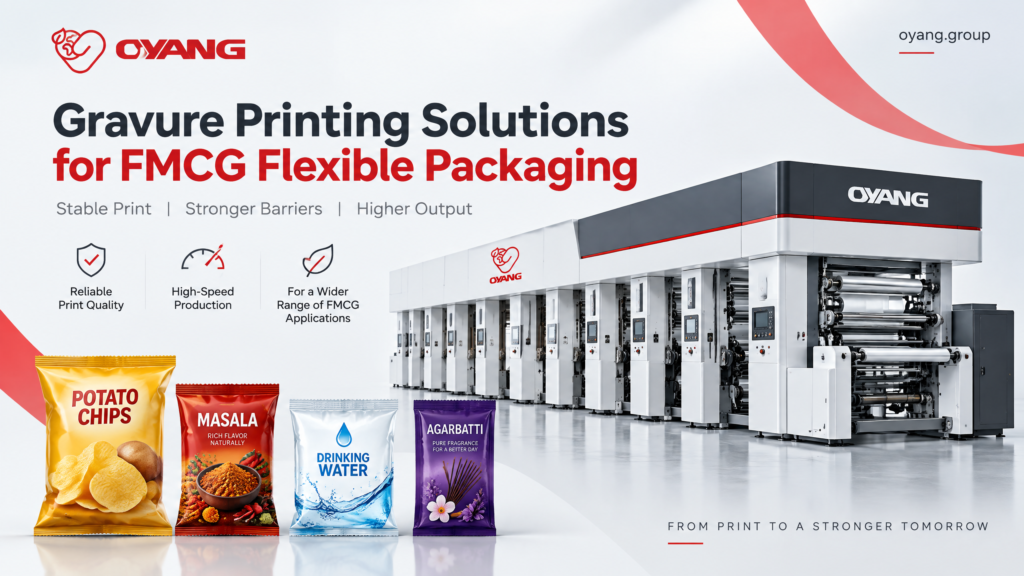
Figure 1: The OYANG EASYPRINT 3.0 ELS Rotogravure Press (280 m/min) configured for high-output chips packets, spice masala sachets, and water nylon roll conversion.
Video 1: Machine run of the OYANG EASYPRINT 3.0 ELS line showing high-speed web path stability, quick changeovers, and uniform inking for FMCG flexible rolls.
By machining all bearing pockets and locating planes in a single clamping cycle, side frame parallelism tolerances are locked rigidly to ≤ 0.015 mm. This structural stability enables our Electronic Line Shaft (ELS) direct-drive servos to maintain longitudinal and transverse color register accuracy within ±0.05 mm during continuous high-speed roll splices.
For converters expanding into downstream pouch manufacturing, printed barrier rolls feed seamlessly into our bag-making lines, including the OYANG 650Z High Speed Center Seal Pouch Making Machine for center-seal pillow bags and the OYANG 650S High Speed 3-Side Seal Pouch Making Machine for portion-pack sachets.
Related Technical Guides & Converting Resources
- → What is Rotogravure Printing and How It Works? Core Principle Guide: Review the fluid dynamic transfer cycle, doctor blade shearing mechanics, and drying physics.
- → Rotogravure vs. Flexo: 4 Printing Types Compared: An engineering comparison of tooling costs, dot reproduction limits, and production profitability break-evens.
- → Disadvantages of Rotogravure: 5 Bottlenecks & Solutions: In-depth analysis of cylinder tooling lead times and how ELS automation mitigates traditional changeover waste.
- → Rotogravure Cylinders: Process & Maker Guide: Technical breakdown of copper plating, electromechanical engraving cells, and hard chrome surface tolerances.
Frequently Asked Questions (FAQ)
What causes metallization flaking on a chips packet printing machine?
Metallization peeling occurs when printing impression forces exceed 18 N/mm or when web tension spikes beyond ±2.0 N, causing micro-shearing between the thin 40 nm aluminum layer and the base film. Using 70 Shore A synthetic rubber sleeves and low-friction air dancers eliminates this mechanical damage.
How does a masala pouch printing machine stop spice oil and fragrance penetration?
It integrates reverse-side barrier lacquering stations and enclosed doctor blade systems, applying chemical-resistant primers that stop pungent spice essential oils (capsaicin, turmeric oils) from softening exterior inks during high-speed vertical form-fill-seal packaging.
Can an industrial sachet printing machine process thin 35μm sachet water nylon without stretching?
Yes, by combining low-temperature high-volume drying air (≤ 50°C at 30 m/s) with sensitive closed-loop servo dancers, the machine restricts dynamic web tension to 20–35 N/m, preventing the thermal neck-in that causes water sachet bursts.
Why is continuous web printing preferred over pre-formed pouches for agarbatti incense packaging?
Continuous web printing achieves production speeds exceeding 250 m/min while applying heavy inline rub-resistant varnishes, shielding packaging graphics against harsh synthetic perfume oils while cutting unit packaging costs by up to 50%.