

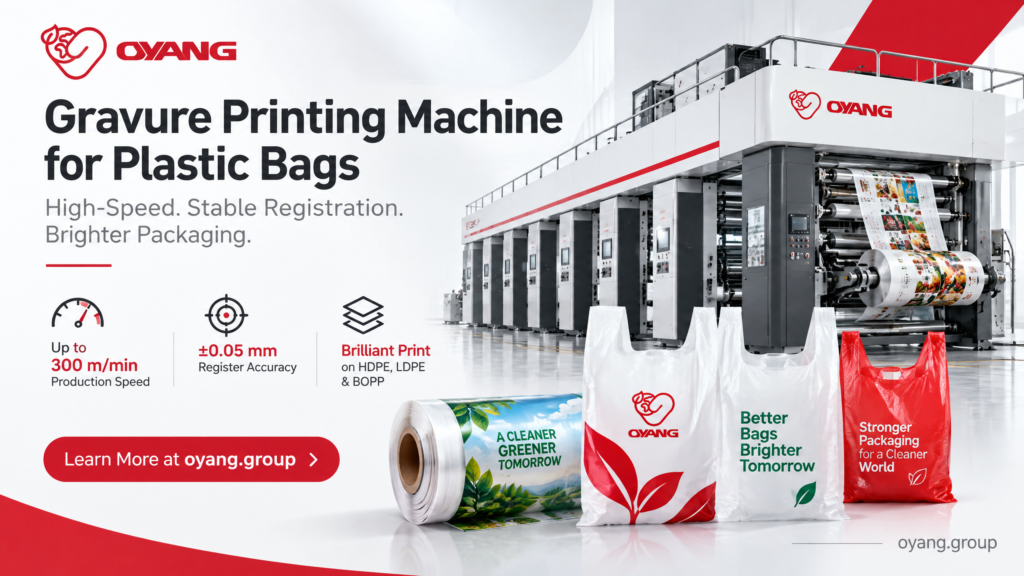
Designed to eliminate film necking, telescoping roll edges, and ink flaking on thin tubular HDPE, LDPE, and woven BOPP webs, OYANG’s roll-to-roll plastic bag printing machine integrates closed-loop micro-tension regulation (±1.5 N stability) with dual-vector AC servo direct drives. Engineered for continuous conversion across grocery carry bags, T-shirt vest sacks, and regional panni pouches, this high-yield poly bag printing machine runs at production velocities up to 280 m/min, holding dynamic register within ±0.05 mm while providing heavy solid ink laydown and instant ink drying without web distortion.
Manufacturing Bottlenecks: Sheet-Fed Screen Printing vs. Roll-to-Roll Pre-Printing
Factories producing retail carrier bags, garbage liners, and grocery packaging frequently hit critical output ceilings when relying on manual or semi-automatic bag printing methods. Transitioning to an industrial roll-fed plastic bag gravure printing machine fundamentally transforms unit economics:
- Manual Sheet-Fed / Semi-Auto Screen Printing: Pre-formed plastic bags are loaded manually onto flat screens. Production is capped at 15–25 bags per minute per operator, resulting in extreme labor costs, excessive solvent vapor exposure, non-uniform ink film thickness, and visible multi-color misalignment on retail logos.
- Continuous Roll-to-Roll Pre-Printing: Raw blown film tubing or flat sheeting is printed continuously on a multi-color printing machine for plastic bags before entering downstream bag conversion lines. Operating at 200 to 280 m/min, roll-to-roll pre-printing cuts labor by over 80% while delivering brilliant photographic detail and deep solid color opacity.
Industrial Conversion Capacity Rule
Shift Output (Bags) = (Web Speed × 60 × Shift Hours ÷ Bag Cut Length) × Overall Equipment Effectiveness (OEE)
Engineering Proof: Operating an OYANG roll-fed line at 250 m/min with a 350 mm bag cut length and 85% OEE yields approximately 36,428 printed bags per hour. A single continuous roll-fed printing line replaces up to 12 semi-automatic sheet-fed screen tables, reducing annual labor overhead while preventing ink smearing.
Substrate Physics: Engineering Low-Gauge Polythene & Panni Web Paths
Converting high-elasticity polyolefin films on an industrial polythene bag printing machine requires overcoming strict rheological and electrostatic constraints:
1. Preventing Web Stretch on Low-Density Polyethylene (LDPE)
Thin LDPE films (15–35 μm) have low tensile modulus. Excessive draw tension between print units causes the film to neck down laterally and stretch longitudinally, resulting in irreversible graphic distortion and registration drift. OYANG’s poly printing machine utilizes low-inertia dynamic-balanced aluminum guide rolls and dual-nip tension decoupling, locking operating tension within a strict 20–35 N/m window.
2. Thickness Variation in Blown Film & Panni Tubing
Blown film rolls—often converted into local retail bags (commonly specified as panni bags in regional markets)—frequently feature gauge variations of ±8% across the bubble. On an OYANG panni printing machine, self-leveling pneumatic impression rollers with high-elasticity NBR rubber sleeves (70–75 Shore A) absorb gauge inconsistencies, transferring ink cleanly without generating edge slack or center wrinkles.
3. Surface Energy & Ink Adhesion (Corona Treatment Integration)
Polyolefin substrates like PP, HDPE, and LDPE possess non-polar surfaces with native surface energy under 32 dynes/cm, leading to poor ink wetting and post-seal flaking. An inline high-frequency electronic corona treater elevates surface tension to ≥ 40 dynes/cm immediately before the primer or first color deck, guaranteeing 100% tape-test adhesion even under abrasive retail handling.
Technical Matrix: Engineering Controls for Plastic & Poly Bag Substrates
| Substrate Category | Film Caliper | Tension Control Window | Drying Profile | Critical Engineering Control |
|---|---|---|---|---|
| LDPE / LLDPE Bags | 18 – 60 μm | 20 – 35 N/m web | 45 – 52°C (Air velocity 30 m/s) | Low-friction air-bearing dancer; water chill roll post-cooling |
| HDPE Shopping / T-Shirt Bags | 10 – 25 μm | 25 – 45 N/m web | 48 – 55°C (Air velocity 32 m/s) | Spiral-grooved idlers to vent air cushion; active static discharge |
| BOPP Laminated Bags | 15 – 35 μm | 40 – 65 N/m web | 55 – 65°C (Air velocity 35 m/s) | High-speed solvent extraction; reverse printing for high gloss |
| PP Woven Tubular / Valve Sacks | 50 – 90 g/m² | 80 – 150 N/m web | 50 – 60°C (Air velocity 30 m/s) | High impression load (≥ 25 N/mm) to penetrate woven fabric peaks |
OYANG Engineering Foundation: Robust Vibration-Damped Printing Performance
Converting lightweight poly packaging requires structural machinery that tolerates 24/7 non-stop operational cycles without register deviation or oil leakage.
Inside OYANG’s 130,000 m² production complex, all side frames, mechanical cross-ties, and bearing journals for the EASYPRINT 3.0 ELS Rotogravure Printing Machine and HONOR 3.5 ELS Rotogravure Printing Machine are precision-machined on Japanese MAZAK and OKUMA 5-axis CNC machining centers.

Figure 1: OYANG EASYPRINT 3.0 ELS Rotogravure Press (280 m/min) featuring shaftless cylinder chucking and high-efficiency convective drying for polyethylene and BOPP bag webs.
Video 1: Machine run of the OYANG EASYPRINT 3.0 ELS rotogravure line, demonstrating 280 m/min high-speed web handling and rapid shaftless cylinder docking.
With all frame locating planes maintained to a datum tolerance of ≤ 0.015 mm, nip pressure across the web remains uniformly parallel, completely eliminating doctor blade scoring and film track wandering. Printed master rolls flow directly into our downstream converting equipment—such as the OYANG 650S High Speed 3-Side Seal Pouch Making Machine or automatic sealing-cutting lines—yielding clean, wrinkle-free bags at peak production economics.
Related Technical Guides & Converting Resources
- → What is Rotogravure Printing and How It Works? Core Principle Guide: Review the fluid dynamic transfer cycle, doctor blade shearing mechanics, and drying physics.
- → Rotogravure vs. Flexo: 4 Printing Types Compared: An engineering comparison of tooling costs, dot reproduction limits, and production profitability break-evens.
- → Disadvantages of Rotogravure: 5 Bottlenecks & Solutions: In-depth analysis of cylinder tooling lead times and how ELS automation mitigates traditional changeover waste.
- → Rotogravure Cylinders: Process & Maker Guide: Technical breakdown of copper plating, electromechanical engraving cells, and hard chrome surface tolerances.
Frequently Asked Questions (FAQ)
What is a plastic bag printing machine?
A plastic bag printing machine is an industrial roll-to-roll press configured to print high-resolution branding, barcodes, and solid ink layers onto tubular or flat poly films (LDPE, HDPE, BOPP) before the film is folded, slit, and sealed into finished bags.
How does a poly bag printing machine prevent LDPE film from stretching?
It uses multi-stage AC servo direct drives paired with low-friction air-bearing dancer rollers to decouple tension zones, keeping dynamic web pull strictly below 35 N/m and holding multi-color register accuracy within ±0.05 mm.
What is the difference between a roll-to-roll poly bag printer and semi-auto bag printers?
A roll-to-roll poly bag printer prints continuous master rolls at velocities exceeding 280 m/min with automatic registration and convective drying, whereas semi-auto machines process individual pre-formed bags manually at under 30 bags per minute.
Can a panni printing machine handle tubular blown film with thickness variations?
Yes, an industrial panni printing machine incorporates high-resilience synthetic rubber impression rollers (70–75 Shore A) and pneumatic self-aligning bearings to compensate for tubular gauge fluctuations without edge wrinkling.