

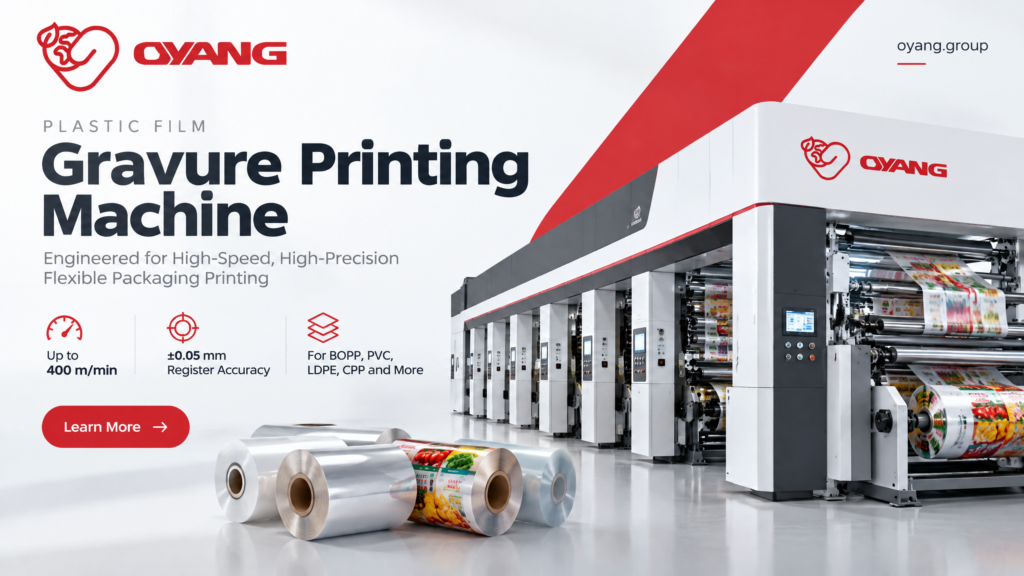
A plastic film printing machine (specifically an industrial roll-to-roll plastic film gravure printing machine) is engineered to print extensible and heat-sensitive flexible packaging webs including BOPP, PVC, LDPE, CPP, and multi-layer co-extrusions. Operating at continuous speeds up to 400 m/min, the press utilizes seven-zone closed-loop servo tension regulation, static neutralization, and chill-roll thermal stabilization to eliminate web elongation and thermal contraction, holding multi-color register accuracy strictly within ±0.05 mm across large-format roll conversion.
Substrate Dynamics: Mitigating Thermal and Elastic Deformation Across Polymer Webs
Unlike cellulose paper, non-porous thermoplastic films exhibit dramatic physical shifts when subjected to mechanical tension and drying temperatures inside an inline plastic film roll printing machine. High-speed gravure conversion requires dedicated engineering adaptations tailored to each specific polymer morphology:
1. Biaxially Oriented Polypropylene (BOPP)
As the industry workhorse for snack packaging and overwrap films, running a dedicated bopp film printing machine or bopp printing machine involves managing high electrostatic surface charges (often exceeding 15 kV) and preventing film wrinkling at thin gauges (12–18 μm). Active active static bars with high-frequency ion blowers and mirror-polished ceramic guide rolls are required ahead of the inking stations to stop electrostatic ink repulsion (feathering) and dust attraction.
2. Polyvinyl Chloride (PVC) Shrink Films
A specialized pvc film printing machine converts heat-shrink sleeves (40–50 μm) with transversal shrinkage rates up to 60%. Because PVC begins dimensional recovery at temperatures as low as 55°C, drying hoods must feature extended low-temperature, high-air-velocity nozzles (35–45 m/s at ≤ 48°C) paired with immediate exit chill rollers to lock web width prior to entering subsequent print decks.
3. Low-Density Polyethylene (LDPE) and Cast Polypropylene (CPP)
When running an ldpe printing machine or pp printing machine, the primary conversion hurdle is substrate elasticity. LDPE exhibits low tensile modulus, causing severe web necking and longitudinal elongation under minimal mechanical pull. Ultra-low-friction dancer arms running on carbon-fiber rollers and micro-load-cell feedback loops isolate infeed tension to within ±1.0 N, preventing permanent stretch during 300+ m/min acceleration sweeps.
Substrate Conversion & Tension Matrix
| Substrate Material | Typical Caliper Range | Tension Setpoint (N/m web) | Max Oven Temp (°C) | Critical Engineering Control |
|---|---|---|---|---|
| BOPP Film | 12 – 40 μm | 40 – 70 N/m | 55 – 65°C | Dual-stage static de-ionizers; high-velocity solvent desorbing |
| PVC Shrink Film | 35 – 50 μm | 30 – 50 N/m | 40 – 48°C | High-flow ambient-air hoods; forced water chill rolls (≤ 15°C) |
| LDPE / LLDPE | 25 – 80 μm | 20 – 40 N/m | 45 – 52°C | Ultra-low dancer inertia; direct-drive servo outfeed isolation |
| BOPET Film | 10 – 25 μm | 50 – 90 N/m | 65 – 75°C | High thermal stability; precision doctor blade wiping to avoid scratches |
| Cast PP (CPP) | 20 – 60 μm | 25 – 45 N/m | 48 – 55°C | Anti-blocking roll geometry; micro-grooved idle rollers |
Key Engineering Technologies for High-Speed Film Gravure
Achieving ±0.05 mm register on non-rigid polymeric roll stocks requires precise mechanical control over the entire web path:
- Low-Inertia Aluminum Guide Rollers: All idler rollers are dynamically balanced up to 450 m/min with dynamic runout ≤ 0.01 mm, finished with hard-anodized coatings and micro-grooved spirals that bleed off trapped boundary air layers, preventing web slippage.
- Independent Driven Chill Rolls: Dual-layer water jacket chill rolls installed after each oven deck lower the film temperature below its glass transition state (Tg), instantly stiffening the polymer web before it enters the subsequent printing nip.
- Pre-Conditioning Heating/Corona Integration: For films with surface energy below 38 dynes/cm (such as raw BOPP or PE), inline corona treatment increases dyne levels above 42 dynes/cm, ensuring chemical bonding with solvent or water-based inks without pinholing.
OYANG Engineering Practice: Distortion-Free Converting on HONOR Series Presses
Film stretch in gravure presses is frequently triggered by frame flexure and inconsistent nip pressure across wide web widths. When converting extensible 12μm BOPP or sensitive shrink PVC films, mechanical chassis resonance translates directly into registration hunting and edge wrinkling.
To guarantee mechanical parallelism, OYANG Group machines the side frames, bearing saddles, and impression slide ways for the HONOR 3.5 ELS Rotogravure Printing Machine and HONOR 4.0 ELS Rotogravure Printing Machine inside its 130,000 m² production complex using Japanese MAZAK and OKUMA 5-axis CNC machining centers.

Figure 1: OYANG HONOR 3.5 ELS Rotogravure Press (300 m/min, 10-color) engineered with closed-loop tension zones and integrated chill rolls for flexible packaging film converting.
With all frame locating planes maintained to a geometric tolerance of ≤ 0.015 mm, nip pressure remains completely linear across the full 1300 mm web width. Integrated with full-speed turret unwinding and downstream converting equipment—such as our Flexible Packaging Film Rolls (OPP, BOPP, CPP, PET) supply or high-speed pouch lines—converters maintain premium optical clarity, razor-sharp barcoding, and zero mechanical film elongation.
Related Technical Guides & Converting Resources
- → What is Rotogravure Printing and How It Works? Core Principle Guide: Review the fluid dynamic transfer cycle, doctor blade shearing mechanics, and drying physics.
- → Rotogravure vs. Flexo: 4 Printing Types Compared: An engineering comparison of tooling costs, dot reproduction limits, and production profitability break-evens.
- → Disadvantages of Rotogravure: 5 Bottlenecks & Solutions: In-depth analysis of cylinder tooling lead times and how ELS automation mitigates traditional changeover waste.
- → Rotogravure Cylinders: Process & Maker Guide: Technical breakdown of copper plating, electromechanical engraving cells, and hard chrome surface tolerances.
Frequently Asked Questions (FAQ)
What is a plastic film printing machine?
A plastic film printing machine is a continuous roll-to-roll gravure press engineered with multi-stage closed-loop tension zones and low-temperature drying systems to print on flexible polymeric webs like BOPP, PVC, LDPE, and CPP without stretching or thermal warping.
How does a bopp printing machine avoid static electricity and ink whiskers?
A BOPP printing machine integrates active ionizing static eliminator bars ahead of print stations and maintains low ink viscosity (14–16 seconds Ford Cup #4) to suppress electrostatic charge buildup and prevent ink feathering on non-conductive film surfaces.
Why do PVC shrink films require specialized drying controls on a pvc film printing machine?
PVC shrink film begins dimensional contraction around 50°C, requiring high-velocity low-temperature air drying (≤ 48°C) coupled with high-efficiency water chill rollers to prevent sleeve shrinkage and transverse web distortion during multi-color runs.
Can an ldpe printing machine handle low-micron elastic films without stretching?
Yes, modern LDPE gravure machines utilize low-inertia carbon-fiber or dynamically balanced aluminum idle rollers alongside sensitive floating dancer tension loops to hold web tension below 40 N/m, eliminating permanent film stretch and registration drift.