

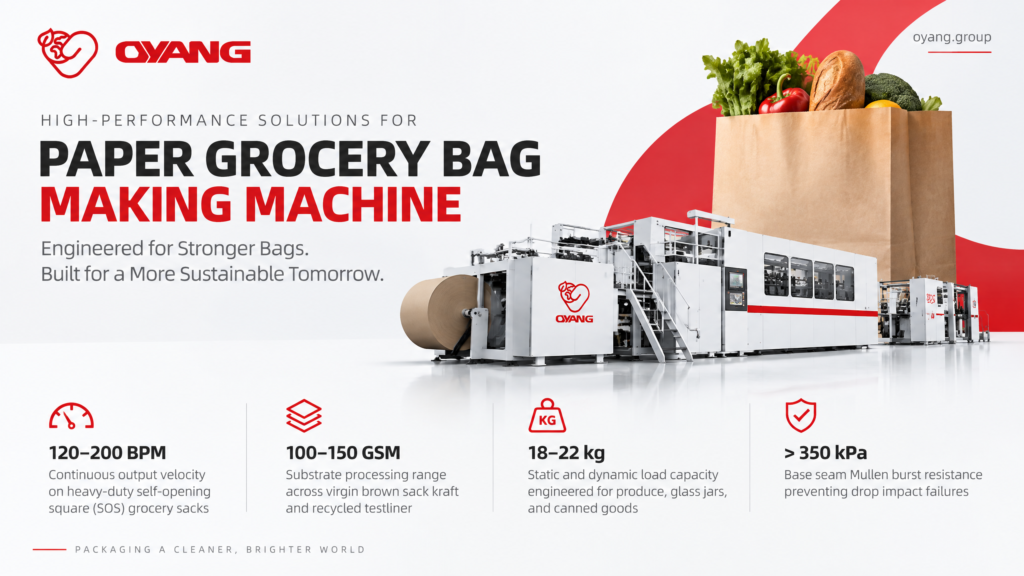
A heavy-duty paper grocery bag making machine (also engineered across commercial packaging lines as a grocery bag making machine, grocery paper bag making machine, or high-capacity shopper making machine) converts continuous master reels of unbleached virgin and semi-extensible sack kraft (100 to 150 GSM) into high-volume self-opening square (SOS) sacks. Built to transport dense supermarket goods up to 18 to 22 kg without bottom rupture, industrial converting platforms such as the SMART-17 and SG600 integrate large-diameter bottom-forming drums, multi-track high-penetration cold adhesive applicators, and high-torque closed-loop servo web tensioning. These lines achieve stable converting outputs of 120 to 200 bags per minute on heavy grocery formats (such as standard 1/6 BBL sacks), maintaining bottom squareness tolerances within ±0.5 mm and Mullen burst strengths exceeding 350 kPa.
Kinematic Demands of Heavy-Duty Grocery Sack Converting
Supermarket checkout operations rely heavily on self-opening square (SOS) sacks, most notably the industry-standard 1/6 Barrel (1/6 BBL) specification (approximately 305 × 178 × 432 mm). Unlike lightweight boutique packaging, a heavy grocery sack must stand upright independently in packing wells, allow rapid manual opening with a single wrist snap, and transport sharp-edged canned goods, refrigerated dairy, and produce without base delamination. Selecting the proper paper grade is essential; review our material criteria in the kraft paper material selection guide.
Converting heavy basis weight substrates (100 to 150 GSM) at high speed introduces severe mechanical challenges. Heavy kraft fibers possess high bending stiffness (Gurley stiffness > 800 mg), resisting tight radius folds and exerting high spring-back forces. Operating a commercial grocery paper bag making machine requires specialized kinematics across five inline processing zones:
- High-Tension Unwind & Pre-Scoring: Hydraulic shaftless unwinds handle jumbo kraft rolls up to 1500 mm in diameter. Heavy-pressure carbide scoring wheels deeply pre-crease the side gussets and bottom fold axes to break internal fiber memory without fracturing surface fibers.
- Continuous Longitudinal Seam Extrusion: High-solid-content water-based cold adhesive is extruded under pressure along the tube lap joint, forming a multi-track bond line that cures rapidly under continuous nip compression.
- Rotary Flying Shear Cutoff: A synchronized servo-driven rotary cutter severs the heavy paper tube transversely, using progressive shear angles to minimize acoustic shock and blade wear.
- Large-Radius Bottom Drum Opening: Oversized mechanical opening fingers and dual vacuum suckers spread the tube base into an open diamond geometry without tearing the thick corner folds.
- Anti-Burst Bottom Sealing & Calendering: Multi-segment cold glue wheels lay down an interlocking adhesive grid across the bottom flaps, followed by high-pressure calender rollers (0.6 to 0.8 MPa) that compact the paper fibers.
To verify bag weight targets and raw paper yield during high-volume converting runs, plant engineers can consult our reference on paper bag weight calculation and material yield formulas.
Anti-Burst Engineering: Large Square Bottom Forming Mechanics
The primary point of failure for an industrial shopper making machine product is bottom drop rupture. When a consumer loads 20 kg of groceries, hydraulic-like shock pressures focus on the central bottom fold. OYANG heavy-duty machinery incorporates three key design elements to reinforce the base:
1. Oversized Forming Mandrels & Deep-Crease Kinematics
Standard paper bag machines utilize small-radius folding blades suited for 60–80 GSM stock. When processing 130 GSM kraft, sharp radiuses cause fiber fracturing along the outer fold layer. The SMART-17 features enlarged, progressive forming ploughs and polished guide rails that guide the stiff paper through gradual angular transitions (reducing peak folding shear stress by 40%), preserving tensile strength along the bag corners.
2. Enlarged Dual-Diameter Bottom Drum Architecture
To form large rectangular bases (bottom widths from 120 to 220 mm), the bottom drum diameter must be expanded to provide sufficient dwell time. The OYANG heavy-sack bottom drum uses mechanical gripping fingers with hardened alloy pads paired with continuous vacuum channels. This holds the bottom flaps firmly in position throughout glue transfer, eliminating diagonal skewing and adhesive smear.
3. Multi-Track Cold Adhesive Interlocking Grid
Instead of a single thin glue film, the bottom glue station applies an interlocking grid of high-tack PVAc adhesive (viscosity 1,800 to 2,500 mPa·s). The adhesive is metered via precision doctor-blade sumps. Under downstream heavy spring-loaded nip rollers, the adhesive penetrates deeply into the porous unbleached kraft fibers, creating a cross-linked bond line that achieves fiber-tearing adhesion across the base.
Engineering Video: SMART-17 High-Speed SOS Converting Line
Observe the synchronized roll unwinding, continuous tube forming, and high-speed bottom drum opening in operation on the OYANG SMART-17 platform:
Video 1: Real-time high-speed SOS paper sack conversion on the OYANG SMART-17 production line.
Field Engineering Diagnosis: Troubleshooting Heavy Grocery Sack Flaws
High web stiffness and thick caliper variations can cause processing faults on high-speed lines. Use this shop-floor calibration guide to diagnose common heavy kraft converting issues:
| Converting Defect | Root Mechanical / Physical Cause | Standard Workshop Calibration Protocol |
|---|---|---|
| Bottom Burst Under Static Load (< 15 kg) | Adhesive penetration inadequate on heavy 120+ GSM unbleached kraft; nip calender roll pressure set too low (< 0.4 MPa). | Increase calender air cylinder pressure to 0.65 MPa; raise water-based adhesive solids ratio or increase doctor blade gap to 0.12 mm. |
| Gusset Crease Cracking / Fiber Split | Radial scoring disc profile too sharp; low paper equilibrium moisture content (web RH < 4.5% causing fiber brittleness). | Replace creasing discs with larger corner radius (R = 0.8 mm); condition raw kraft paper rolls to 6.0–7.5% moisture content prior to converting. |
| Bottom Flap Angular Skew (> 1.5 mm) | Asymmetric vacuum pull in drum opening cups; mechanical gripper fingers out of parallel alignment across the 200 mm base width. | Clean vacuum manifold filter ports; adjust gripper mechanical stops using precision dial indicators to within ±0.02 mm across drum face. |
| Web Flutter at Rotary Shear Cutoff | Servo draw roller nip pressure insufficient to grip heavy 140 GSM kraft; unwind brake tension lagging behind line acceleration. | Increase draw roll pneumatic clamping pressure to 0.5 MPa; recalibrate unwind servo dancer PID loop for heavier web inertia. |
Supermarket Grocery Sack vs. Standard Retail Carrier: Technical Matrix
Converting lines designed for heavy supermarket grocery packaging require different mechanical and structural configurations than standard retail lines:
| Technical Parameter | Heavy-Duty Grocery Sack Line (SMART-17 / SG600) | Light-to-Medium Retail Carrier Line (OYANG 16B) |
|---|---|---|
| Compatible Paper Grammage | 100 – 150 g/m2 (Heavy Sack Kraft) | 60 – 100 g/m2 (Light Commercial Kraft) |
| Maximum Rated Velocity | 120 – 200 bags/min | 150 – 220 bags/min |
| Bottom Width Range | 100 – 220 mm (Large Square Bottom) | 70 – 150 mm (Medium Square Bottom) |
| Base Tensile Burst Strength | > 350 kPa (High Anti-Burst Integrity) | 180 – 240 kPa |
| Safe Dynamic Payload | 18 – 22 kg (Heavy grocery items) | 5 – 8 kg (Apparel & light pharmacy) |
| Primary Use Case | Supermarket checkout sacks (1/6 BBL), wholesale clubs | Bakery items, pharmacy goods, retail merchandise |
OYANG Heavy Converting Platforms: SMART-17 and SG600
Converting stiff 150 GSM kraft reels at 200 bags/min requires substantial machine frame mass to absorb rotational shock loads. Standard welded steel frames can experience frame deflection over time, leading to registration error and accelerated bearing wear. OYANG structural wall panels are cast from high-density HT250 gray cast iron, pre-aged to relieve residual stress, and precision-machined on Japanese MAZAK and OKUMA 5-axis CNC suites to hold tolerances within ≤ 0.015 mm:
1. SMART-17: Automated High-Speed SOS Grocery Production Line
The SMART-17 Automatic High-Speed Paper Bag Production Line is engineered specifically for high-volume grocery sacks. Capable of processing bag widths from 150 to 330 mm and cut lengths from 280 to 530 mm, the SMART-17 delivers high output (up to 220 bags/min) with closed-loop tension control and quick-set recipe changes.

Figure 1: The SMART-17 High Speed Converting Line producing square bottom grocery sacks.
2. SG600: High-Speed SOS Line with Inline Flexographic Printing
For converters supplying branded grocery chains requiring high-graphic print alongside heavy construction, the SG600 High Speed SOS Paper Bag Machine with Inline Printing integrates 2- to 4-color flexographic printing directly into the bag forming line. This single-pass setup eliminates intermediate rewinding, printing high-impact logos directly onto heavy unbleached kraft rolls.

Figure 2: The SG600 Integrated Paper Bag Line combining inline printing, bag forming, and automated collation.
To review best practices for plant configuration, auxiliary material handling, and equipment selection, explore our operational guide on how to make a professional paper bag: Factory manufacturing guide.
For detailed guidance on specifying ancillary systems like inline tension brakes, auto-splicers, and roll lifters, read our setup overview on which machine is used to make paper bags: Factory setup guide.
Related Technical Guides & Converting Resources
- → Paper Bag Material & Kraft Selection Guide: Analyzing virgin unbleached kraft vs. semi-extensible sack paper burst resistance and tensile energy absorption (TEA).
- → Paper Bag Weight Calculation & Material Yield Guide: Engineering formulas for calculating single-bag weight, roll consumption, and square-meter yield across heavy basis weights.
- → How to Make a Professional Paper Bag: Factory Guide: In-depth production parameters covering web tension balancing, fiber-tear cold adhesive curing, and bottom drum adjustments.
- → Which Machine Is Used to Make Paper Bags? Setup Guide: Plant infrastructure planning, roll unwind handling, pneumatic line layout, and machine line positioning.
Frequently Asked Questions (FAQ)
What is a standard 1/6 BBL paper grocery sack and what machine produces it?
A 1/6 Barrel (1/6 BBL) paper sack is the standard commercial grocery bag used in North American and international supermarkets (dimensions approx. 305 × 178 × 432 mm). It is converted on heavy-duty roll-fed SOS machines like the OYANG SMART-17, using 100 to 130 GSM unbleached kraft paper to support payloads up to 18 to 22 kg.
How does a heavy grocery paper bag machine prevent bottom bursting under heavy loads?
Anti-burst bottom protection is achieved through deep mechanical creasing of the heavy paper, an enlarged bottom drum that extends adhesive contact time, multi-track high-solids PVAc glue application, and secondary calender rollers delivering 0.6 to 0.8 MPa of compression pressure. This forces adhesive deep into the kraft fiber matrix, ensuring Mullen burst strength exceeds 350 kPa.
Can recycled testliner paper run on a grocery bag making machine at high speed?
Yes, but high-yield recycled testliner has shorter fibers and lower tensile energy absorption than virgin kraft. To run recycled board without tearing, modern machines deploy closed-loop dancer roll tension systems and progressive forming wings to minimize peak web tension transients during high-speed operation.
What is the advantage of inline flexographic printing on a grocery sack machine?
An inline flexographic printing unit (featured on the SG600 line) prints 2 to 4 colors directly onto the paper web before tube forming. This single-pass approach eliminates offline rewinding and storage, lowers converting floor labor requirements by over 40%, and guarantees print registration with the bag bottom folds.