

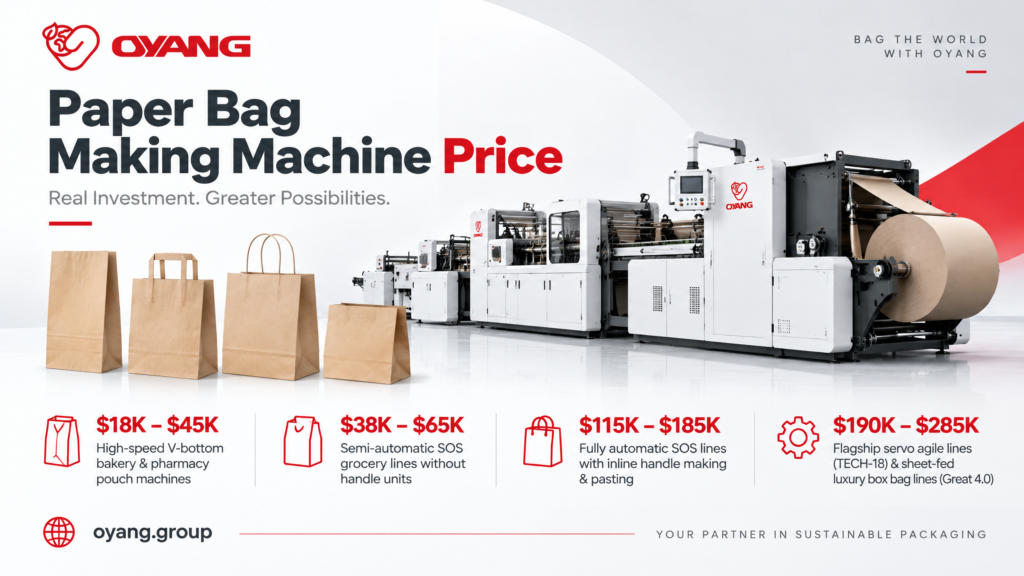
The factory-direct paper bag making machine price (internationally benchmarked across commercial converters as paper bag machine price, paper bag manufacturing machine cost, or cost of paper bag making machine) ranges from $18,000 to over $285,000 USD (FOB) depending on kinematic automation, handle integration, and substrate feed mechanics. High-speed roll-fed sharp-bottom (V-bottom) machines span $18,000 to $45,000 USD; semi-automatic square-bottom (SOS) machines without handles (such as the OYANG 16B) range between $38,000 and $65,000 USD; fully automatic SOS production lines with inline handle making and pasting (such as the OYANG 16A and SMART-17) require capital outlays between $115,000 and $185,000 USD; while high-tier automated platforms featuring 2-minute servo format changeover (TECH-18) or sheet-fed luxury non-crease box bag forming (Great 4.0 Supreme) range from $190,000 to $285,000 USD.
Primary Drivers Dictating Paper Bag Machine Procurement Cost
When commercial packaging converters evaluate the paper bag machine cost or formulate a machinery procurement requisition, price discrepancies between competing quotes stem from fundamental mechanical architecture, drive topology, and component grade rather than arbitrary markups. Four primary engineering factors determine equipment CapEx:
- Drive Topology (Mechanical Line-Shaft vs. Distributed Servo Bus): Entry-level machines utilize central AC motors driving chains, bevel gears, and mechanical gearboxes ($38,000–$55,000 USD). Premium platforms integrate 16 to 24 independent servo motors coordinated over high-speed EtherCAT or Profinet fieldbuses ($130,000–$220,000 USD). The servo architecture eliminates mechanical gear backlash, enables digital touchscreen recipe adjustments in under 2 minutes, and cuts routine mechanical maintenance overhead by 60%.
- Structural Chassis Rigidity & Machining Tolerances: Fabricated steel-tube frames assembled with standard hand tools deform under high cyclic vibration. OYANG structural machine panels are cast from high-density HT250 gray cast iron, pre-aged to relieve thermal stresses, and milled on Japanese MAZAK and OKUMA 5-axis CNC machining suites to surface tolerances ≤ 0.015 mm. This structural investment adds 15–25% to initial machine manufacturing cost but guarantees a 12- to 15-year operational service life under continuous multi-shift production.
- Inline Automation Modularity: Decoupled bag-forming machines produce plain open sacks. Adding inline continuous handle forming, servo-timed adhesive pasting, and automatic handle fold-in units increases machine footprint and adds $65,000 to $95,000 USD to line CapEx, but eliminates manual post-converting handling steps.
- Inline Auxiliary Processing Modules: Integrating 2- to 4-color flexographic printing stacks directly onto the unwind section adds $22,000 to $48,000 USD. Adding automated dual-turret flying splice unwinds with zero-speed accumulators adds $25,000 to $40,000 USD, eliminating line stoppages during roll transitions.
For a comprehensive itemization of freight rates, import tariffs, and auxiliary utility preparation, review our industry pricing study on how much does a paper bag making machine cost: Landed CapEx analysis.
Commercial Price Matrix: Standard Configurations & Investment Ranges
The following commercial matrix provides verified budgetary guidance for paper bag manufacturing machine price planning across standard industrial models, based on FOB shipping terms:
| Machine Category & Model | Base Configuration | Converting Speed | Estimated Price Range (FOB) | Typical Payback (ROI) |
|---|---|---|---|---|
| Sharp Bottom (V-Bottom) OYANG 16C Series | Roll-fed satchel/bakery pouches, servo draw, rotary cut | 300 – 600 bags/min | $18,000 – $45,000 USD | 6 – 9 Months |
| Semi-Auto SOS (No Handle) OYANG 16B Series | Roll-fed square bottom sack, mechanical cam, cold glue | 60 – 100 bags/min | $38,000 – $65,000 USD | 8 – 12 Months |
| Auto SOS with Inline Handle OYANG 16A Series | Inline twisted rope or flat handle making & pasting station | 120 – 150 bags/min | $115,000 – $165,000 USD | 10 – 14 Months |
| High-Speed Mass SOS Line SMART-17 Series | Reinforced cast chassis, high-speed drum, auto packaging link | 180 – 220 bags/min | $145,000 – $185,000 USD | 11 – 15 Months |
| Agile Digital Servo SOS Line TECH-18 Platform | Multi-axis EtherCAT bus, 2-minute digital size changeover | 150 – 180 bags/min | $190,000 – $245,000 USD | 12 – 16 Months |
| Sheet-Fed Luxury Box Bag Great 4.0 Supreme | Sheet feeder, mouth & bottom card insert, zero waist crease | 50 – 80 bags/min | $220,000 – $285,000 USD | 12 – 16 Months |
Optional Machinery Add-Ons & Modular Line Pricing
When customizing a base machine line to match specific client contracts, procurement managers should account for modular peripheral options:
- Inline 2-Color Flexographic Printing Stack: +$22,000 – $28,000 USD. Includes ceramic anilox cylinders, closed-loop doctor blade chamber, and drying tunnel directly synchronized to the main line shaft.
- Inline 4-Color High-Graphic Flexo Unit: +$38,000 – $48,000 USD. Includes servo-driven print cylinders, computerized color registration eyes, and extended forced-air drying chambers.
- Dual-Turret Continuous Non-Stop Flying Splice Unwind: +$25,000 – $40,000 USD. Eliminates line stops for master roll transitions, saving approximately 30 meters of scrap paper and 15 minutes of downtime per roll change.
- Automatic Downstream Bag Collating & Bundling Line (BP500): +$28,000 – $42,000 USD. Counts, compresses, and secondary poly-bags converted outputs, reducing downstream pack-off labor by 2 to 3 workers per shift.
- Full-Servo Motorized Size-Change Tooling Package: +$25,000 – $35,000 USD. Replaces manual hand-wheel adjustments with ball-screw servo slides linked to HMI recipes for rapid 2-minute tool repositioning.
Engineering Video: Manufacturing Infrastructure & Machine Assembly Verification
Examine the CNC machining centers, structural assembly procedures, and quality inspection protocols inside the OYANG manufacturing campus:
Video 1: Inspection of OYANG precision CNC machining bays and assembly lines verifying machine build quality.
Total Cost of Ownership (TCO) & Commercial ROI Model
Evaluating the cost of automatic paper bag making machine installations requires reviewing total operating expenses alongside initial purchase price. The following production model contrasts a high-output fully automatic line against a semi-automatic converting cell:
| Operational Variable | Semi-Automatic Cell (OYANG 16B + Manual Handle) | Fully Automatic Line (OYANG 16A Inline) |
|---|---|---|
| Initial CapEx (FOB Base) | $48,000 USD (Lower entry barrier) | $138,000 USD |
| Direct Labor Per Shift | 3 – 4 Workers (Forming, transfer, pasting) | 1 Operator (Full supervision only) |
| Hourly Shift Output (Bags/Hr) | 3,800 – 4,500 bags/hr | 7,500 – 9,000 bags/hr |
| Direct Labor Cost Per Bag | $0.012 – $0.018 USD / bag | $0.002 – $0.004 USD / bag |
| Annual Labor Savings (2 Shifts) | Baseline benchmark | $48,000 – $72,000 USD Net Savings / Year |
This comparative financial model highlights why high-volume converters adopt fully automated lines: the direct labor and handling savings of $50,000+ USD per year amortize the price delta between semi-automatic and fully automatic platforms in approximately 14 to 18 months of double-shift commercial operation.
To calculate detailed factory manufacturing overheads, raw paper reel consumption, and direct adhesive expenses per bag, explore our technical guide on paper bag manufacturing cost: Unit cost and pricing guide.
For comprehensive plant cash flow modeling, break-even timelines, and factory square-meter utilization strategies, review our business setup analysis on paper bag manufacturing business setup: Complete CapEx & ROI guide.
To verify unit cost formulas based on your target bag sizes, kraft paper grammage, and local utility tariffs, refer to our detailed formulas in how much does it cost to produce a paper bag: Cost calculation formulas.
Related Technical Guides & Commercial Resources
- → How Much Does a Paper Bag Making Machine Cost?: Granular breakdown covering FOB factory costs, container shipping rates, import duties, and ancillary compressor sizing.
- → Paper Bag Manufacturing Cost: Unit Cost & Pricing Guide: Cost modeling across substrates, adhesive consumption, and inline versus offline handle assembly.
- → Paper Bag Manufacturing Business Setup & ROI Guide: Comprehensive investment planning covering machine payback modeling, facility zoning, and raw paper inventory cycles.
- → How Much Does It Cost to Produce a Paper Bag? Cost Formulas: Practical mathematical formulas for evaluating power consumption, scrap margins, and batch economics.
Frequently Asked Questions (FAQ)
What is the average price range for an industrial paper bag making machine?
The average price ranges from $18,000 to over $285,000 USD (FOB). High-speed sharp-bottom machines cost $18,000 to $45,000 USD; semi-automatic SOS machines cost $38,000 to $65,000 USD; fully automatic SOS lines with inline handles range from $115,000 to $185,000 USD; and high-end servo or sheet-fed luxury box bag lines range from $190,000 to $285,000 USD.
Why is there a significant price difference between semi-automatic and fully automatic paper bag machines?
Semi-automatic machines form open-mouth bag bodies using mechanical gearboxes and central line shafts, requiring manual offline handle pasting. Fully automatic machines incorporate 16 to 24 independent servo motors, industrial fieldbus control, electronic cams, and inline handle making and pasting stations. This eliminates manual labor, doubles output speed, and enables changeovers in under 2 minutes.
What hidden ancillary costs should be budgeted alongside the machine purchase price?
Converters should budget for ocean container freight ($3,500–$9,000 per 40HQ container), import customs tariffs (typically 2–6% depending on HS code and destination), screw air compressor and drying systems ($4,500–$8,000), factory electrical power drop connections ($2,000–$5,000), and an initial consignment of spare parts and adhesive consumables ($3,000–$6,000).
What is the typical return on investment (ROI) timeframe for a fully automatic paper bag line?
Under commercial conditions operating two 8-hour shifts per day at 75% Overall Equipment Effectiveness (OEE), a fully automatic line like the OYANG 16A typically achieves full capital payback within 10 to 14 months. The payback is driven by high output (7,500+ bags/hr) combined with labor savings of $50,000+ USD per year compared to semi-automatic operations.