350x97.png)
350x97.png)
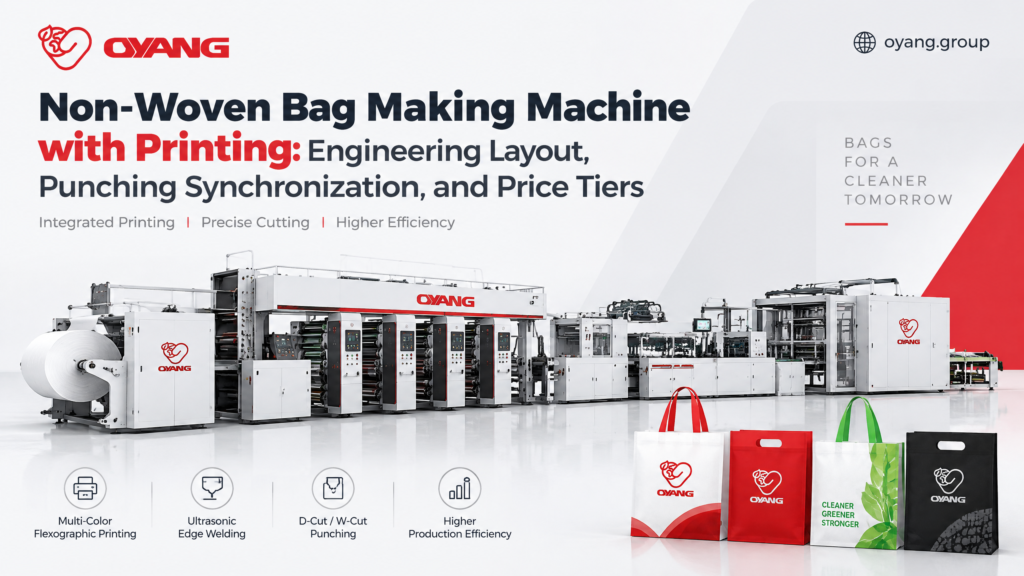
Non-Woven Bag Making Machine with Printing: Engineering Layout, Punching Synchronization, and Price Tiers
Engineered to eliminate intermediate roll rewinding and secondary registration error, OYANG’s integrated non woven bag making machine with printing consolidates multi-color flexographic printing, ultrasonic edge welding, and inline hydraulic D-cut or W-cut punching into a single continuous process. Operating at stable line speeds of 80–120 bags/min, this integrated kinematic architecture cuts scrap loss from 3.5% to under 0.8% while removing 2 to 3 manual handling operators per shift.
1. Engineering Diagnosis: Two-Step Converting vs. Fully Integrated Inline Production
In traditional bag conversion plants, fabric rolls undergo printing on an isolated flexo press, are rewound onto a turret, transported across the factory floor, and mounted onto a standalone bag maker. This discontinuous workflow introduces three acute failure modes: web boundary deformation from uncalibrated rewinding tension, surface scuffing during forklift transport, and print-to-cut pitch drift exceeding ±3.0mm when web elasticity relaxes.
An inline non woven bag making and printing machine eliminates these friction points by synchronizing the continuous printing press directly with downstream folding triangles, gusseting wheels, and ultrasonic welding horns. To understand how acoustic horns manage localized molecular fusion without scorching printed graphics, explore our engineering report on ultrasonic non woven bag sealing machine vs heat seal.
| Operational Metric | Two-Stage Offline System (Print + Rewind + Bag) | OYANG Inline Making & Printing Line | Information Gain / Production Benefit |
|---|---|---|---|
| Material Trim & Start-Up Waste | 3.2% – 4.5% (rewind tails + re-threading runs) | < 0.8% (continuous electronic tension) | Conserves ~26 kg PP spunbond per metric ton converted |
| Cutting & Punching Registration | ±2.0mm to ±3.5mm (humidity & tension decay) | ≤ ±0.5mm (closed-loop photocell lock) | Completely removes graphic drift on D-cut handle borders |
| Labor Staffing per Production Cell | 3–4 operators (1 press tech + 2 handlers + 1 bag tech) | 1–2 technicians (centralized touch HMI) | Lowers direct human overhead by $18,000–$32,000/year |
| WIP Buffer Floor Space | 80 – 120 m² (staging pallets between cycles) | Zero intermediate staging required | Frees up 65% of plant space for finished goods storage |
2. Motion Topology: Servo Phase-Lock, Color Register, and Punching Kinematics
Integrating rotary flexographic printing units with reciprocal ultrasonic cross-cutting and punching requires sophisticated motion coordination. Because non-woven fabric has low tensile yield limits (especially lightweight 40–60 gsm grades), sudden acceleration spikes will stretch the substrate, resulting in accumulated pitch errors.

Figure 1: OYANG XB700/800 Multi-Functional Non-Woven Bag Making Machine with Inline Printing and Punching Integration.
A. High-Speed Photocell Phase-Lock (Electronic Camming)
The printing module lays down an optical registration mark along the outer trim salvage. A high-bandwidth German optical sensor monitors this register mark at continuous web speeds. If elongation shifts the mark by > 0.15mm, the master motion controller calculates the differential and dynamically offsets the downstream rotary cross-cutter and ultrasonic horns via real-time electronic camming (E-CAM). Seam weld placement and handle cuts remain centered across 10,000-bag production batches.
B. Kinematic Integration of D-Cut & W-Cut Punching Modules
In dedicated d cut non woven bag printing machine lines, the handle hole is punched through a hydraulic or high-cycle servo eccentric press fitted with tool-steel dies. For grocery vest bags on a w cut non woven bag printing machine (U-cut/T-shirt configuration), synchronized gusset fold plates recess the fabric before the progressive punch tool cuts the strap handles.
To preserve knife edge longevity and ultrasonic sonotrode tuning during prolonged high-speed cycling, review our technical guide on ultrasonic non woven bag making horns and generators.
3. Investment Analysis: Non Woven Bag Making Machine with Printing Price Matrix
Capital investment for an integrated line depends directly on color count (1 to 4 colors), printing cylinder architecture, web width (up to 800mm), and bag format flexibility (flat, D-cut, drawstring, or box bag). Below is an engineering CapEx breakdown reflecting FOB baseline pricing:
| Equipment Line Configuration | Indicative Price Range (USD FOB) | Rated Capacity | Supported Bag Formats & Print Specs |
|---|---|---|---|
| Single-Color Inline D-Cut Bag Making Line | $32,000 – $42,000 | 60 – 100 bags/min | D-cut flat bags, pharmacy bags, single-side solid branding |
| 2-Color Multifunctional D-Cut & W-Cut Line (XB/XC-700) | $42,000 – $58,000 | 80 – 120 bags/min | D-cut, W-cut T-shirt, drawstring pouches, 2-color precision flexo |
| 4-Color High-Speed Servo D-Cut Bag Line (XC-800 Pro) | $58,000 – $78,000 | 90 – 120 bags/min | Retail carry bags, soft-handle inline attaching, 4-color fine text |
| Fully Automatic 3D Box Bag Line with Inline Printing (OYANG 16S / TECH 26) | $75,000 – $135,000 | 70 – 100 bags/min | Box bags with loop handles, heavy retail shopping totes, multi-color |
Capacity & Scrap Economics Rule:
Daily Net Output (Bags) = Line Speed (bpm) × 60 × Hours × OEE × (1 – Scrap Rate)
*Operational Case: At 100 bags/min across a 10-hour shift at 90% OEE and 0.8% scrap, the OYANG inline system delivers 53,568 finished bags per day. Compared to a 3.5% offline scrap baseline, this saves 1,450 bag equivalents in raw fabric each operating shift. For complete landed cost estimations, review our breakdown on non woven bag making machine price and landed cost analysis.
4. Solid-Steel Stability: Why Machining Precision Dictates Print Registration
When an inline flexo printing tower and a high-impact punching unit operate on the same chassis, mechanical cross-talk is the primary failure hazard. Punching impacts create dynamic micro-vibrations that travel through common bedplates, disturbing the ceramic anilox roller contact zone and causing horizontal ink banding (chatter marks).
To prevent this harmonic coupling, OYANG constructs all machine side-frames from heavy 45mm solid alloy steel wall panels. Every component is machined in-house across our 130,000 m² production complex utilizing five-axis Japanese MAZAK and OKUMA CNC centers. Critical bearing seats and sonotrode guide rails maintain dimensional flatness within ≤ 0.015mm. This structural dampening eliminates chatter transfer, keeping four-color process registration locked at speeds exceeding 100 bags per minute.
To explore stand-alone roll slitting prior to inline conversion, consult our technical equipment page on the ONL-XE1800 Nonwoven Fabric Plastic Film Slitting Machine. If handle loop sealing is evaluated as an off-line secondary station, inspect the non woven bag handle sealing machine manual vs auto analysis.
Engineering Field Demonstrations & Machinery Specifications
Witness kinematic register tracking, continuous flexo inking, and automated punch ejection on live shop-floor production lines:
Related Engineering Guides & Technical Resources
Deepen your line engineering knowledge with these peer articles from OYANG’s packaging machinery research base:
- Flexo Press Architecture: Central impression drums vs stack printing configurations → Non-Woven Flexo Printing Machine: CI vs Stack Analysis.
- Handle Sealing Mechanics: Comparing manual attachments with continuous automated welding → Non-Woven Bag Handle Sealing Machine: Manual vs Auto Guide.
- Acoustic Stack Tuning: Resonant tracking, titanium horn profiles, and generator loads → Ultrasonic Non-Woven Bag Making: Horns & Generators Guide.
- Total Capital Expenditure: Factory landed budgeting, shipping containers, and plant feasibility → Non-Woven Bag Making Machine Price & Landed Cost Breakdown.
5. Frequently Asked Questions (FAQ)
What is the typical price range for a non woven bag making machine with printing?
FOB pricing for an industrial non-woven bag making machine with inline printing ranges from $32,000 to $42,000 for single-color D-cut systems, $42,000 to $58,000 for 2-color multifunctional D-cut and W-cut units, and $75,000 to $135,000 for fully automatic 3D box bag lines equipped with multi-color servo flexo printing towers.
Can an inline flexo printing unit use water-based inks without smearing at 100 bags/min?
Yes. OYANG inline flexographic printing modules incorporate forced-air medium-wave infrared drying tunnels and ceramic anilox metering rollers. This high-efficiency heat exchange system cures eco-friendly water-based inks on polypropylene spunbond fabric in less than 0.35 seconds, completely preventing smearing or ink transfer before the web enters downstream ultrasonic folding rollers.
How does an inline machine adjust between D-cut and W-cut bag production?
Switching between bag formats takes less than 30 minutes on multifunctional models like the OYANG XB/XC series. Converting from D-cut to W-cut involves disengaging the oval handle die, activating the side gusset inserting discs, and setting the servo-driven cross-punch tool to execute vest strap punching with automatic cut-out scrap vacuum extraction.
What scrap rate reduction should an investor expect when upgrading to an inline system?
Operating an integrated inline making and printing machine typically reduces total factory scrap from a traditional 3.2%–4.5% range down to under 0.8%. This saving is achieved by eliminating roll lead tails, removing intermediate rewinding tension variations, and utilizing continuous photocell closed-loop register synchronization.