350x97.png)
350x97.png)
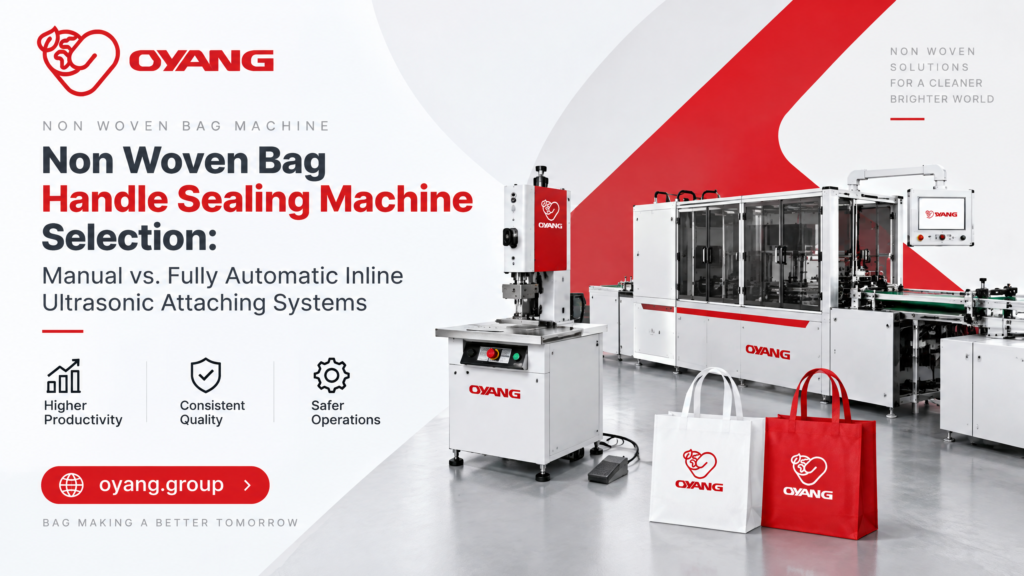
Non Woven Bag Handle Sealing Machine Selection: Manual vs. Fully Automatic Inline Ultrasonic Attaching Systems
For packaging converters operating flat-bag lines or standard bottom-seal units, attaching soft loop handles represents the primary labor bottleneck in the shop floor. While an offline manual non woven sealing machine delivers low entry investment, it restricts operator output to 12–15 bags per minute while introducing human placement error. Upgrading to a dedicated non woven bag handle sealing machine or an inline servo-synchronized attaching station on a bottom seal bag making machine elevates production to 80–100 bags per minute. This guide details pneumatic clamping safety circuits, ASTM D1876 weld peel dynamics (> 150 N), and tooling selection for bag factories.
Manual vs. Inline Loop Attaching: Throughput, Seam Variance & Operational Safety
Bag making operations frequently rely on standalone manual ultrasonic welders for secondary handle attachment. However, manual positioning creates high scrap rates due to inconsistent operator dwell times and angle variations. The table below compares the performance of standalone manual welders against fully automated inline systems:
| Engineering Metric | Manual Foot-Pedal / Benchtop Unit | Standalone Auto Feeder (OYANG15-F700) | Inline Multi-Axis Servo System (TECH 23/26) |
|---|---|---|---|
| Conversion Speed | 10–15 finished bags/min | 35–45 finished bags/min | 80–100 finished bags/min (Continuous) |
| Labor Intensity | 1 operator per machine (100% manual loading) | 1 operator (manual bag feed, auto handle loop) | Zero manual handling (fully automated line) |
| Positional Alignment | Visual guide only (± 3.0 mm variance) | Pneumatic edge stops (± 1.0 mm variance) | Optical fiber registration & servo placement (≤ 0.5 mm) |
| Operator Safety Circuit | Single mechanical foot switch (pinch risk) | Dual concurrent optoelectronic pushbuttons | Fully enclosed interlocked safety doors & light curtains |
| Weld Repeatability | Varies with human fatigue | Consistent pneumatic timer (± 10 ms) | Synchronized servo cam profiles (± 1 ms) |
Operator Ergonomics & Anti-Pinch Pneumatic Safety
Foot-pedal operated standalone non woven sealing machine units represent a frequent shop-floor safety hazard. When an operator attempts to smooth a wrinkled 70 gsm PP spunbond mouth hem while stepping on the pedal, accidental cylinder firing can lead to severe hand injuries.
Modern stand-alone units like the OYANG15-F700 incorporate an EN 574-compliant two-hand control circuit. Both optical palm buttons must be engaged concurrently within a 500-millisecond window to trigger horn descent. The system aborts the welding stroke immediately if either hand leaves the safety zone.
Ultrasonic Welding Physics: Horn Penetration, Knurling & ASTM D1876 Seam Testing
Attaching a loop handle ribbon requires joining four fabric layers: two layers of folded mouth hem plus two plies of the strap ribbon. A standard non woven fabric sealing machine must generate precise mechanical friction without cutting through the outer polypropylene fibers:
Core Parameters for Strong Handle Bond Seams
- Horn Resonance Frequency: High-efficiency 20 kHz acoustic stack (transducer + booster + titanium horn) delivering 1,500 W to 2,000 W of instantaneous energy.
- Diamond-Knurl Penetration Depth: Anvil pattern rollers utilize a 0.35 mm diamond knurl profile. The micro-pyramids focus high-frequency acoustic waves into focal nodes, melting polymer filament interfaces while leaving adjacent non-compressed fibers intact.
- Dynamic Dwell Timing: Welding cycle consists of a 25–40 ms sonic burst under 0.4–0.5 MPa cylinder pressure, followed immediately by a 60–80 ms chilled pneumatic hold to solidify the polymer melt pool.
- ASTM D1876 T-Peel Compliance: A properly calibrated non woven bag sealer must yield finished handle pull-off test results exceeding 150 N (with target performance > 165 N). Strap material tearing before seam detachment confirms an optimal molecular weld.
Kinematic Synchronization: Integrating Handle Welding with Bottom Seal Bag Making
When running a high-speed bottom seal bag making machine, handle attaching cannot operate as an uncoordinated secondary process. Inline automation synchronizes the bottom gusset thermal seal with handle loop feeding:
4-Axis Servo Inline Handling Sequence
- Strap Ribbon Feeding: Dual dedicated servo motors unwind two continuous nonwoven ribbons (25–30 mm width) through optical tension sensors, maintaining uniform web feed.
- Rotary Cut & Loop Formation: Pneumatic rotary shear knives cut the ribbons to specified length (typically 350–450 mm), while vacuum transfer mechanical fingers fold the ribbons into U-shaped handles.
- Secondary Positioning: The robotic fingers advance into the open mouth hem of the bag web while the web stops momentarily during bottom seal indexing.
- Dual-Station Ultrasonic Fusion: Dual 20 kHz horns descend simultaneously, welding both loop ends to the bag mouth in under 40 milliseconds before the main web advances.
OYANG Ultrasonic Converting Technology: Built for Precision Sealing
High-speed ultrasonic handle attaching requires mechanical alignment to prevent uneven horn contact and localized fabric burning. At OYANG’s 130,000 m² production center, machine side-frames and horn mounts are machined on Japanese MAZAK and OKUMA 5-axis CNC lines to tolerances ≤ 0.015 mm, ensuring parallel horn-to-anvil contact across extended production runs.

OYANG15-G-F700: Automatic Soft Handle Ultrasonic Sealing Machine
The optimal upgrade for converters operating manual nonwoven sealing units. The F700 automatically feeds, measures, cuts, and folds handle ribbons. The operator simply feeds pre-formed flat or box bags against optical edge stops, doubling line efficiency.
- Production Rate: 35–45 finished bags/min with a single operator
- Ultrasonic Stack: 20 kHz auto-tuning digital generator with overload protection
- Handle Sizing: Fully adjustable strap lengths from 300 to 500 mm

TECH 23: Integrated 3D Box Bag Line with Inline Loop Welding
For industrial plants transitioning from standalone converting equipment to continuous high-speed automation. The TECH 23 features an inline multi-servo handle attaching station, producing finished 3D shopping bags with welded loop handles at sustained speeds of 90–100 bags/min.
- Continuous Speed: 90–100 bags/min (1 operator per line)
- Changeover Efficiency: Automated recipe-based size change in ≤ 90 seconds
- Handle Pull-Off Force: Exceeds 165 N static resistance under ASTM D1876
Engineering Resources & Production Demonstrations
Explore factory video documentation and handle attaching manuals from our technical engineering department:
Frequently Asked Questions (FAQ)
What is the difference between a manual non woven sealing machine and an automatic handle machine?
A manual non woven sealing machine relies entirely on the operator to position the handle strap and trigger a foot pedal, resulting in speeds of only 10–15 bags per minute with placement variations up to ±3 mm. An automatic handle sealing machine (such as the OYANG15-G-F700) automatically measures, cuts, folds, and feeds the handle loops into the welding zone, increasing output to 35–45 bags per minute with precise positioning and dual-hand safety protection.
How is the weld strength of an ultrasonic non woven bag handle tested?
Handle weld strength is evaluated using the ASTM D1876 T-peel test protocol. A calibrated tensile testing machine clamps the bag mouth and the handle strap, applying continuous tension at 300 mm/min until failure. Commercial quality standards demand a tensile pull resistance exceeding 150 N. On high-quality welds, the polypropylene spunbond fabric fibers tear before the ultrasonic joint separates.
Can a non woven bag handle sealing machine be integrated into an existing bottom seal line?
Yes. Standalone automatic units can be installed directly downstream of a bottom seal bag making machine with optical sensing arms. However, fully integrated converting platforms (like the OYANG TECH series) perform bottom gusset sealing and loop handle attaching synchronously on a unified servo bus, eliminating intermediate manual collection and saving up to 80% in operating labor.
Why do ultrasonic welding horns for non woven handles use a diamond knurl pattern?
Smooth horns dissipate acoustic energy across too wide a surface area, requiring longer dwell times that scorch or melt through thin nonwoven fabrics. A diamond knurl anvil features micro-pyramidal peaks (typically 0.35 mm deep) that concentrate the 20 kHz mechanical vibrations into localized contact points, achieving rapid fusion in under 40 milliseconds without damaging surrounding spunbond fibers.
Upgrade Your Handle Sealing Bottlenecks
Consult with OYANG’s packaging line engineers. Submit your bag dimensions, handle specifications, and current output to receive an equipment ROI analysis and machine proposal.