350x97.png)
350x97.png)
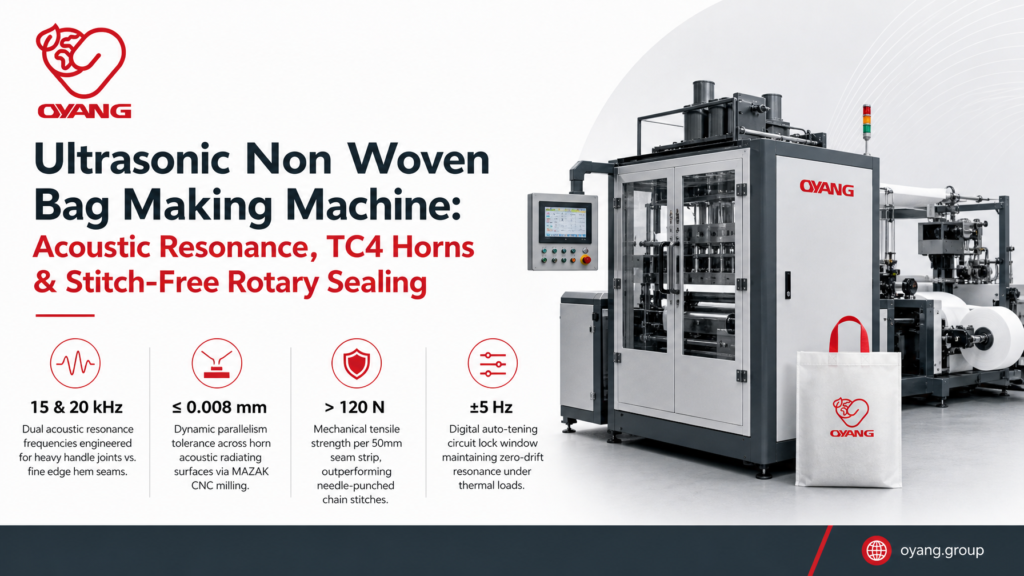
Ultrasonic Non Woven Bag Making Machine: Acoustic Resonance, TC4 Horns & Stitch-Free Rotary Sealing
An industrial ultrasonic non woven bag making machine utilizes high-frequency acoustic energy operating at 15 kHz or 20 kHz to achieve molecular thermal fusion on thermoplastic polypropylene (PP) spunbond fibers in under 0.15 seconds without needles, sewing threads, or chemical glues. By combining digital automatic frequency-tracking generators, TC4 aviation-grade titanium alloy horns machined to flatness tolerances of ≤ 0.008mm, and hardened rotary engraving anvils, modern ultrasonic sealing lines deliver seam tensile strengths exceeding 120 N/50mm while eliminating burn-through on lightweight 30–120 g/m² nonwovens running at linear converting speeds up to 120 m/min.
Dual acoustic resonance frequencies engineered for heavy handle joints vs. fine edge hem seams.
Dynamic parallelism tolerance across horn acoustic radiating surfaces via MAZAK CNC milling.
Mechanical tensile strength per 50mm seam strip, outperforming needle-punched chain stitches.
Digital auto-tuning circuit lock window maintaining zero-drift resonance under thermal loads.
Acoustic Molecular Fusion: The Mechanical Physics of Needle-Free Sealing
Unlike thermal conduction sealing (which applies continuous external heat blocks that scorch and stiffen synthetic polymers), ultrasonic conversion relies on localized frictional energy dissipation. When high-frequency mechanical micro-vibrations are transferred into polypropylene nonwovens, energy concentrates precisely at the contact peaks of the embossing anvil roller.
1. Piezoelectric Conversion in PZT-8 Transducer Stacks
The ultrasonic generator converts 220V 50/60Hz alternating current into high-voltage high-frequency electrical oscillations. This signal enters the transducer assembly, consisting of axially pre-stressed PZT-8 lead zirconate titanate piezoelectric ceramic rings. Through the inverse piezoelectric effect, electrical oscillations transform into longitudinal mechanical vibrations. An acoustic booster (typically fabricated from high-tensile 7075-T6 aluminum or titanium) multiplies the mechanical amplitude by a calculated ratio of 1:1.5 to 1:2.0, delivering a peak-to-peak amplitude of 18μm to 35μm to the working face of the horn.
2. Intermolecular Friction & Immediate Polymer Bond
As the vibrating horn compresses the fabric layers against the hardened pattern roller at dynamic pressures of 0.3 to 0.6 MPa, ultrasonic compressional waves induce high-frequency shear strain within the semi-crystalline PP fiber chains. The intermolecular and interfacial friction elevates localized temperatures above the melting point of polypropylene (160°C–165°C) within 80 to 150 milliseconds. When the sonic pulse ceases, the molten polymer cools instantaneously under pneumatic hold-down, forming a continuous recrystallized molecular bond without thermal embrittlement.
15 kHz vs. 20 kHz Systems: Acoustic Selection Matrix
A persistent operational flaw in nonwoven bag plants is deploying mismatched acoustic frequencies for distinct bag converting zones. Machine converters must match generator frequency to physical material thickness and joint surface area:
| Engineering Characteristic | 15 kHz Acoustic System | 20 kHz Acoustic System | Operational Recommendation |
|---|---|---|---|
| Resonant Wavelength ($$\lambda$$) | ~340 mm in titanium alloy | ~255 mm in titanium alloy | 15 kHz allows larger single horn frontal face |
| Maximum Effective Horn Width | 180 mm to 220 mm continuous span | 50 mm to 120 mm modular width | 15 kHz required for wide gusset & bottom folds |
| Continuous Power Output | 2,600W – 3,200W Heavy-duty | 1,200W – 2,000W Precision | 15 kHz handles 4–6 fabric layers at handle lugs |
| Acoustic Displacement Amplitude | 25μm to 35μm (High shear force) | 14μm to 22μm (Fine detail) | 20 kHz prevents burning on 30–50 g/m² webs |
| Primary Converting Function | Heavy handle welding, 3D box bottom sealing | Rotary continuous seam sewing, edge hemming | Hybrid plants install both system tiers |
Acoustic Horn Metallurgy: Aerospace TC4 Titanium vs. Cr12MoV Die Steel
The ultrasonic horn (sonotrode) acts as a resonant waveguide operating in high-cycle mechanical fatigue. Premature horn failures directly dictate machine downtime and erratic seam delamination:
| Metallurgical Property | Aerospace Grade TC4 (Ti-6Al-4V) | Cr12MoV / D2 Cold Work Die Steel | Engineering Consequence |
|---|---|---|---|
| Acoustic Velocity ($$c$$) | 5,070 m/s (High transmission efficiency) | 5,180 m/s (High internal attenuation) | Titanium runs 25°C cooler during 24-hr shifts |
| Mechanical Quality Factor ($$Q_m$$) | > 1,800 (Minimal energy loss) | < 600 (High internal hysteresis damping) | Steel horns convert acoustic power into parasitic heat |
| Yield Strength ($$\sigma_y$$) | 880 MPa (Extreme fatigue limit) | 1,500 MPa (Brittle under cyclic tension) | Steel horns suffer micro-cracking at node radii |
| Surface Wear Resistance | Moderate (Requires nitriding / carbide coat) | High (HRC 58–62 surface hardness) | Steel lasts longer under continuous abrasive contact |
| Manufacturing Flatness Tolerance | ≤ 0.008mm (MAZAK 5-Axis CNC) | ≤ 0.020mm (Standard surface grinding) | Titanium provides uniform pressure across entire web |
Rotary Pattern Roller Engineering: Contact Dynamics & Relief Geometry
In continuous ultrasonic sewing machines and automatic bag line rotary sealers, the pattern anvil roller (花轮) dictates seam aesthetic quality, shear strength, and edge trimming precision:
- Tooth-to-Land Relief Ratio: The contact land area of embossing teeth must represent 28% to 35% of the total seam surface. Land ratios below 20% create excessive energy concentration, slicing the fabric rather than sealing; ratios above 45% diffuse acoustic energy, resulting in weak cold joints.
- Hardened High-Frequency Tool Steel (DC53 / GCr15): Rotary anvils undergo vacuum carburizing and cryogenic tempering to achieve a case hardness of HRC 60–63 with a case depth of 1.2mm, preventing tooth flattening under dynamic continuous nip pressures.
- Simultaneous Ultrasonic Cut & Seal Bevels: For side hems and zipper bag edges, pattern wheels integrate a dual-angle geometry: a 45° to 60° shearing knife shoulder adjacent to a 0.8mm textured stippled anvil face. This enables simultaneous fabric edge slitting and edge sealing in a single mechanical pass, yielding clean, lint-free edges without loose filaments.
- Pneumatic Micro-Balancing Cylinder Control: The rotary horn anvil assembly is held in place by dual precision low-friction pneumatic cylinders. Regulators must maintain uniform parallel downward force of 1.5 to 4.2 bar, dynamically calibrated against fabric grammage via digital proportional valves.
OYANG Auxiliary Converting & Ultrasonic Equipment Platforms
To support high-capacity converting lines and independent finishing workshops, OYANG manufactures a comprehensive suite of CE-certified ultrasonic sewing units and post-press auxiliary machines:
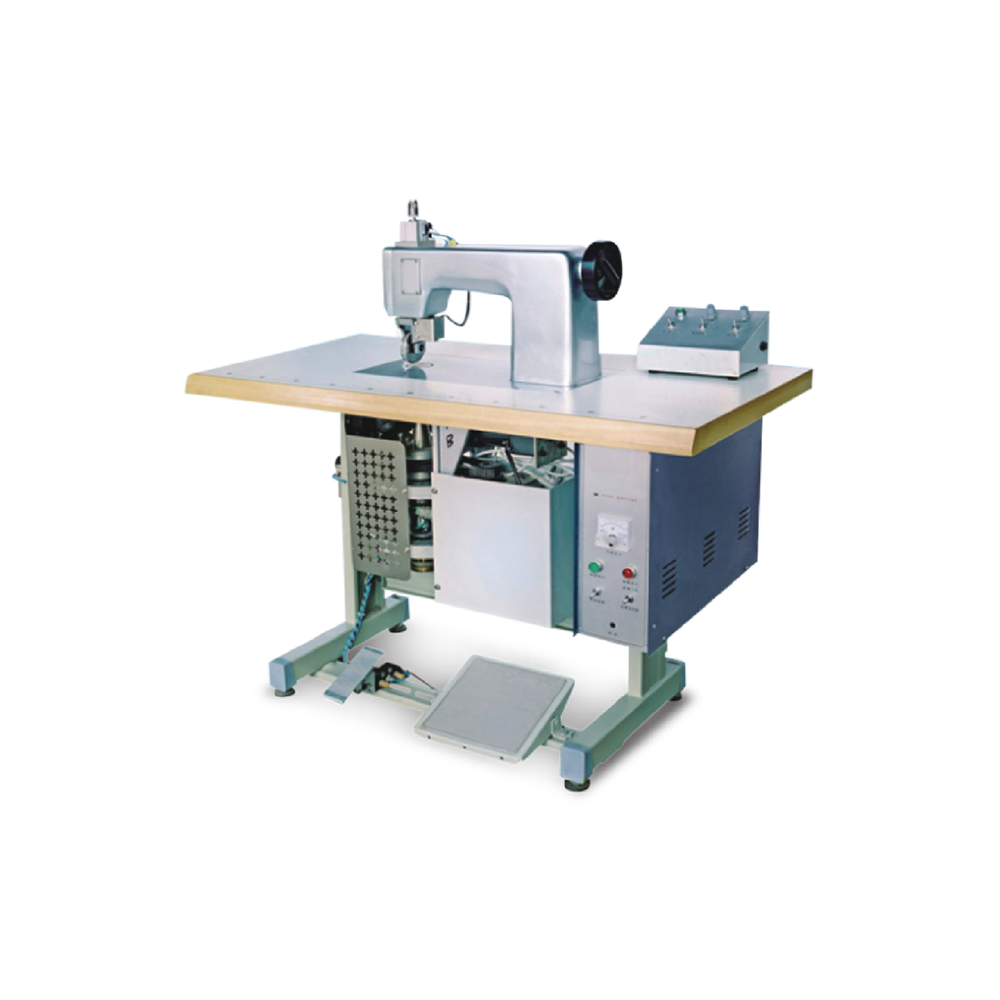
Ultrasonic Lace Sewing Machine
The industrial standard for decorative hemming, continuous edge trimming, and seam fusion on shopping bags, surgical gowns, and gift pouches.
- Operating Frequency: 20 kHz auto-tracking system
- Sewing Velocity: Up to 20 m/min continuous stitch
- Pattern Tooling: Customizable rotary pattern rollers

Soft Handle Ultrasonic Sealer (OYANG15-F700)
Dedicated workstation for welding high-strength soft loop handles onto finished D-cut or flat nonwoven bags with automated loop feeding.
- Acoustic Power: 15 kHz 2600W heavy transducer
- Cycle Speed: 25–35 handles/min
- Weld Integrity: Tensile holding capacity > 15 kg

Nonwoven Roll Slitting Machine (ONL-XE1800)
High-precision web slitter for converting master nonwoven and laminated rolls into narrow ribbons for handles, gusset piping, and bag bodies.
- Max Web Width: 1800mm parent roll capacity
- Slitting Speed: Up to 250 m/min continuous
- Tension Control: Multi-point closed-loop magnetic brake

Ultrasonic Cross-Cutting Machine (OYANG15-H)
Acoustic sheet cutting machine providing sealed, unfrayed transverse cut edges on heavy-gauge nonwovens, tablecloths, and packaging liners.
- Cut Edge Finish: Sealed acoustic fused edges (zero fraying)
- Cutting Accuracy: ±0.5mm servo length control
- Feeding System: Optical tracking with auto tension feed
Frequently Asked Questions (FAQ)
Optimize Your Factory Acoustic Sealing Systems
Eliminate weak handle joints, horn overheating, and continuous seam failures. Speak directly with OYANG acoustic engineers to configure custom rotary pattern rollers, digital ultrasonic generators, and complete auxiliary lines.
Download Auxiliary Machinery Brochure (PDF)