

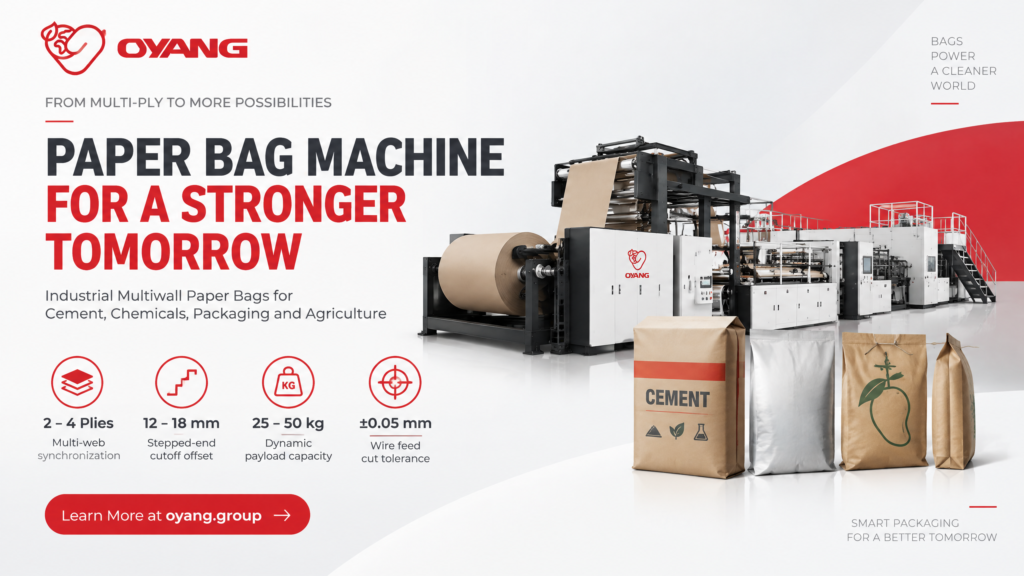
An industrial multiwall paper bag making machine (manufactured across specialized packaging sectors as a cement paper bag making machine, laminated paper bag making machine, aluminium foil paper bag making machine, or high-speed mango protection bag machine) is a heavy-duty converting system engineered to fabricate 2- to 4-ply structural sacks or specialized agricultural enclosures. For building materials like cement, dry mortar, and chemical minerals, multiwall lines convert 2 to 4 plies of high-extensible kraft paper (70 to 90 GSM per ply) using synchronized stepped-end rotary cutters that offset individual plies by 12 to 18 mm. This multi-ply overlap allows starch paste to bond every ply during bottom drum closure, creating closed-mouth valve bags capable of withstanding 25 to 50 kg dynamic drop impacts at line speeds of 120 to 180 bags/min. For agricultural agronomy, specialized protective lines incorporate continuous high-speed wire-insertion heads that synchronize, cut, and embed 0.40 to 0.55 mm galvanized tie wires into dual-ply shaded fruit bags at rates of 250 to 350 bags/min.
Industrial Multiwall Valve Sacks: Stepped-End vs. Flush-Cut Mechanics
Standard retail grocery bags rely on single-ply flush-cut tubes folded into flat or square bottoms. In contrast, heavy industrial applications—such as portland cement, plaster, and chemical resin powders—require multi-ply tubing engineered to withstand dropping from loading chutes without splitting:
- The Stepped-End Cutoff Mechanism: In a heavy-duty multiwall paper bag making machine, 2 to 4 independent paper webs travel into a stepped-cut perforating station. Independent rotary knife cylinders score each layer at staggered cross-intervals (typically spaced 12 to 18 mm apart). When high-speed draw rollers pull the web over a separation drum, each ply tears cleanly along its perforation, creating an overlapping stepped edge.
- Individual Ply Bonding (Anti-Sifting Seal): During the bottom-forming stage on a bottomer line, adhesive applicator discs apply cold starch paste across the staggered tabs. Each individual ply overlaps and bonds to its matching ply on the opposite side of the tube. This multi-ply step joint eliminates powder leakage pathways, ensuring that dense, aerated cement cannot sift through seams during road transit.
- Automatic Internal Valve Sleeving: Industrial cement sacks are sealed on both ends at the bag factory, leaving only a small corner opening (the filling valve). An automatic valve station inserts an internal kraft or polyethylene sleeve into this opening. During pneumatic packing at the cement mill, pressurized powder flows through the valve; once filled, the internal product weight pushes the flexible valve flap upward, automatically self-sealing the sack without post-fill sewing.
To understand how paper fiber elongation and high tensile energy absorption (TEA) prevent drop fractures, study our technical resource on kraft paper for paper bag making: GSM, tensile strength & bursting index guide.
Technical Benchmark: Heavy Industrial Sacks vs. Agro Fruit Protection Bags
The table below compares engineering specifications, raw material inputs, and mechanical configurations across heavy-duty industrial converting lines and high-speed agricultural protective bag machinery:
| Converting Category | Industrial Cement & Chemical Sacks (Multiwall) | Agricultural Fruit Protection Bags (Mango/Grape) |
|---|---|---|
| Substrate Structure | 2 to 4 plies: 70–90 GSM extensible kraft + HDPE / Alu-foil barrier film. | 1 to 2 plies: 38–55 GSM wet-strength kraft (outer) + black carbon paper (inner). |
| Sealing & Cutoff Style | Stepped-end rotary perforation cutoff; starch paste bottoming with valve insert. | Rotary serrated knife shear; cold water-resistant emulsion side seam. |
| Auxiliary Mechanism | Rotary needle-roller de-aeration perforator; inline valve patch applicator. | Continuous wire feeder, dual-die shear, and localized hot-melt adhesive head. |
| Rated Machine Speed | 100 – 180 bags/min (Tuber / Bottomer line) | 250 – 350 bags/min (Continuous wire inserting) |
| Primary Functional Target | 25–50 kg payload; drop-impact survival; zero moisture ingress. | UV light shading; pesticide barrier; easy manual tree branch clamping. |
For detailed insights into serrated cutoff mechanics and high-speed web handling on compact food platforms, review our technical guide on V-bottom paper bag making machines: Rotary serrated cutoff and food packaging guide.
High-Barrier Converting: Aluminum Foil & De-Aeration Micro-Perforation
Packaging hygroscopic chemicals, high-grade infant nutrition powders, and reactive mineral cements requires integrating barrier layers on an aluminium foil paper bag making machine or laminated paper bag making machine:
1. Multi-Web Unwind Tension Synchronization
Combining 3 plies of 80 GSM extensible paper with 1 ply of 7 μm aluminum foil laminated to 20 GSM PE requires precise web tension balance. Because aluminum foil has virtually zero elastic stretch (< 1.0% elongation before foil rupture) while extensible kraft elongates up to 7.0%, the tuber employs individual closed-loop servo brake motors on each reel shaft. Ultrasonic sensors measure each reel diameter, maintaining individual web tension within ±1.0 N to prevent foil delamination or paper web wrinkling.
2. De-Aeration Micro-Needle Perforation
During high-speed rotary packing at cement or chemical facilities, powder is injected under high pneumatic pressure. If trapped air cannot escape immediately, sacks balloon and burst. The multiwall tuber incorporates high-frequency rotary pin rollers that create 18 to 28 micro-perforations per cm2 (hole diameter 0.15 to 0.25 mm) through the kraft plies. In foil-barrier sacks, these perforations are staggered beneath overlapping unperforated plies, creating a tortuous labyrinth path that allows air to vent while maintaining an effective moisture barrier.
For deeper insight into how continuous web feeds, draw rollers, and rotary knives synchronize mechanically, review our foundational guide on how does a paper bag machine work: Mechanics and workflow.
Specialized Agro Mechanics: Continuous Wire-Insertion in Mango Protection Bag Machines
Agricultural fruit growing requires specialized protective enclosures to shield fruit from sunburn, insect stings, and pesticide residue. Operating a mango protection bag machine presents unique mechanical engineering challenges:
- Substrate Combination (Wet-Strength & Shading Paper): Fruit bags combine an outer sheet of 40 to 50 GSM wet-strength kraft (treated with water-repellent wax or sizing to survive orchard rainfall) with an inner ply of black carbon paper that completely blocks UV light, accelerating even fruit skin coloration.
- Continuous Wire-Feeding Kinematics: Farmers secure bags around fruit stems by hand-twisting an embedded metal wire. The machine must continuously uncoil 0.40 to 0.55 mm annealed galvanized tie wire from a master spool, straighten it through a 7-roller straightening fixture, and advance it across an intermittent servo draw wheel.
- High-Speed Die Shearing & Hot-Melt Tack: At cycle speeds of 300 bags/min (5 cycles per second), a dual-action mechanical cutter shears the wire to an exact 75 to 90 mm length. A high-speed hot-melt glue applicator dispenses a 0.2 g micro-dot, immediately sandwiching the wire between the paper collar and a reinforcing paper tab. A pneumatic compression clamp chills the bond within 0.15 seconds, ensuring the wire cannot shift or puncture adjacent bags in transit.
Machinery Selection & CapEx Investment Benchmarks
The table below outlines technical specifications and factory-direct price ranges for industrial multiwall and agricultural converting platforms:
| Machine Series | Converting Capabilities | Rated Output Speed | Connected Power | FOB Factory Price |
|---|---|---|---|---|
| OYANG-MB300 Agro Protection Bag Line | 1–2 Ply fruit protection bags (mango/grape) with inline wire inserting | 250 – 350 bags/min | 7.5 – 11.0 kW | $24,000 – $36,000 USD |
| OYANG-HDT4 Multiwall Stepped-End Tuber | 2–4 Ply extensible kraft tube forming with stepped-cut and micro-perforator | 120 – 180 tubes/min | 35.0 – 48.0 kW | $145,000 – $195,000 USD |
| OYANG-HDB2 Industrial Valve Bottomer Line | Automatic square-end bottom folding, valve sleeve inserting, and cover pasting | 100 – 140 bags/min | 42.0 – 58.0 kW | $185,000 – $265,000 USD |
| OYANG-HD Turnkey Plant Complete Valve Cement Line | Synchronized Tuber + Valve Bottomer + Automated Palletizing conveyor | 120 – 150 bags/min | 85.0 – 110.0 kW | $340,000 – $460,000 USD |
To budget ocean freight rates, wooden container crating, customs tariffs, and air compressor sizing, review our capital guide on how much does a paper bag making machine cost: Landed CapEx analysis.
Precision Manufacturing: Built for High-Load Converting
Pulling up to 4 heavy paper reels simultaneously generates substantial cantilever forces on machine side frames. Substandard machinery built with welded steel channels flexes under dynamic tension, causing web alignment shift and uneven glue laydown.
OYANG eliminates mechanical deflection by casting all side panels and structural frames from HT250 gray cast iron, stress-relieved and finished on Japanese MAZAK and OKUMA 5-axis CNC machining centers to a flatness tolerance of ≤ 0.015 mm. This structural rigidity maintains precision stepped-cut knife clearances and smooth draw roller rotation across high-tonnage multiwall converting runs.
Related Technical Guides & Converting Resources
- → Kraft Paper for Paper Bag Making: GSM, Tensile Strength & Bursting Index Guide: Structural testing benchmarks, fiber orientation, and mechanical parameters for converting.
- → V-Bottom Paper Bag Making Machine: Food Packaging Guide: Technical analysis of rotary serrated cut-off knives, greaseproof substrate handling, and high-speed bakery pouches.
- → How Much Does a Paper Bag Making Machine Cost?: Granular financial breakdown covering FOB factory costs, container shipping rates, import duties, and ancillary compressor sizing.
- → How Does a Paper Bag Machine Work? Mechanics & Workflow: Kinematic breakdown of roll unwinding, continuous tube formation, and rotary bottom folding.
Frequently Asked Questions (FAQ)
What is a stepped-end cutoff mechanism on a multiwall paper bag machine?
A stepped-end cutoff mechanism uses staggered rotary scoring knives to cut each ply of a multiwall tube at offsets of 12 to 18 mm. This creates an overlapping step joint where each individual kraft ply is bonded to its corresponding ply with cold starch adhesive during bottom formation, eliminating powder sifting pathways in cement and chemical bags.
How does an agro fruit protection bag machine insert tie wires at high speeds?
An agricultural fruit bag machine uses an intermittent servo wire-feed mechanism that straightens 0.40 to 0.55 mm galvanized wire from a spool, shears it to length via dual-action mechanical dies, and deposits it across the bag collar. A micro-hot-melt applicator bonds the wire under a paper reinforcing patch at speeds up to 350 bags per minute.
Why is de-aeration perforation necessary for heavy industrial valve sacks?
During high-speed pneumatic filling of fine powders like cement, air is pumped into the bag along with the product. Without micro-perforations (18 to 28 holes per cm²), trapped air causes sacks to balloon and burst. Micro-perforations allow pneumatic air to escape rapidly while retaining dense powder within the sack.
What is the typical investment cost for an industrial multiwall valve bag manufacturing plant?
A standalone stepped-end tuber costs between $145,000 and $195,000 USD (FOB), while an automatic valve bottoming line ranges from $185,000 to $265,000 USD. A complete turnkey multiwall production line capable of producing 25 to 50 kg cement sacks ranges from $340,000 to $460,000 USD. In contrast, high-speed agricultural fruit protection bag machines range from $24,000 to $36,000 USD.