

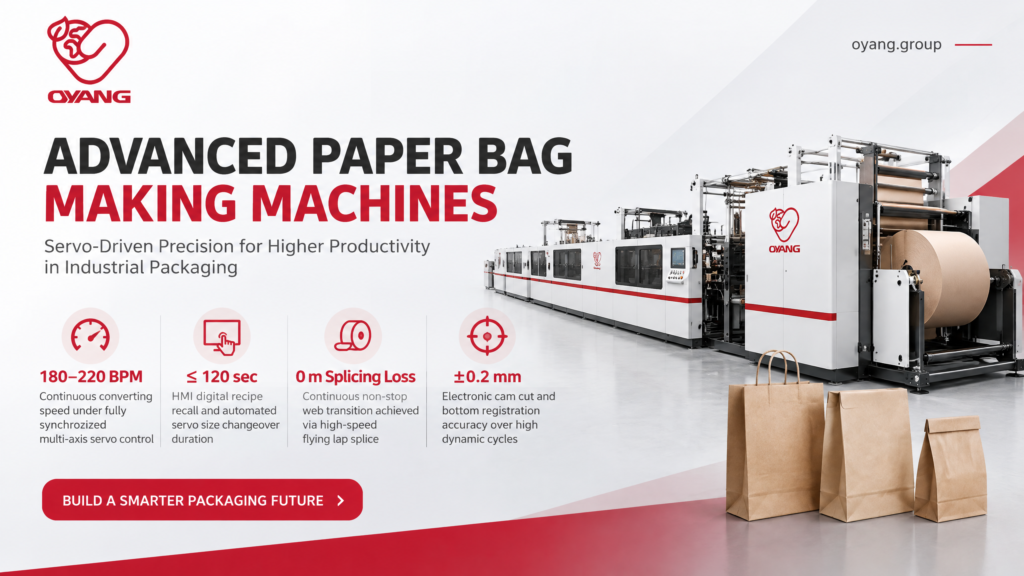
A modern automatic paper bag making machine (also engineered across industrial packaging plants as a fully automatic paper bag making machine, automatic paper bag machine, or paper bag machine automatic) integrates a multi-axis servo bus topology that eliminates mechanical line-shaft backlash and gear wear. High-output converting systems like the OYANG TECH-18 and SMART-17 coordinate 16 to 24 independent servo axes over real-time industrial Ethernet (EtherCAT/Profinet). Featuring dual-arm turret unwinds with non-stop zero-speed or flying splicing, closed-loop ultrasonic edge position control (EPC), and electronic camming (E-Cam), this fully automatic bag making machine architecture sustains continuous production speeds of 180 to 220 bags per minute while holding tube length cutoff tolerances to ±0.2 mm and maintaining line Overall Equipment Effectiveness (OEE) above 90%.
Mechatronic Architecture: Multi-Axis Bus Topology vs. Line-Shaft Drives
Legacy converting lines rely on a central AC motor driving an extended mechanical line shaft coupled through bevel gearboxes, chains, and splined drive shafts. Over operating cycles exceeding 10,000 hours, progressive gear-tooth backlash and chain elongation create torsional play across the machine frame. At speeds above 120 BPM, this mechanical lag causes registration hunting, tube cutoff drift, and asymmetrical bottom flaps.
An advanced fully automatic paper bag manufacturing machine replaces mechanical line shafts with an all-servo distributed drive network. In OYANG high-capacity platforms, an industrial motion controller coordinates 16 to 24 independent servo drives via high-speed EtherCAT or Profinet fieldbus at communication cycle times below 1.0 millisecond.
Each functional station—including unwinding tension, rotary perforation, draw rollers, flying shears, bottom-opening fingers, and glue transfer wheels—operates under independent servo control. Kinematic coordination relies on software-driven electronic cam (E-Cam) curves. Operators adjust bag length, bottom width, or registration offset directly on the touchscreen HMI, triggering automated multi-axis repositioning without manual gear swapping. For a comprehensive factory infrastructure setup roadmap, consult our guide on which machine is used to make paper bags: Factory setup guide.
Continuous Web Control: Non-Stop Flying Splicing & Ultrasonic EPC
In high-speed bag manufacturing, line stoppages for jumbo roll changeovers degrade overall plant OEE. Shutting down, threading a new roll, and re-accelerating a paper bag automatic machine can consume 15 to 20 minutes and generate 30 to 50 meters of wasted paper. Continuous high-volume platforms address this with two automated web-handling systems:
1. Automated Turret Unwind & High-Speed Flying Splicer
Dual-station rotary unwinds hold the active converting roll and a prepared standby roll. As the active roll reaches its minimum core diameter, surface accelerometers match the standby roll’s surface speed to the web line velocity. A pneumatic nip arm presses the prepared adhesive tape leader onto the running web while a serrated flying knife severs the expiring tail in under 0.05 seconds. The entire splice occurs at line speeds up to 180 m/min without stopping the machine, keeping web tension transients within ±5% via dancer arm feedback.
2. High-Frequency Closed-Loop Ultrasonic Web Guiding (EPC)
Web wander during master reel unwinding causes side-glue flap variations and uneven gusset depths. The OYANG automated unwind uses high-frequency ultrasonic edge sensors (sampling rate ≥ 200 Hz) that detect lateral web deviations of ±0.05 mm regardless of paper dust or web transparency. The sensor output drives a linear ball-screw steering frame powered by a dedicated brushless DC servo, correcting lateral tracking errors within 50 milliseconds before the web enters the longitudinal creasing section.
Engineering Video: TECH-18 Two-Minute Automated Size Changeover Kinematics
Observe how multi-axis servo positioning automatically recalibrates the forming mandrel, draw nip rollers, and bottom-forming stations on the OYANG TECH-18 converting line:
Video 1: Touchscreen recipe selection and automated servo dimension changeover on the OYANG TECH-18 platform.
Field Engineering Diagnosis: Troubleshooting Automated Line Mechatronics
High-speed servo-driven converting lines require precise synchronization between electrical and mechanical subsystems. Use this workshop diagnostic matrix to address common automation faults:
| Automation Fault | Root Electrical / Kinematic Cause | Standard Workshop Calibration Protocol |
|---|---|---|
| Cutoff Length Register Drift (> 1.0 mm) | Optical print mark sensor lens fouled by paper dust; registration mark search window gate misaligned in PLC cam program. | Clean optical sensor optics; narrow registration sensor gate to ±5 mm of expected mark position; recalibrate servo electronic gear ratio. |
| Web Break During Flying Splice | Speed mismatch between expiring roll surface and incoming roll; splice dancer arm pneumatic damping too stiff. | Verify diameter sensor calibration; reduce dancer air pressure by 0.1 MPa to absorb splice impact; confirm pre-splice tape tack. |
| Bottom Drum Phase Mismatch / Jam | EtherCAT network jitter exceeding 250 μs; absolute encoder coupling slippage on bottom drum drive shaft. | Check industrial Ethernet cable shielding; tighten encoder clamping ring to specified torque (4.5 N·m); zero-reference the bottom drum cam. |
| EPC Guiding Hunting / Oscillation | Ultrasonic sensor gain loop set too high; mechanical backlash in guide frame ball screw. | Lower PID controller proportional gain ($$K_p$$) by 15%; verify ball screw nut pre-load and lubricate guide tracks. |
Fully Automatic vs. Semi-Automatic Paper Bag Lines: Technical Comparison
When specifying machinery for high-volume converting facilities, technical teams should evaluate automation levels against line OEE, changeover agility, and labor efficiency:
| Technical Parameter | Fully Automatic Line (TECH-18 / SMART-17) | Semi-Automatic Converting Line (OYANG 16B) |
|---|---|---|
| Motion Control Architecture | 16–24 Axis Real-Time Fieldbus (EtherCAT) | Central line-shaft drive with auxiliary servos |
| Changeover Duration | ≤ 2 minutes (Automated digital recipe recall) | 45 – 90 minutes (Manual tool & gear adjustment) |
| Unwind Splicing Technology | Non-stop automatic flying/zero-speed splice | Manual reel change with complete line stoppage |
| Continuous Production Output | 180 – 220 bags/min | 80 – 120 bags/min |
| Inline Quality Detection | Vision inspection for glue track, tear, and register | Periodic manual operator sampling |
| Operating Labor Required | 1 operator per 2 lines (Highly automated) | 2 – 3 dedicated operators per line |
OYANG Automated Flagships: TECH-18 and SMART-17
Operating multi-axis electronic camming at 220 cycles per minute generates alternating mechanical accelerations across the machine frame. Lightweight welded steel frames are prone to high-frequency micro-vibrations, leading to registration error and bearing fatigue. All OYANG wall panels and base beds are cast from high-density HT250 gray cast iron, pre-aged to relieve residual internal stresses, and precision-machined in climate-controlled MAZAK and OKUMA 5-axis CNC machining centers to ensure alignment tolerances within ≤ 0.015 mm:
1. TECH-18: Automated Size Changeover Paper Bag Machine
The TECH-18 Auto Size Change Paper Bag Machine sets the industry standard for high-mix, high-volume converting. Powered by intelligent digital recipe management, operators can reconfigure tube width, cut length, and bottom dimensions in under 2 minutes. The platform achieves continuous production speeds up to 180 bags/min with full multi-axis servo synchronization.

Figure 1: The OYANG TECH-18 fully automated paper bag converting platform.
2. SMART-17: High-Speed SOS Production Line (Up to 220 Bags/Min)
The SMART-17 High-Speed Paper Bag Production Line is engineered for dedicated mass-volume manufacturing. Built with reinforced cast-iron side walls and a high-speed rotary bottom drum, the SMART-17 achieves steady-state converting speeds of 180 to 220 bags/min, providing high throughput for large retail and food packaging programs.

Figure 2: The OYANG SMART-17 high-output continuous bag line.
For plant managers designing industrial facilities and evaluating line payback, refer to our comprehensive guide on paper bag manufacturing business setup and ROI analysis.
To train technical personnel on real-time tension calibration and inline flexo synchronization, review our practical operational procedures in how to operate a paper bag machine with inline printing.
To eliminate end-of-line collection bottlenecks when running at 220 bags/min, integrate your converting line with our automatic bag packing line: BP500 bundling system for automated stacking and strapping.
Related Technical Guides & Converting Resources
- → Which Machine Is Used to Make Paper Bags? Setup Guide: Complete plant infrastructure guide, power distribution layout, and pneumatic sizing for automated converting lines.
- → Paper Bag Manufacturing Business Setup & ROI Guide: CapEx modeling, break-even timelines, and factory footprint design for high-speed automated machinery.
- → How to Operate a Paper Bag Machine & Inline Printing: Shop-floor setup guide covering master web threading, viscosity management, and electronic camming synchronization.
- → Automatic Bag Packing Line: BP500 & Bundling: Eliminate end-of-line bottlenecks on 220 BPM bag lines with automatic counting, secondary poly-bagging, and bundling.
Frequently Asked Questions (FAQ)
What distinguishes a fully automatic paper bag making machine from a mechanical line-shaft machine?
A fully automatic machine replaces mechanical drive shafts, chains, and change gears with a distributed multi-axis servo bus system coordinated by a high-speed motion controller. Stations communicate over real-time industrial Ethernet (EtherCAT/Profinet), allowing digital recipe recall, electronic cam synchronization, and size changeovers in under 2 minutes.
How does non-stop flying splicing improve converting plant OEE?
Conventional roll changes require stopping the converting line, leading to 15 to 20 minutes of downtime and up to 50 meters of wasted paper during restart. An automatic dual-turret flying splicer matches the new roll’s surface speed to line velocity and completes the splice on-the-fly, eliminating changeover stops and keeping overall plant OEE above 90%.
What role does ultrasonic edge position control (EPC) play during continuous operation?
Ultrasonic EPC sensors continuously monitor web edge alignment at high sampling frequencies (≥ 200 Hz). The system detects lateral web deviations down to ±0.05 mm and guides the unwind frame via a servo-driven linear ball screw, ensuring consistent tube creasing and side-glue positioning even with telescoping master reels.
How fast can format sizes be changed on an automatic paper bag machine?
On advanced servo-driven platforms like the OYANG TECH-18, common size changeovers take under 2 minutes. Operators enter new bag parameters on the touchscreen HMI, and motorized servo actuators automatically reposition forming plates, cutoff knives, and bottom opening fingers to their programmed coordinates.