350x97.png)
350x97.png)
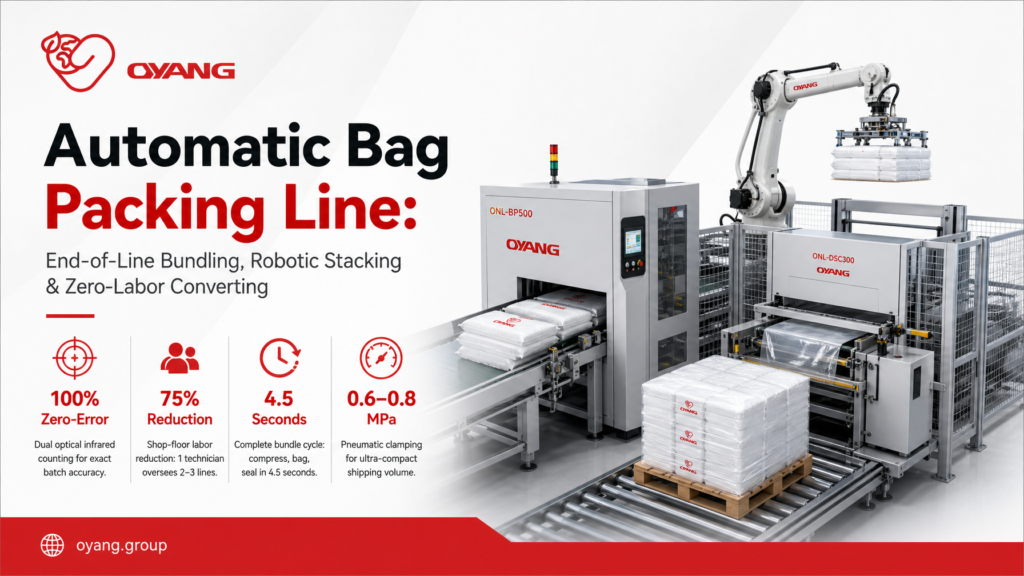
Automatic Bag Packing Line: End-of-Line Bundling, Robotic Stacking & Zero-Labor Converting
An integrated automatic bag packing line (incorporating the OYANG ONL-BP500 bagging machine and ONL-DSC300 bundling line) eliminates the critical end-of-line packaging bottleneck where high-speed bag machines running at 80–100 bags/min overwhelm manual packing labor. By synchronizing optical batch counting, pneumatic compression tamping, servo-driven bundle transfer, and automatic polybag sealing into a continuous 4.5-second packing cycle, this automated system reduces packaging labor requirements from 3–4 operators down to 0.5 operators per machine cell, guaranteeing 100% counting accuracy for bulk wholesale distribution.
Dual optical infrared counting eliminates manual pack discrepancies (25/50/100 batch preset).
Shop-floor labor reduction: 1 roving technician oversees 2 to 3 fully automated converting lines.
Complete bundle cycle: compression tamping, polythene sleeve insertion, and thermal trim-sealing.
Pneumatic hydraulic clamping pressure purging air pockets for ultra-compact shipping volume.
The Shop-Floor Bottleneck: Why Manual End-of-Line Kills Factory OEE
In modern flexible and nonwoven packaging converting facilities, capital investment has historically prioritized front-end machinery speed. Modern machines (such as the OYANG 16S, TECH 23, or SMART-17) consistently eject 1.3 to 1.7 bags every second. However, manual post-converting workflows create an operational bottleneck:
1. Manual Tally Drift & Wholesale Rejections
Fatigued manual operators collecting bags from delivery belts suffer mental counting drift after just 45 minutes of shift work. Preset 50-count retail packs frequently ship with 48 or 52 bags. Large retail distribution networks impose severe financial chargebacks and order rejections when receiving audit miscounts. Automated optical gate sensors detect bag lead edges dynamically, guaranteeing exact stack counts before release.
2. Inherent Bulkiness & Shipping Container Inefficiencies
Nonwoven box bags, loop-handle retail carriers, and paper grocery sacks trap air within their interior gussets. Manual packing cannot generate sufficient compression force to purge this air. Consequently, uncompressed bundles expand loosely inside shipping cartons, forcing factories to purchase oversize corrugated boxes and pay up to 28% higher ocean freight expenses per million bags shipped.
3. Labor Churn and Upstream Forced Throttling
When an end-of-line operator steps away for bundle strapping, tape replacement, or pallet staging, completed bags accumulate and jam the delivery belts within 60 seconds. Plant managers routinely force machine operators to throttle line speeds down from 100 bags/min to 60 bags/min simply so packing labor can keep pace, wiping out the Capex advantage of high-speed converting machinery.
End-of-Line Labor & Economic Model: Manual Packing vs. OYANG Automated Line
The operational cost calculation demonstrates an accelerated payback period when replacing manual collection benches with an inline OYANG automated packaging cell (calculating a two-shift facility running 16 hours/day, 300 days/year, producing 24 million bags annually):
| Operational Metric | Manual Packaging Table Setup | OYANG Automated Packing Cell (BP500 + DSC300) | Annual Economic Impact |
|---|---|---|---|
| Direct Headcount per Line | 3 to 4 Operators (Counting, folding, taping) | 0.5 Operator (1 roving operator per 2 lines) | Saves 3 FTE technicians per cell |
| Annual Labor Overhead | $36,000 – $48,000 USD (@ $1,000/mo/worker) | $6,000 USD (Shared technician allocation) | -$30,000 to -$42,000 USD saved yearly |
| Average Machine Speed Realized | 60–75 bags/min (Throttled for workers) | 90–100 bags/min (Full mechanical rated speed) | +33% Output capacity expansion |
| Outer Packing Film / Box Volume | Standard bulky pack (Loose air volume) | Compressed flat bundle (Pneumatic purged) | 18%–25% Ocean freight savings |
| Counting Error Margin | ±2% Discrepancy rate | 0.00% Defect rate (Optical verification) | Zero customer chargeback penalties |
| Equipment Payback Period | N/A (Sunk operational expense) | 8.5 to 11.2 Months | Rapid ROI with lasting margin gain |
Integrated Mechanical Workflow: The 4-Stage Automated Sequence
The OYANG automated end-of-line packaging architecture operates on a deterministic, PLC-synchronized mechanical cycle that mounts directly to the outfeed conveyor of the host bag making machine:
- Dynamic High-Speed Optical Counting & Intermittent Shingling: Finished bags exiting the ultrasonic side-weld or bottom-fold station pass through dual polarized retro-reflective laser sensors. The PLC tracks individual bag edges. Upon reaching the programmed target count (e.g., exactly 50 units), a pneumatic diverter gate indexes instantly, shingling the completed stack onto a secondary accumulation indexer without interrupting the upstream continuous flow.
- Multi-Axis Pneumatic Tamping & Compression Squaring: The gathered bag stack moves into the squaring hopper. Four-sided pneumatic alignment tampers square the bag edges, while a heavy vertical pneumatic press descends under 0.6 MPa pressure. This purges air pockets from within the folded gussets, reducing the vertical bundle height by 40% to 55%.
- Servo-Driven Bundle Insertion & Polythene Bagging (ONL-BP500): A dual-gripper servo pusher arm drives the compressed stack into the bagging zone. The ONL-BP500 automatically dispenses a roll-fed PE outer film sleeve, opens the bag mouth via vacuum suction cups, slides the compacted nonwoven bundle inside, and seals the package via a precision impulse heat-wire cutter.
- Automatic Cross-Strapping & Case Bundling (ONL-DSC300): The sealed poly-pack travels across the powered transition conveyor into the ONL-DSC300 automated strapping module. Tension-monitored polypropylene (PP) strapping bands are tensioned, heat-welded, and cut around the bundle in single or parallel cross configurations, preparing the packs for automated robotic palletizing.
OYANG End-of-Line & Auxiliary Converting Machinery
To eliminate labor overhead and streamline packaging operations, OYANG manufactures a comprehensive suite of CE-certified auxiliary packaging lines and hydraulic punching systems:

ONL-BP500 Automatic Bagging Machine
Industrial automatic packaging unit designed to sleeve and seal stacked bags into outer protective polybags. Features auto-film feeding, vacuum opening, and impulse thermal sealing.
- Packaging Speed: 8–15 bundles/min
- Bundle Capacity: Stacks of 20 to 100 bags
- Control Interface: Siemens PLC with color touchscreen HMI

ONL-DSC300 Automatic Bag Packing Line
Complete heavy-duty end-of-line packaging cell integrating stack compression, continuous belt transfer, and high-speed automated strapping for large logistics orders.
- System Integration: Inline connection to all OYANG bag machines
- Strapping Material: Polypropylene (PP) packaging strap
- Pneumatic Squaring: 4-direction alignment before bundling

ONL-DSC350 Bag Bundling Packing Machine
Compact, semi-automatic compression and strapping unit ideal for space-constrained workshops or multi-machine manual feeding configurations.
- Footprint: Compact modular frame on locking casters
- Strapping Velocity: 1.5 seconds per strap cycle
- Clamping Force: Adjustable pneumatic down-clamp

Automatic T-Shirt Bag Punching Machine
High-capacity hydraulic punch unit for cutting U-cut / W-cut handles on stacked nonwoven shopping bags with automated optical stack feeding.
- Cycle Speed: Up to 30 punch strokes/min
- Hydraulic Force: 10-Ton rigid mechanical frame
- Safety System: Infrared dual light curtains + two-hand tie down
Video Demonstration: Automated Bag Handling & Packaging in Motion
Frequently Asked Questions (FAQ)
Automate Your Packaging Line & Eliminate Labor Bottlenecks
Stop throttling your converting machinery due to packing delays. Speak with OYANG automation engineers to design a fully integrated end-of-line stacking, punching, and bundling solution customized for your factory layout.
Download Auxiliary Machinery Brochure (PDF)