

Engineered to eliminate web snapping, micro-pinholing, and toxic solvent entrapment on brittle 20–25 μm hard-temper PTP blister foils, OYANG’s automatic pharmaceutical aluminum foil printing machine integrates ultra-low-friction air-bearing dancer tension loops (±0.8 N dynamic stability) with Electronic Line Shaft (ELS) direct-drive servos. Operating at production speeds up to 300 m/min, this industrial aluminum foil printing machine executes multi-color graphics, reverse-side OP (Over-Print) protective priming, and bottom HSL (Heat-Seal Lacquering) in a continuous pass, holding color registration strictly within ±0.05 mm while suppressing retained solvent levels below 3.0 mg/m².
Industrial Rotary Press vs. Commercial Foil Fuser Machine: Technical Demarcation
Procurement directors in barrier packaging must clearly differentiate between heavy-duty industrial converting machinery and commercial post-press equipment:
- Industrial Rotogravure Aluminum Foil Press: A multi-ton, web-fed continuous production line engineered to process raw aluminum alloy coils (Alloy 8011-H18 hard foil, 8021-O cold-form barrier, 1235 flexible laminates) across 600 mm to 1300 mm master web widths. It incorporates ATEX/LEL explosion-proof drying systems, solvent-recovery conduits, and inline lacquering stations compliant with international pharmaceutical GMP standards.
- Commercial Foil Fuser Machine: A compact sheet-fed tabletop unit designed for digital copy centers and craft embellishment. A foil fuser machine uses heated rubber rollers to adhere metallic toner foils to toner-printed digital sheets. It cannot process raw metal coils, lacks tension decoupling, provides zero chemical barrier lacquering, and is mechanically incapable of industrial flexible packaging conversion.
Web-Handling Mechanics: Overcoming the Zero-Plasticity Threshold of PTP Blister Foil
Unlike thermoplastic films that stretch under tensile pull, pharmaceutical blister lidding foil (Alloy 8011, temper H18, 20–25 μm) possesses a tensile elongation of less than 2.5%. Any sudden micro-spike in line torque will instantly fracture the foil web, causing catastrophic breaks and extensive oven re-threading downtime on an aluminium foil printing machine.
1. Frictionless Dancer Tension Decoupling (≤ ±0.8 N Stability)
Every print station operates with dynamically balanced, low-inertia aluminum idler rollers (surface hardness ≥ HV800, dynamic unbalance ≤ 0.3 g·mm) suspended on ultra-sensitive air-bearing pneumatic cylinders. Paired with independent digital servo infeed nips, this architecture decouples turret unwind reel inertia from the impression nip, restricting running tension drift within ±0.8 N across entire roll diameters.
2. Controlled Impression Deflection & Pinhole Mitigation
Subjecting unsupported bare foil to excessive or uneven nip loading shears the microscopic grain structure of the aluminum, creating light-permeable micro-pinholes that destroy moisture and oxygen barrier properties. OYANG presses maintain linear pneumatic contact calibrated between 10 and 18 N/mm via high-durometer (80–85 Shore A) synthetic rubber impression rollers. Total deflection across the 1000 mm cylinder face is held to ≤ 0.010 mm, ensuring ink release without micro-cracking the metal matrix.
3. GMP-Compliant Solvent Extraction (≤ 3.0 mg/m²)
Regulated pharmaceutical blister converting enforces strict volatile organic compound (VOC) residual caps. OYANG drying tunnels utilize aerodynamically balanced 3D nozzle arrays discharging heated fresh air at 35–42 m/s. This turbulence sweeps away boundary solvent layers instantly, driving total retained solvent down to ≤ 3.0 mg/m²—surpassing the strict 5.0 mg/m² international pharmacopeia benchmark.
Substrate Physics & Mechanical Control Specifications
| Substrate Grade | Alloy & Caliper Range | Calibrated Tension Band | Drying Air Velocity | Target Conversion Benchmark |
|---|---|---|---|---|
| Pharma PTP Blister Foil | Alloy 8011-H18 (20 – 25 μm) | 25 – 40 N/m web | 35 – 42 m/s (≤ 75°C) | Zero web snap; pinhole count ≤ 1/m²; solvent ≤ 3.0 mg/m² |
| Cold-Form Blister Foil | Alloy 8021-O (45 – 55 μm) | 40 – 65 N/m web | 30 – 38 m/s (≤ 65°C) | Zero creasing; bond lamination strength ≥ 4.5 N/15mm |
| Dairy Cup Lidding Foil | Alloy 8011-O/H14 (30 – 38 μm) | 30 – 50 N/m web | 32 – 40 m/s (≤ 80°C) | Food-grade odor-free drying; heat-seal peel force ≥ 10 N/15mm |
| High-Barrier Retort Foil | Alloy 1235 (7 – 9 μm laminated) | 50 – 75 N/m web | 35 – 45 m/s (≤ 85°C) | Zero delamination under 135°C retort sterilization cycles |
Procurement Analysis: Key Factors Determining Aluminium Foil Printing Machine Price
Evaluating quotes for an aluminium foil printing machine price requires analyzing structural line engineering against production waste and yield metrics rather than basic nameplate speed:
- ELS Direct Servo vs. Line-Shaft Drive: Electronic Line Shaft systems require a 20–35% higher initial investment but slash start-up substrate scrap from 250 meters to under 35 meters per job change, delivering full capital recovery inside 14 months on high-cost aluminum coil stock.
- Dual-Sided Functional Coating Units: Integrating high-precision reverse-gravure coater decks for heat-seal lacquers (HSL coating weight 4.0–6.0 g/m² ± 0.2 g/m²) consolidates printing and lacquering into a single workflow, eliminating secondary offline coating lines.
- 100% Surface Video Inspection: High-speed matrix CCD cameras running real-time image processing detect missing blister text, ink splatters, and micro-pinholes down to 0.1 mm, satisfying cleanroom quality audit requirements.
OYANG Engineering Foundation: Sub-0.015mm CNC Machining for Vibration-Free Tracking
When converting unsupported 20μm foil, micro-vibrations across machine wall panels cause immediate doctor blade chattering, generating transversal drag lines and non-uniform lacquer deposits.
Inside OYANG’s 130,000 m² production complex, the structural side frames, bearing saddles, and doctor blade slide units for the HONOR 4.0 ELS Rotogravure Printing Machine and HONOR 3.5 ELS Rotogravure Printing Machine are processed on Japanese MAZAK and OKUMA 5-axis CNC machining centers.

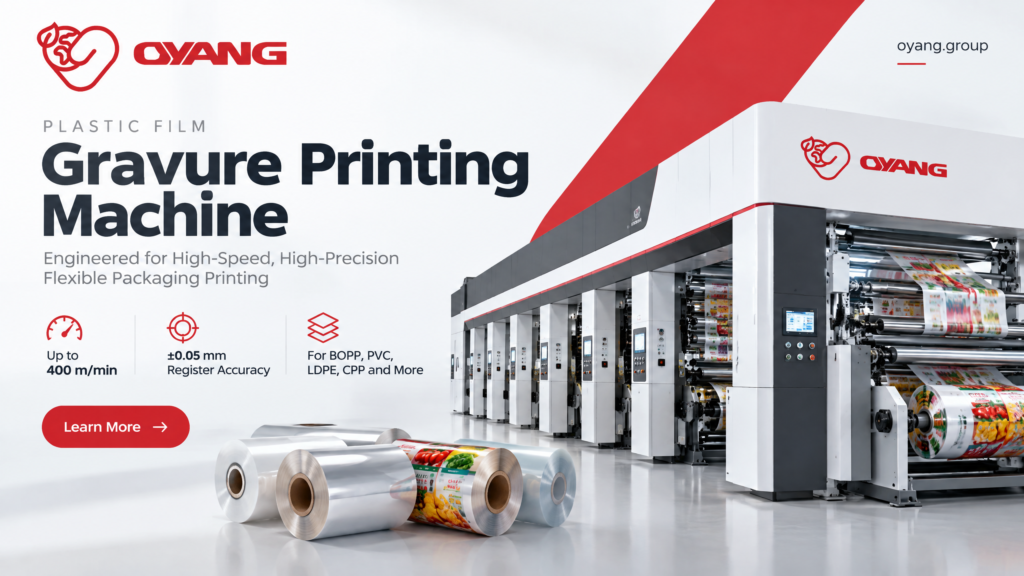
Figure 1: OYANG HONOR 4.0 ELS Rotogravure Press equipped with low-inertia air-bearing dancers and solvent recovery hoods for pharmaceutical aluminum foil converting.
With all frame locating planes and bearing bores machined to a datum tolerance of ≤ 0.015 mm, roller parallelism completely eliminates lateral web wander. The servo-synchronized system holds longitudinal and transverse color registration strictly within ±0.05 mm at 300 m/min. For complete barrier bag conversion lines, pre-printed barrier foils feed downstream into the OYANG 650QSB Flat Bottom Pouch Making Machine to manufacture leak-proof, high-barrier pouch packaging.
Related Technical Guides & Converting Resources
- → What is Rotogravure Printing and How It Works? Core Principle Guide: Review the fluid dynamic transfer cycle, doctor blade shearing mechanics, and drying physics.
- → Rotogravure vs. Flexo: 4 Printing Types Compared: An engineering comparison of tooling costs, dot reproduction limits, and production profitability break-evens.
- → Disadvantages of Rotogravure: 5 Bottlenecks & Solutions: In-depth analysis of cylinder tooling lead times and how ELS automation mitigates traditional changeover waste.
- → Rotogravure Cylinders: Process & Maker Guide: Technical breakdown of copper plating, electromechanical engraving cells, and hard chrome surface tolerances.
Frequently Asked Questions (FAQ)
What is an aluminum foil printing machine?
An aluminum foil printing machine is a continuous roll-to-roll rotogravure press engineered with sensitive low-tension controls, dynamically balanced low-inertia idler rolls, and specialized drying systems to print on unsupported metal foils and barrier laminates without web tearing or creasing.
How does an automatic pharmaceutical aluminum foil printing machine prevent foil snapping?
It uses high-speed AC synchronous servo drives and ultra-low-friction air-bearing dancer cylinders that respond within milliseconds to web tension shifts, keeping tension fluctuations within ±0.8 N to prevent breaking brittle 20μm hard-temper PTP foils.
What is the difference between an industrial foil printing press and a foil fuser machine?
An industrial foil press is a multi-color gravure web press converting master rolls of bare aluminum foil at hundreds of meters per minute, whereas a foil fuser machine is a small commercial craft unit using heat to transfer toner foils onto individual pre-printed paper sheets.
What factors influence the aluminium foil printing machine price?
Pricing is driven by the choice between mechanical line shafts vs. ELS direct servo drives, operating width (e.g., 800 mm to 1300 mm), speed ratings (200 to 350 m/min), inline OP/HSL lacquer coater units, and automated 100% video inspection systems.