

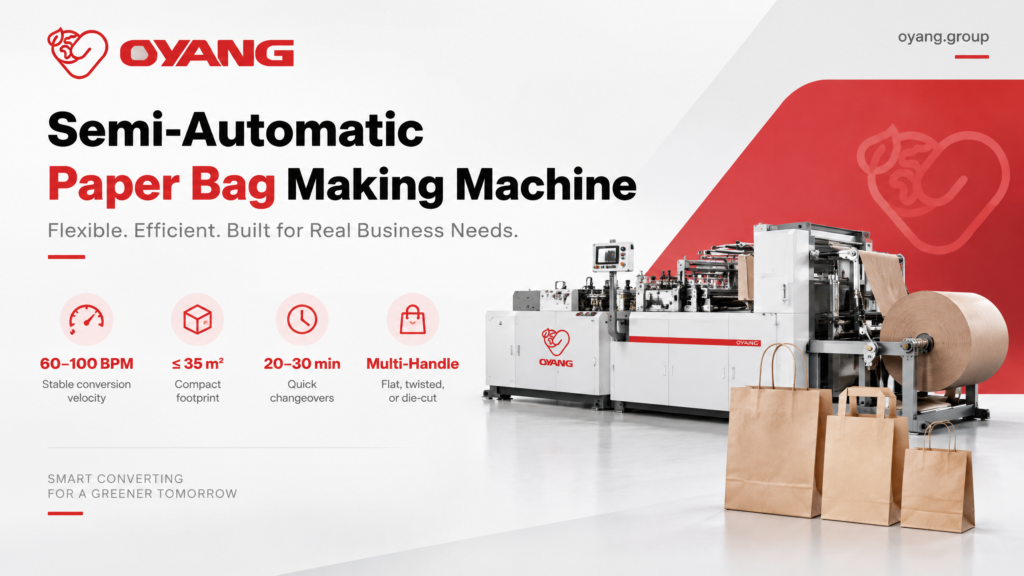
A robust semi automatic paper bag making machine (also recognized across converting facilities as a semi automatic paper bag machine, paper bag making machine semi automatic, or paper bag semi automatic machine) decouples primary roll-fed tube forming and square bottom folding from handle application. Engineered for flexible commercial short runs, regional print shops, and high-mix retail orders, the OYANG 16B Semi-Automatic SOS Paper Bag Machine converts standard kraft paper reels (60 to 130 GSM) into SOS bags at steady operating speeds of 60 to 100 bags per minute. Coupled with offline auxiliary handle units like the ONL-HFA and ONL-HRA, this decentralized configuration enables bag changeovers within 20 to 30 minutes while requiring under 35 m² of factory floor area and preserving base dimensional accuracy within ±0.5 mm.
The Engineering Logic: Decoupled Converting vs. Fully Integrated Inlines
While massive 20-meter integrated inline bag machines dominate multi-million-unit supermarket contracts, they present distinct operational hurdles for converters serving regional businesses, boutique bakeries, and promotional clients. A fully integrated machine running inline handle units incurs high capital risk, requires specialized multi-axis servo technicians, and demands 1 to 2 hours of mechanical re-tooling whenever bag width or handle style varies.
A decentralized converting strategy utilizes a semi automatic paper bag machine to produce open-mouth square bottom carrier bodies from master rolls. Handle attachment is subsequently handled by dedicated offline pasting stations. This decoupled layout provides three specific engineering advantages:
- Production Buffering: The master bag-forming line runs continuously without being throttled by handle reel breaks or glue applicator jams downstream.
- Format Agility: Unhandled sacks can be sold directly as grocery SOS bags, or routed to offline units to receive flat paper handles, twisted paper cords, or punched reinforcement eyelets.
- Electrical & Mechanical Simplicity: Synchronous drive relies on hardened helical gear trains and centralized mechanical cams, reducing plant power draw and eliminating complex fieldbus programming.
For a granular assessment of operational expense, labor overhead, and payback cycles between these workflows, review our comparative study on semi-automatic vs. fully automatic bag machines: Labor vs. automation guide.
Mechanical Transmission & Offline Converting Stations
The kinematic reliability of a commercial paper bag making machine semi automatic platform depends on precise gear meshing and steady pneumatic coordination:
1. Helical Gear Main Drive & Mechanical Cams
The OYANG 16B utilizes an oil-submerged helical gear transmission driven by a heavy-duty inverter motor. Synchronized cam lobes actuate the tube side-tuckers and bottom-opening gripper fingers. This mechanical drive achieves smooth reciprocal motions without servo hunting, dampening harmonic vibrations and holding dimensional repeat accuracy within ±0.5 mm on 60 to 130 GSM kraft stock.
2. Rotary Perforation & Pneumatic Separation Knife
Web separation is executed via a rotary serrated perforation knife paired with high-speed pneumatic snap rollers. By pre-perforating the paper tube and pulling it across a mechanical differential nip, the machine produces clean, tear-resistant bag tops without rough frayed edges, ensuring a flat rim for secondary handle adhesion.
3. Decentralized Offline Handle Applicators (ONL-HFA / ONL-HRA)
Once open-mouth bags are formed, they can be transferred to an offline handle station. An operator feeds the bags into an automatic conveyor where the ONL-HFA (for flat paper tape handles at 35–40 bags/min) or the ONL-HRA (for twisted rope cords with kraft backing patches) applies water-based or hot-melt glue and presses the handles firmly against the bag mouth.
Engineering Video: OYANG 16B Semi-Automatic Line in Operation
Observe the continuous master reel unwinding, tube seaming, and bottom drum opening sequence running on the compact OYANG 16B SOS platform:
Video 1: Commercial SOS bag converting on the OYANG 16B semi-automatic production machine.
Field Engineering Diagnosis: Calibrating Semi-Automatic Mechanical Linkages
Mechanical cam and gear drive systems require regular alignment checks to prevent mechanical play over continuous shifts. Use this workshop diagnostic guide for preventive troubleshooting:
| Mechanical Issue | Root Mechanical / Tooling Cause | Standard Workshop Calibration Protocol |
|---|---|---|
| Tube Cutoff Length Variation (> 1.0 mm) | Drive belt slip on the mechanical variable transmission (P.I.V. gearbox); draw roller nip pressure loose. | Inspect and tension P.I.V. chain links; tighten draw roller pneumatic clamping regulator to 0.45 MPa; check feed roller rubber sleeves for wear. |
| Bottom Flap Wrinkling / Skewed Fold | Bottom drum mechanical opening fingers out of phase; timing chain slacking between drum and side folders. | Loosen finger cam locking hub; use a dial caliper to balance opening finger depth to ±0.05 mm; tension the drive chain to ≤ 5 mm deflection. |
| Offline Handle Pull-Off Failure (< 8 kg) | Cold glue formulation solids too low (< 40%); insufficient compression dwell time on the handle pasting belt. | Switch to high-tack PVAc emulsion (viscosity 1,400–1,800 mPa·s); increase delivery press belt pressure to 0.5 MPa; extend dwell time by 0.5 s. |
| Rough / Frayed Tube Cutoff Edges | Rotary perforation knife blade teeth chipped; clearance between rotary blade and anvil cylinder exceeded 0.08 mm. | Sharpen or replace carbide perforation knife blade; adjust rotary anvil gap using feeler gauges to exactly 0.03–0.05 mm. |
Semi-Automatic Cell vs. Fully Automatic Production: Specification Matrix
Matching machinery choices to operational order profiles is critical for commercial converters. This technical comparison outlines the capabilities of semi-automatic cells versus high-speed automated lines:
| Technical Metric | Semi-Automatic Cell (OYANG 16B + ONL-HFA) | Fully Automatic Line (OYANG 16A / TECH-18) |
|---|---|---|
| Main Drive Topology | Central mechanical helical gears & mechanical cams | Distributed 16–24 axis servo bus (EtherCAT) |
| Operating Velocity | 60 – 100 bags/min (Bag body line) | 150 – 220 bags/min (Fully integrated) |
| Format Changeover Time | 20 – 30 minutes (Fast mechanical change) | ≤ 2 minutes (Automated servo recipe recall) |
| Floor Space Required | Under 35 m² (Total modular footprint) | 75 – 110 m² (Full linear production train) |
| Installed Electrical Load | 11 – 15 kW (Lower energy consumption) | 35 – 55 kW |
| Optimal Order Profile | Short to medium runs (2,000 to 30,000 bags) | Large-scale continuous retail orders (> 100,000 bags) |
OYANG Compact Platforms: 16B SOS Converter & Auxiliary Units
Maintaining kinematic accuracy on mechanically driven converting equipment requires rigid side frames and stable shaft supports. Lightweight steel plate frames are vulnerable to torsion under heavy gear loads, accelerating tooth wear and introducing timing play. All OYANG 16B side panels and gearbox housings are cast from high-grade HT250 gray cast iron, pre-aged to relieve residual stress, and precision-machined in climate-controlled MAZAK and OKUMA 5-axis CNC machining suites to maintain alignment tolerances within ≤ 0.015 mm:
1. OYANG 16B: Semi-Automatic SOS Paper Bag Machine
The OYANG 16B Semi-Automatic SOS Paper Bag Machine converts flat-base sacks without handles from roll-fed kraft. Processing bag face widths from 120 to 330 mm and cut lengths from 220 to 520 mm, the 16B offers an accessible solution for bakery, grocery, and pharmacy bag manufacturing with low maintenance requirements.

Figure 1: The OYANG 16B roll-fed square bottom SOS paper bag machine.
2. ONL-HFA: Automatic Flat Paper Handle Pasting Machine
To add handles to pre-formed bags, the ONL-HFA Automatic Flat Handle Pasting Machine integrates directly into the finishing cell. Operating at 35 to 40 bags per minute, it bonds flat kraft handles to the inner or outer bag mouth, automating a step traditionally done by hand.

Figure 2: The ONL-HFA automatic offline flat paper handle pasting station.
To understand how material yield and raw roll grammage influence overall cost dynamics on short runs, consult our comprehensive guide on paper bag manufacturing cost: Unit cost and pricing guide.
Selecting proper paper grades is critical when running mechanical gripper drums; check fiber bursting specs in our paper bag material and kraft selection guide.
To calculate precise unit costs across varying batch sizes and handle configurations, refer to our detailed formula breakdown in how much does it cost to produce a paper bag: Cost calculation formulas.
Related Technical Guides & Converting Resources
- → Semi-Automatic vs. Fully Automatic Bag Machines: Evaluating capital expenditure, format changeover agility, and labor variance for converting operations.
- → Paper Bag Manufacturing Cost: Unit Cost & Pricing Guide: Cost modeling across substrates, adhesive consumption, and offline handle assembly operations.
- → Paper Bag Material & Kraft Selection Guide: Substrate tensile strength, fiber grain direction, and burst resistance requirements for mechanical converting.
- → How Much Does It Cost to Produce a Paper Bag? Cost Calculation Formulas: Practical formulas for evaluating power consumption, scrap margins, and batch economics.
Frequently Asked Questions (FAQ)
What distinguishes a semi-automatic paper bag making machine from a fully automatic machine?
A semi-automatic paper bag making machine forms the paper tube and square bottom bag body from roll stock, but handle pasting is completed as a separate offline process. In contrast, a fully automatic machine executes handle making, handle pasting, tube forming, and bottom folding in a continuous single-pass production sequence.
What production volume is optimal for a semi-automatic paper bag converting cell?
A semi-automatic converting cell is practical for small-to-medium batch orders between 2,000 and 30,000 bags. It allows regional packaging converters to handle diverse SKU dimensions with 20- to 30-minute changeovers, avoiding the complex re-tooling times of high-output automated lines.
How are handles attached using an offline handle pasting machine?
Pre-formed square bottom paper bags are manually fed into the conveyor table of an auxiliary unit like the ONL-HFA or ONL-HRA. The auxiliary machine dispenses adhesive (cold emulsion or hot-melt), positions pre-assembled flat or twisted paper handles onto the mouth perimeter, and presses them firmly under a secondary compactor belt.
What are the floor space and power requirements for a semi-automatic converting line?
A complete semi-automatic converting cell (including the OYANG 16B SOS machine and an offline handle unit) requires under 35 m² of factory floor space. The electrical power connection is rated between 11 and 15 kW, allowing installation in facilities with standard light-industrial power supplies.