

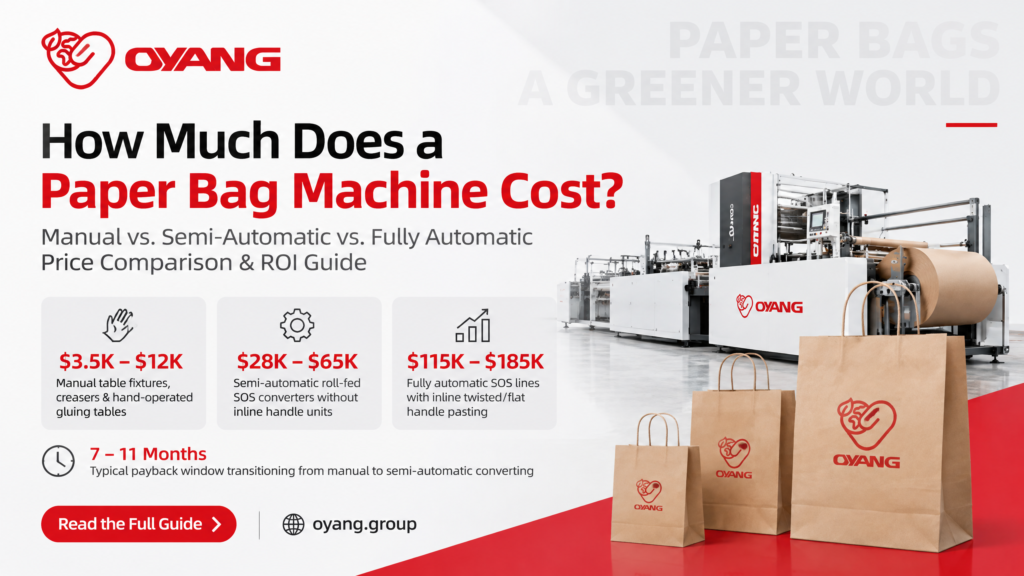
The global market semi automatic paper bag machine price (frequently quoted across converting equipment auctions as semi automatic paper bag making machine price) ranges from $28,000 to $65,000 USD (FOB) for new, standardized roll-fed square-bottom (SOS) systems such as the OYANG 16B. By comparison, entry-level manual paper bag making machine price options (encompassing standalone sheet creasers, table-top gluing stations, and hand-operated folding jigs) range between $3,500 and $12,000 USD, but require 4 to 8 manual workers to produce only 500 to 1,200 bags per shift. While used or budget manual machines require minimal initial capital, they generate high hidden operating expenses: scrap rates exceeding 8% to 12%, frequent gear backlash drift, and excessive adhesive waste. In contrast, an industrial paper bag automatic machine price commands $115,000 to $185,000 USD for integrated handle lines like the OYANG 16A, which reduces scrap below 1.5% and lowers unit labor cost from $0.018 down to $0.003 USD per bag.
Price Discrepancy Breakdown: Manual vs. Semi-Automatic vs. Fully Automatic
When plant managers review machine procurement options, the substantial price spread between manual converting apparatuses, semi-automatic lines, and fully automated machinery reflects differences in mechanical assembly, drive components, and production capacity:
- Manual Paper Bag Converting Apparatus ($3,500 – $12,000 USD): These systems rely on separate manual units: a foot-treadle sheet creaser, a table-top manual glue spreader, and hand-operated bottom-folding clamps. Because operators fold each bag by hand, output is restricted to 40–60 bags per person per hour. To produce 8,000 bags per day requires 12 to 16 manual workers, generating high wage expenses and substantial dimensional inconsistency.
- Industrial Semi-Automatic Roll-Fed SOS Converters ($28,000 – $65,000 USD): Machines like the OYANG 16B convert continuous kraft reels into square-bottom bag bodies at 60 to 100 bags per minute. The paper tube forming, cutting, and bottom folding are fully mechanical, driven by hardened helical gears and synchronized cams. Adding handles is managed as a decoupled offline process via semi-automatic pasting machines like the ONL-HFA ($12,000–$18,000 USD), offering balanced flexibility for regional converters.
- Fully Automatic Multi-Axis Servo SOS Lines ($115,000 – $185,000 USD): Integrated platforms execute handle making, handle pasting, tube creasing, cut-off, and bottom opening in a single continuous process. Utilizing 16 to 24 independent servo axes over real-time fieldbus networks, these lines produce 120 to 220 finished handled shopping bags per minute with only one supervising technician.
For an exhaustive engineering comparison of labor variances and operational economics across these setups, review our technical report on semi-automatic vs. fully automatic bag machines: Labor vs. automation guide.
Commercial Quotation Matrix: Manual vs. Semi-Auto vs. Auto Machinery
The following commercial quotation matrix compares pricing, labor allocation, and output across converting automation levels:
| Machinery Tier & Class | FOB Purchase Price | Shift Output (8 Hrs) | Direct Labor Required | Scrap & Defect Rate |
|---|---|---|---|---|
| Manual Converting Cell Creaser, table gluer, hand jigs | $3,500 – $12,000 USD | 500 – 1,200 bags | 4 – 8 Workers | 8.0% – 12.0% |
| Used / Refurbished Semi-Auto Legacy mechanical gear drive | $15,000 – $24,000 USD | 15,000 – 22,000 bags | 2 – 3 Workers | 5.0% – 8.0% |
| New Semi-Automatic SOS OYANG 16B Roll-Fed Converter | $38,000 – $65,000 USD | 28,000 – 42,000 bags | 1 – 2 Workers | 1.5% – 2.5% |
| Fully Automatic SOS Line OYANG 16A / SMART-17 Line | $115,000 – $185,000 USD | 55,000 – 85,000 bags | 1 Technician | ≤ 1.0% |
The True Financial Equation: Hidden OpEx in Budget & Used Machinery
Purchasing a low-cost, secondhand, or unbranded manual paper bag apparatus can appear budget-friendly during initial CapEx budgeting. However, accounting teams and plant engineers often find that hidden maintenance, component replacement, and substrate scrap costs surpass the initial equipment savings within 12 months:
1. Cumulative Gear Backlash and Shaft Fatigue
Low-priced semi-automatic machines frequently use soft, non-heat-treated carbon steel gears ($$45\#$$ steel) rather than hardened alloy gears (20CrMnTi). After 6 to 9 months of continuous operation, tooth wear introduces cumulative mechanical backlash. This causes bottom-creasing and cutoff knives to drift by ±2.0 to 3.5 mm, resulting in high rejection rates on branded commercial orders.
2. Excessive Paper Scrap and Raw Material Waste
In paper bag manufacturing, raw paper reels represent 65% to 75% of total bag unit cost. A manual or worn secondhand converting setup operates with a scrap rate of 8% to 12% due to web wander and inconsistent glue application. Standardized semi-automatic lines like the OYANG 16B keep scrap rates under 2.0%, saving an average converting facility $18,000 to $32,000 USD annually in raw kraft paper waste alone.
3. Uncontrolled Cold Adhesive Squeeze-Out
Manual gluing and uncalibrated doctor wheels frequently deposit excessive water-based cold adhesive. Excess glue migrates inside the bag during stacking, sealing the interior and rendering batches unsellable. Industrial semi-automatic units integrate precision doctor blades with micrometer adjustments, limiting glue application to an exact 0.08–0.10 mm film thickness.
Engineering Video: OYANG 16B Production Speed & Mechanical Stability
Examine the mechanical gear synchronization, continuous roll unwinding, and bottom-drum folding on the OYANG 16B semi-automatic SOS converting platform:
Video 1: Commercial SOS bag converting on the OYANG 16B semi-automatic production machine.
Unit Economics: Manual Hand-Folding vs. Industrial Semi-Automatic Output
To evaluate whether a packaging converter should adopt manual hand-finishing or invest in an industrial semi-automatic line, consider this direct financial comparison based on producing 30,000 standard SOS grocery sacks (size: 280 × 150 × 320 mm):
| Cost Component | Manual Converting Operation | Industrial Semi-Auto (OYANG 16B) |
|---|---|---|
| Time to Produce 30,000 Bags | 25 – 30 Working Days (Single bench) | 6.5 – 8.0 Operating Hours (1 Shift) |
| Direct Labor Hours Required | 600 – 750 Man-Hours | 8 – 16 Man-Hours (Operator + assistant) |
| Direct Labor Cost Per Bag | $0.018 – $0.026 USD / bag | $0.003 – $0.005 USD / bag |
| Paper Scrap Losses | 8.5% ($765 USD loss on batch) | 1.5% ($135 USD loss on batch) |
| Net Batch Cost Advantage | Baseline benchmark | +$1,080 USD Savings per 30K Batch |
This unit analysis indicates that converting facilities producing over 60,000 bags per month recoup the price difference of an industrial semi-automatic line in approximately 8 to 11 months through combined labor reductions and paper yield improvements.
To evaluate additional capital considerations, landed shipping container freight rates, and factory utility layouts, review our comprehensive analysis on how much does a paper bag making machine cost: Landed CapEx analysis.
For plant managers calculating exact raw paper yield, roll grammage consumption, and adhesive costs, consult our reference guide on paper bag manufacturing cost: Unit cost and pricing guide.
For detailed international converting cost benchmarks across emerging packaging markets, read our comprehensive study on paper packaging profitability and global machinery cost guide.
Related Technical Guides & Commercial Resources
- → Semi-Automatic vs. Fully Automatic Bag Machines: Evaluating capital expenditure, format changeover agility, and direct labor allocation for packaging operations.
- → How Much Does a Paper Bag Making Machine Cost?: Granular breakdown covering FOB factory costs, container shipping rates, import duties, and compressor sizing.
- → Paper Bag Manufacturing Cost: Unit Cost & Pricing Guide: Cost modeling across substrates, adhesive consumption, and offline handle assembly operations.
- → Paper Packaging Profitability & Global Cost Guide: Equipment economics comparing domestic mechanical lines with high-speed automated machinery.
Frequently Asked Questions (FAQ)
What is the typical price range for a semi automatic paper bag machine?
A new industrial roll-fed semi automatic paper bag machine (such as the OYANG 16B) costs between $38,000 and $65,000 USD (FOB). Basic manual bench-top converting kits range from $3,500 to $12,000 USD, while secondhand mechanical units range between $15,000 and $24,000 USD depending on age and mechanical condition.
Why do used and low-cost paper bag machines carry high hidden operating costs?
Low-cost and secondhand converting machines often have worn gears and unhardened cam tracks that introduce mechanical backlash. This causes cutoff length drift, leading to paper scrap rates of 8% to 12% (compared to under 1.5% on modern machines), uneven adhesive application, and recurring maintenance downtime that erodes initial purchase savings.
What is the output difference between manual and semi-automatic paper bag making?
A team of 4 manual workers hand-creasing and gluing bags produces approximately 500 to 1,200 finished bags per 8-hour shift. In contrast, a semi-automatic roll-fed converting machine operated by one technician produces 28,000 to 42,000 square-bottom bags per shift, delivering over 25 times the manual throughput.
How long does it take to recoup the investment in a semi-automatic paper bag machine?
For commercial converting plants producing at least 60,000 bags per month, investing in a machine like the OYANG 16B typically amortizes within 7 to 11 months. The financial payback is driven by reducing manual labor overhead from $0.018 down to $0.003 USD per bag, alongside reducing raw kraft paper scrap by 5% to 8%.