

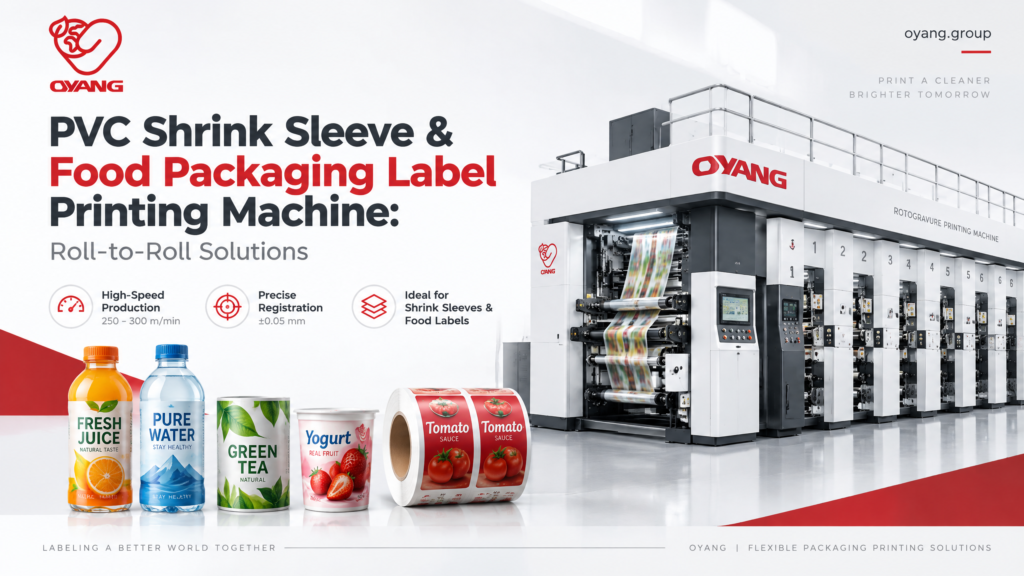
PVC Shrink Sleeve & Food Packaging Label Printing Machine: Roll-to-Roll Solutions
Designed to eliminate premature thermal shrinkage, web wrinkling, and adhesive bleed across heat-sensitive 35–50 μm shrink films and self-adhesive stocks, OYANG’s roll-to-roll label and sleeve printing presses deliver continuous 250 to 300 m/min production for beverage bottle sleeves, wrap-around bands, and barrier food labels. By pairing low-temperature drying air tunnels (≤ 45°C) with internal chilled impression drums (12–15°C) and closed-loop Siemens S120 multi-axis servo synchronization, this industrial pvc shrink label printing machine maintains dynamic tension stability within ±0.8 N, locking color register tolerances strictly to ±0.05 mm across PVC, PETG, OPS, and pressure-sensitive laminates.
Substrate Physics: Overcoming Pre-Shrinkage & Registration Drift on Heat-Shrink Webs
Converting shrink sleeves presents entirely different physical challenges compared to standard flexible film printing. Sourcing engineers and plant managers configuring a pvc sleeve printing machine or food packaging label printer must resolve two acute thermodynamic and mechanical failure modes:
1. The 50°C Thermal Pre-Shrinkage Ceiling on PVC & PETG
Polyvinyl chloride (PVC) and polyethylene terephthalate glycol (PETG) films feature transverse direction (TD) shrink ratios between 50% and 78%. However, their thermal activation window begins at just 55°C. If traditional high-heat drying hoods are used to cure heavy solvent ink deposits, the substrate undergoes irreversible premature shrinkage inside the oven tunnel. This creates longitudinal web curl, distorts barcode geometry, and causes diameter failures during downstream ultrasonic or solvent seaming. OYANG utilizes aerodynamically isolated drying chambers supplying massive air volume (35 m/s) at low temperatures (≤ 45°C), instantly scrubbing away boundary-layer solvents without triggering substrate shrinkage. In modern packaging converting, understanding where rotogravure remains dominant today highlights why high-volume beverage sleeves rely on this low-temperature high-opacity ink laydown.
2. Low-Modulus Web Stretching & Nip Impression Shear
Shrink films possess a low elastic modulus. Tension spikes greater than ±1.5 N induce permanent machine-direction (MD) neck-in, causing the web width to fluctuate. On an industrial pouch label printing machine or roll to roll sticker printing machine, excessive impression pressure also squeezes pressure-sensitive adhesives outward, contaminating idler rollers and snapping the liner. Decoupling line tension via independent servo-driven nip feed rolls and low-friction air dancers eliminates web stretch while keeping nip loads under 14 N/mm. When choosing between web printing processes for label stocks, plant managers evaluate rotogravure vs flexographic printing configurations to weigh run lengths against plate photopolymer swelling from strong solvent inks.
Commercial Output & Sleeve Yield Formula
Hourly Sleeve Yield = (Web Velocity × 60 ÷ Sleeve Layflat Height) × Number of Web Lanes × OEE
Factory Benchmark: Running an OYANG 1050 mm wide web press configured with 6 lanes of 150 mm beverage bottle shrink sleeves (180 mm repeat cutoff) at 260 m/min with an 85% OEE delivers approximately 442,000 finished shrink sleeves per hour. Compared to narrow-web flexographic printing, roll-to-roll rotogravure printing reduces solvent ink consumption by 22% and slashes raw substrate waste during color changes to under 40 meters.
Substrate Physics & Mechanical Control Specifications
| Substrate Grade | Caliper & Shrink Ratio | Dynamic Tension Band | Line Speed & Power Load | Target Quality Metric |
|---|---|---|---|---|
| PVC Shrink Sleeve Film | 35 – 50 μm · TD Shrink 50–58% | 25 – 45 N/m web | Up to 300 m/min · 160 kW | Drying temp ≤ 45°C; zero thermal distortion; retained solvent ≤ 3.0 mg/m² |
| PETG High-Shrink Film | 40 – 45 μm · TD Shrink 70–78% | 30 – 50 N/m web | Up to 280 m/min · 155 kW | Zero pre-shrinkage; chilled impression roller 12°C; dynamic register ±0.05 mm |
| Self-Adhesive Food Labels | 60 – 80 gsm Paper / Glassine Liner | 50 – 85 N/m web | Up to 250 m/min · 145 kW | Zero adhesive bleed; precise web guiding (±0.1 mm); intact liner backing |
| BOPP Wrap-Around Labels | 30 – 38 μm Transparent / Pearlized | 35 – 55 N/m web | Up to 300 m/min · 150 kW | Static elimination ≤ 1.5 kV; static-free rewinding; high optical clarity |
OYANG Engineering Foundation: Sub-0.015mm CNC Machining for Zero-Vibration Sleeve Printing
Achieving sharp photographic dot reproduction and pinhole-free high-opacity white backings on a high-speed label printer for food packaging demands an ultra-rigid mechanical chassis. Microscopic frame vibrations create doctor blade skipping, which results in horizontal banding, pinholes in white backings, and registration drifting across color stations.
Inside OYANG’s 130,000 m² production complex, all side frames, precision bearing blocks, and impression cylinder slide ways for the HONOR 3.5 PLUS ELS Rotogravure Printing Machine and EASYPRINT 3.0 ELS Rotogravure Printing Machine are processed on Japanese MAZAK and OKUMA 5-axis CNC machining centers.

Figure 1: The OYANG HONOR 3.5 PLUS ELS Rotogravure Press configured for high-speed shrink sleeve labels, wrap-around bands, and barrier flexible food packaging.
Video 1: Machine run of the OYANG rotogravure press showcasing continuous unwind/rewind turret splicing, high-speed register synchronization, and low-temperature drying hoods.
By boring all bearing pockets and milling reference datum faces in a single clamping setup, structural wall panel tolerances are locked strictly to ≤ 0.015 mm. This mechanical foundation ensures that our Electronic Line Shaft (ELS) direct-drive servos hold longitudinal and transverse registration strictly within ±0.05 mm during continuous high-speed roll splicing at 300 m/min.
Following roll-to-roll printing, printed master rolls transfer cleanly to downstream slitting and pouch-converting equipment, including the High Speed Film & Label Slitting Machine ONL-SL for precision multi-lane roll separation, and the OYANG 650S High Speed 3-Side Seal Pouch Making Machine for portion-pack pouch packaging.
Related Technical Guides & Converting Resources
- → Is Rotogravure Still Used Today? Modern Uses & Capabilities: Explore why continuous roll-to-roll rotogravure remains the primary choice for shrink sleeves and high-barrier food packaging over flexo and offset.
- → Rotogravure Cylinders: Process & Maker Guide: Critical cylinder engraving standards, chrome hardness, and cell depth tolerances required for opaque white backings on transparent shrink film.
- → Rotogravure vs. Flexo: 4 Printing Types Compared: A financial and technical audit on ink cost efficiency, dot fidelity, and break-even run lengths for beverage sleeve and adhesive label converters.
Frequently Asked Questions (FAQ)
What prevents PVC shrink sleeve film from premature shrinkage during printing?
Premature shrinkage is prevented by maintaining drying tunnel temperatures strictly below 45°C, deploying high-velocity air nozzles (35 m/s) to sweep away solvents quickly, and passing the film over 12–15°C chilled impression backing rollers.
Can an industrial roll to roll sticker printing machine process thermal adhesive stock without bleeding?
Yes, by maintaining dynamic web tension within ±0.8 N and regulating linear impression pressure under 14 N/mm, adhesive migration and bleed along label edges are completely avoided.
Why is rotogravure preferred over flexo for high-volume beverage shrink sleeves?
Rotogravure delivers exceptionally high white ink opacity (essential for sleeve contrast on dark bottles), maintains color consistency across millions of meters, and achieves lower running ink costs without plate swelling issues caused by aggressive solvent formulations.
What is the typical registration tolerance on an automatic PVC sleeve printing machine?
Modern Electronic Line Shaft (ELS) rotogravure presses maintain both longitudinal and transverse color registration within ±0.05 mm, even during automated high-speed turret reel splices at 300 m/min.