

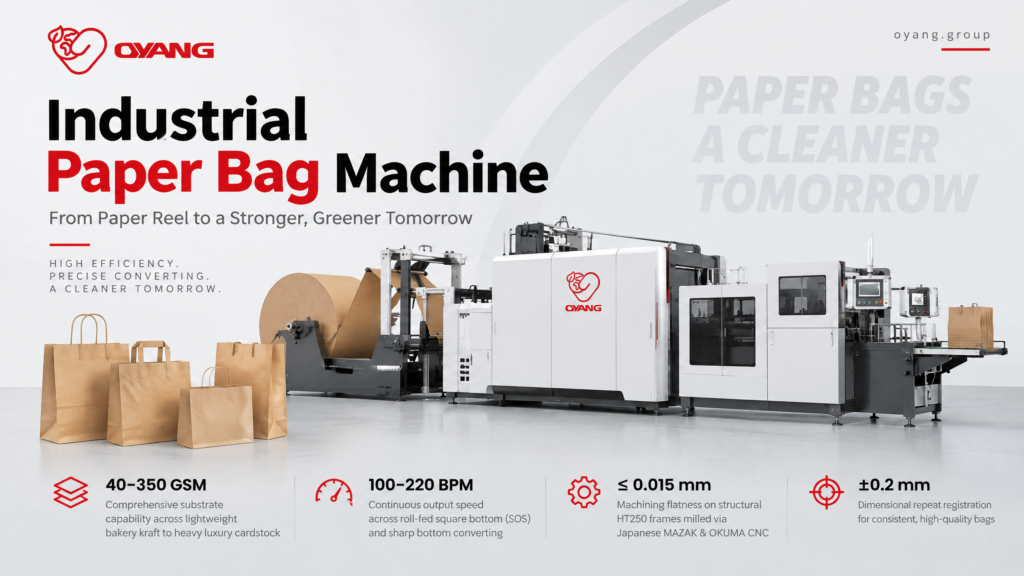
An industrial paper bag making machine (also recognized across web-converting plants as a paper bag machine, paper bag forming machine, or paper bag manufacturing machine) is an automated system engineered to convert master paper reels or pre-cut sheets into structural carrier sacks. Built to process brown kraft, bleached testliner, and laminated cardstock (40 to 350 GSM), heavy-duty manufacturing platforms like the OYANG TECH-18 and SMART-17 execute three primary converting phases: closed-loop tension-regulated unwinding, continuous tube formation with gusset creasing, and rotary bottom opening and adhesive calendering. Operating through distributed multi-axis servo architectures, these production lines sustain conversion velocities of 100 to 220 bags per minute while holding dimensional tolerances within ±0.2 mm and maintaining line Overall Equipment Effectiveness (OEE) above 90%.
The Core Kinematic Stages of Industrial Paper Bag Converting
Regardless of whether an installation utilizes a machine for making paper bag formats with handles, a flat-bottom grocery line, or a flat-and-satchel pastry machine, the conversion sequence relies on three interconnected mechanical phases. For an in-depth operational walkthrough of these mechanisms, see our step-by-step breakdown on how does a paper bag machine work: Mechanics and workflow.
Stage 1: Tension-Regulated Unwind & Ultrasonic Web Guiding
Master paper reels weighing up to 1,500 kg are mounted on hydraulic, shaftless chuck unwinds. As line speed accelerates to 200 m/min, web inertia changes dynamically. A low-friction pneumatic dancer arm coupled with magnetic powder or servo regenerative braking maintains web tension within ±3% of setpoint. Simultaneously, high-frequency ultrasonic edge position control (EPC) sensors track the paper edge, driving a motorized steering frame to correct lateral wander down to ±0.05 mm before the web enters the downstream forming array.
Stage 2: Continuous Longitudinal Seaming & Tube Forming
The flat web travels across rotary scoring discs that pre-crease the side gussets. A cold PVAc emulsion adhesive wheel or pressurized nozzle extruder applies a continuous adhesive seam along the paper margin. The paper then passes through an adjustable forming mandrel, where precision-angled folding plates gently fold the paper into a hollow rectangular tube. Synchronized nip draw rollers pull the web forward while rotary perforation knives or flying servo shears sever the continuous tube into individual segments.
Stage 3: Rotary Bottom Opening, Pasting & Calendering
In self-opening square (SOS) converting, the severed tube enters an enlarged bottom drum. Vacuum suckers grasp the underside while mechanical opening fingers pull the top flap open, forming a clean diamond-shaped base geometry. Pasting segments transfer water-based cold adhesive across the overlapping bottom flaps, and closing plows fold the envelope shut. The newly formed bag passes through high-pressure calender belts (delivering 0.5 to 0.7 MPa of compaction force), driving the adhesive into the kraft fibers to ensure high joint strength before exiting onto an indexing collection table.
Engineering Video: Roll-Fed Paper Bag Machine Mechanics and Web Transport
Examine the mechanical coordination of roll unwinding, continuous tube formation, and rotary bottom folding running on the OYANG paper bag converting line:
Video 1: Workshop overview of OYANG roll-fed paper bag making machinery and precision converting stations.
Technological Evolution: From Mechanical Line Shafts to Multi-Axis Servo Bus
The mechanical architecture of a modern paper bags machine has undergone three distinct evolutionary phases over the past four decades:
- Generation 1: Mechanical Line-Shaft Drives: A single central AC motor powered the entire machine line through a longitudinal drive shaft, bevel gearboxes, chains, and mechanical change gears. While mechanically straightforward, these lines suffered from cumulative gear backlash and chain stretch, resulting in cutoff registration drift (> 1.5 mm) and format changeover times spanning 2 to 4 hours.
- Generation 2: Hybrid Servo-Assisted Systems: Auxiliary servo motors were introduced to control the primary draw rollers and cutoff knives, while bottom forming remained mechanically coupled via gear trains. This improved length accuracy but left mechanical timing synchronization vulnerable to drive wear during speed transitions.
- Generation 3: Fully Distributed Multi-Axis Servo Bus (Industry 4.0): Modern platforms replace physical line shafts entirely with an industrial fieldbus network (EtherCAT or Profinet). In an OYANG machine for manufacturing paper bags, 16 to 24 servo axes operate with electronic camming (E-Cam) curves calculated by a central motion controller at sub-millisecond refresh rates. Operators change bag dimensions digitally via the touchscreen HMI, triggering automatic servo repositioning in under 2 minutes.
To understand how different mechanical designs correspond with market applications, explore our comprehensive taxonomy in the paper bag machine types and taxonomy guide.
Field Engineering Diagnosis: Troubleshooting Converting Line Anomalies
Continuous web converting at speeds over 150 bags/min demands tight coordination between mechanical tooling and web dynamics. Use this shop-floor calibration guide to address converting issues:
| Converting Defect | Root Mechanical / Physical Cause | Standard Workshop Calibration Protocol |
|---|---|---|
| Web Wandering / Gusset Asymmetry | Master roll core chuck misalignment; uneven tension distribution across the dancer guide rollers. | Verify unwind chuck parallelism using dial indicators; recalibrate ultrasonic EPC sensor centering and set proportional gain ($$K_p$$) to eliminate hunting. |
| Cutoff Length Register Drift (> 0.5 mm) | Paper dust accumulation on the optical print mark sensor; slipping nip pressure on the primary servo draw rollers. | Clean optical sensor lens; increase draw roller pneumatic clamping pressure to 0.45 MPa; adjust electronic cam feed forward factor. |
| Bottom Flap Glue Squeeze-Out | Adhesive viscosity too low (< 900 mPa·s); doctor blade clearance on the bottom glue applicator wheel set too wide. | Adjust cold glue formulation to 1,200–1,600 mPa·s; use precision feeler gauges to set doctor blade clearance to exactly 0.08–0.10 mm. |
| Corner Rupture at Bottom Drum Opening | Bottom opening finger vacuum timing lagging behind drum mechanical rotation; paper substrate equilibrium moisture < 5%. | Advance vacuum solenoid trigger angle by 2.0° via HMI cam settings; verify kraft stock equilibrium relative humidity is within 6.0–7.5%. |
Paper Bag Machine Classification: Mechanical Architecture Matrix
A manufacturing plant must specify equipment according to bag geometry, substrate grammage, and volume requirements. This matrix outlines the primary machine categories manufactured across the industry:
| Machine Category | Substrate Compatibility | Converting Velocity | Target Application |
|---|---|---|---|
| Roll-Fed SOS (Square Bottom) | 60 – 180 g/m2 Kraft / Testliner | 120 – 220 bags/min | Supermarket grocery sacks, retail carrier bags, food delivery |
| Roll-Fed Sharp Bottom (V-Bottom) | 40 – 80 g/m2 MG Kraft / Greaseproof | 300 – 600 bags/min | Bakery baguettes, pharmacy pouches, fast-food fry bags |
| Sheet-Fed Non-Crease Box Bag | 160 – 350 g/m2 Heavy Art Board | 50 – 80 bags/min | Luxury cosmetics, jewelry, apparel, premium boutique carriers |
| SOS Line with Inline Handles | 80 – 150 g/m2 Kraft | 120 – 180 bags/min | Department store shoppers, apparel bags with twisted/flat handles |
For detailed design guidelines regarding square bottom conversions, see our technical article on square bottom paper bag making machine engineering architecture.
Manufacturing Precision & CNC Tolerancing at OYANG Group
Converting lines operating at high speeds generate sustained dynamic vibrations that test frame rigidity. Welded steel chassis without thermal stress relief can deform over operational cycles, causing axis deflection and gear wear.
At OYANG’s 130,000 m2 manufacturing campus, all machine wall panels, base beds, and rotary drums are cast from high-density HT250 gray cast iron, pre-aged to eliminate residual internal stresses. Key structural parts are machined on 5-axis CNC machining suites from Japanese MAZAK and OKUMA to ensure mounting surface flatness within ≤ 0.015 mm:
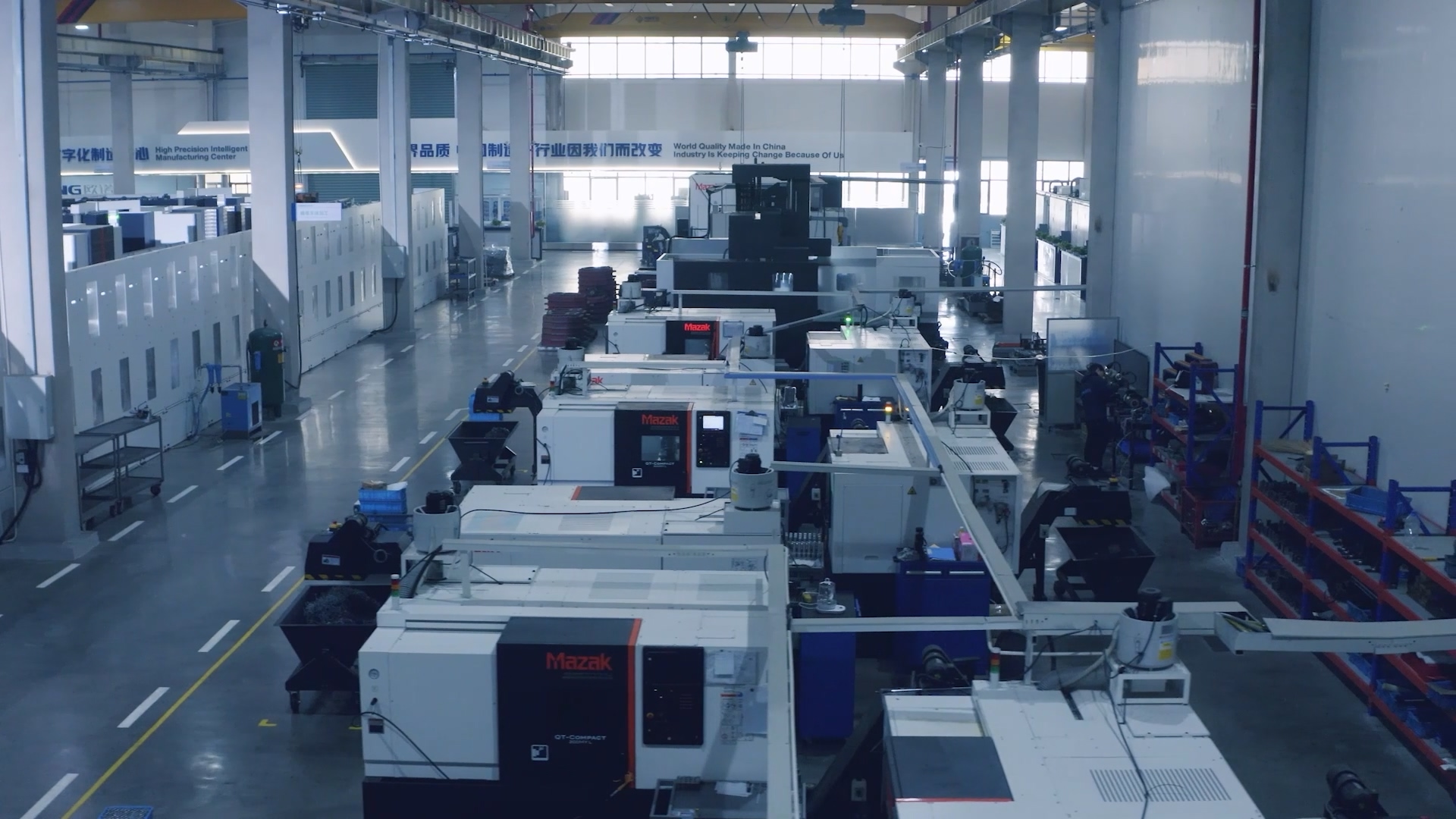
Figure 1: Japanese MAZAK flexible CNC machining center milling heavy wall panels at the OYANG smart manufacturing base.
This mechanical foundation guarantees that shaft bores maintain axial concentricity over continuous multi-shift production, protecting high-speed rotary drums and electronic cam gears against premature wear. For plant operating protocols, review our guide on how to make a professional paper bag: Factory guide.
Featured Platform: OYANG TECH-18 Automated Size-Changeover Paper Bag Machine
The OYANG TECH-18 Paper Bag Machine represents the modern standard for agile commercial converting. Equipped with multi-axis servo positioning, automated recipe recall, and rapid size adjustments, it converts square bottom retail and food sacks at rates up to 180 bags/min.

Figure 2: The OYANG TECH-18 automated square bottom paper bag converting platform.
Related Technical Guides & Converting Resources
- → How Does a Paper Bag Machine Work? Mechanics & Workflow: Detailed analysis of continuous roll unwinding, servo web feeding, tube forming, and bottom closing kinematics.
- → Paper Bag Machine Types, Taxonomy & Price Guide: Structural taxonomy covering roll-fed, sheet-fed, SOS, V-bottom, and auxiliary converting modules.
- → Square Bottom Paper Bag Making Machine Guide: In-depth technical breakdown of SOS bottom-drum forming fingers, vacuum manifolds, and roll-fed selection criteria.
- → How to Make a Professional Paper Bag: Factory Guide: Commercial quality standards for burst resistance, adhesive penetration, crease-line integrity, and anti-static web control.
Frequently Asked Questions (FAQ)
What are the three fundamental mechanical stages of a paper bag making machine?
A continuous paper bag making machine operates via three core mechanical stages: (1) tension-controlled roll unwinding paired with closed-loop ultrasonic edge guiding, (2) longitudinal seaming and tube forming over adjustable mandrels with side-gusset creasing, and (3) rotary bottom opening, adhesive transfer, flap folding, and calender nip compression.
What is the primary difference between square-bottom (SOS) and sharp-bottom (V-bottom) paper bag machines?
Square-bottom (SOS) machines use an enlarged bottom drum equipped with vacuum cups and folding fingers to form a flat, self-standing rectangular base, operating at 120 to 220 bags/min for retail and groceries. Sharp-bottom (V-bottom) machines fold the web into a continuous tube and execute a single transverse fold across the base, running at higher speeds (300 to 600 bags/min) for bakery and pharmacy pouches.
Why is a multi-axis servo bus superior to traditional mechanical line-shaft drives?
A distributed servo bus architecture (EtherCAT/Profinet) replaces mechanical gearboxes, chains, and line shafts with software-coordinated electronic cams (E-Cam). This eliminates mechanical backlash and gear wear, reduces changeover times from hours to under 2 minutes via digital HMI recipes, and holds registration tolerances within ±0.2 mm at high speeds.
How do cast-iron structural frames improve paper bag machine reliability?
Heavy HT250 gray cast iron delivers superior internal vibration damping compared to welded steel plate frames. Milling these frames on 5-axis MAZAK and OKUMA CNC machines to tolerances of ≤ 0.015 mm prevents shaft deflection, extends bearing life, and eliminates frame flexing under high-speed reciprocating converting loads.