

Paper Bag Machine Types, Taxonomy & Price Guide: Roll-Fed, Sheet-Fed, and Indian Market Benchmarks
Engineering Nomenclature: What Are Paper Making Machines Called vs. Bag Converting Units?
In industrial procurement, buyers frequently confuse upstream papermaking machinery with downstream packaging converting machinery. Understanding engineering taxonomy prevents misallocated capital expenditure:
- Paper Making Machines (Fourdrinier Machine): These are massive continuous mills spanning 50 to 150 meters in length that convert wet wood pulp, water, and chemical furnish into solid kraft paper parent reels weighing 1 to 3 tons. They do not manufacture bags.
- Paper Slitting & Rewinding Machines: Auxiliary equipment, such as the ONL-SL Series, that trims master paper mill reels into precise web widths matching specific bag tube formers.
- Paper Bag Converting Machines: Specialized machinery that takes secondary slit reels, performs web guiding, seam gluing, tube forming, rotary cutoff, and bottom closing in high-speed succession. For plants reviewing end-to-end investment roadmaps, explore our foundational guide on how to start a paper bag business.
What Types of Paper Bag Machines Are There? Industrial Taxonomy
Packaging equipment is divided into three primary mechanical architectures based on feeding mechanism, bottom geometry, and folding automation:
| Machine Type & Sub-Category | Mechanical Drive System | Operating Speed Range | Target Bag Types & Applications | Typical Investment (USD) |
|---|---|---|---|---|
|
V-Bottom / Sharp-Bottom Machine (e.g., OYANG 16C Series) | Rotary shear blade with continuous mechanical pinch fold | 200–450 bags/min | Bakery baguettes, pharmaceutical pouches, french fry bags (no handles) | $25,000 – $55,000 |
|
Roll-Fed SOS Square-Bottom Line (e.g., OYANG TECH-18) | Multi-axis digital servo bus (Electronic Line Shaft) | 150–220 bags/min | Grocery delivery, retail flat/twisted handle shoppers, apparel packaging | $110,000 – $280,000 |
|
Sheet-Fed Luxury Box Bag Machine (e.g., Great 4.0 Supreme) | Pneumatic stream feeder + servo creaseless tucking | 50–90 bags/min | High-end cosmetics, jewelry, luxury spirits, non-creased rigid shopping bags | $180,000 – $360,000 |
What Machines and Tools Are Needed to Make Paper Bags Industrially?
Operating a commercial bag plant requires more than an isolated forming unit. A complete industrial line incorporates four interconnected mechanical stations:
1. Primary Converting Unit
The roll-fed or sheet-fed bag making machine equipped with ultrasonic Edge Position Control (EPC), forming plates, servo knife drums, and bottom paste cylinders. To understand the internal mechanics, read our engineering breakdown on how does a paper bag machine work.
2. Inline Flexographic Press
A 2-to-4 color printing module mounted between the unwind stand and forming section, utilizing water-based inks and ceramic anilox rollers.
3. Handle Making & Pasting Units
Dedicated auxiliary units such as the ONL-HRA Round Rope Handle Pasting Machine, which form twisted paper cords and patch rolls at 35–40 pairs/min.
4. Packaging & Stacking Tools
Horizontal pressure delivery belts with pneumatic kicker counters, feeding directly into automatic bundlers to compress bags and eliminate trapped air.
What Is the Cost of Automatic Bag Making Machines in India? Prakash vs. Hanje vs. OYANG
Driven by nationwide single-use plastic enforcement, India has developed a bustling domestic equipment sector, predominantly centered in Gujarat, Haryana, and Delhi NCR. Indian machinery brands like Prakash and Hanje represent low-CapEx entry solutions, but their mechanical architecture differs fundamentally from European-standard multi-servo converters:
| Evaluation Dimension | Indian Regional Machines (Hanje / Prakash) | OYANG Servo Industrial Lines (e.g., TECH-18) |
|---|---|---|
| Pricing Benchmark |
₹15 Lakhs – ₹45 Lakhs ($18,000 – $55,000 USD) (Attractive for small workshops with limited startup capital) |
$110,000 – $280,000 USD (₹90 Lakhs – ₹2.3 Cr) (Engineered for 24/7 continuous contract packaging) |
| Drive Architecture | Mechanical main line shaft, cast iron change-gears, and mechanical rocker linkages. | Multi-axis digital servo bus (Electronic Line Shaft) with independent Siemens/Yaskawa servos per station. |
| Size Changeover Downtime | 2.5 to 4.5 hours (Requires manual gear swapping, wrench plate repositioning). | ≤ 2 minutes (Automated motorized axis movement via touchscreen recipe recall). |
| Operating Speed & Stability | 60–110 bags/min rated; harmonic vibrations increase sharply above 90 bags/min. | 180–220 bags/min continuous; zero harmonic vibration up to 240 bags/min. |
| Tolerance & Scrap Control | ± 1.0 mm cut tolerance; scrap rates average 3.5% – 6.0% on low-grade recycled kraft. | ± 0.5 mm cut tolerance; scrap rates restricted to ≤ 1.2% via closed-loop dancer control. |
While the price of a Hanje paper bag machine or Prakash paper bag machine appeals to regional converters launching on modest budgets, industrial plants targeting high-volume supermarket contracts prioritize Total Cost of Ownership (TCO). A 3.5% reduction in scrap rate and 200% higher sustained yield typically recovers the capital price difference within 14 months of multi-shift operation. To examine these operational dynamics on the shop floor, see our guide on how to make a professional paper bag.
OYANG Engineering Practice: Military-Grade Machining for 24/7 Mechanical Longevity
High-speed paper converting subjects machine frames to intense cyclic shock loads. In mechanical-cam machines, frame flexure over time causes gear backlash, resulting in ragged rotary cuts and glue splatters across bag bottoms.
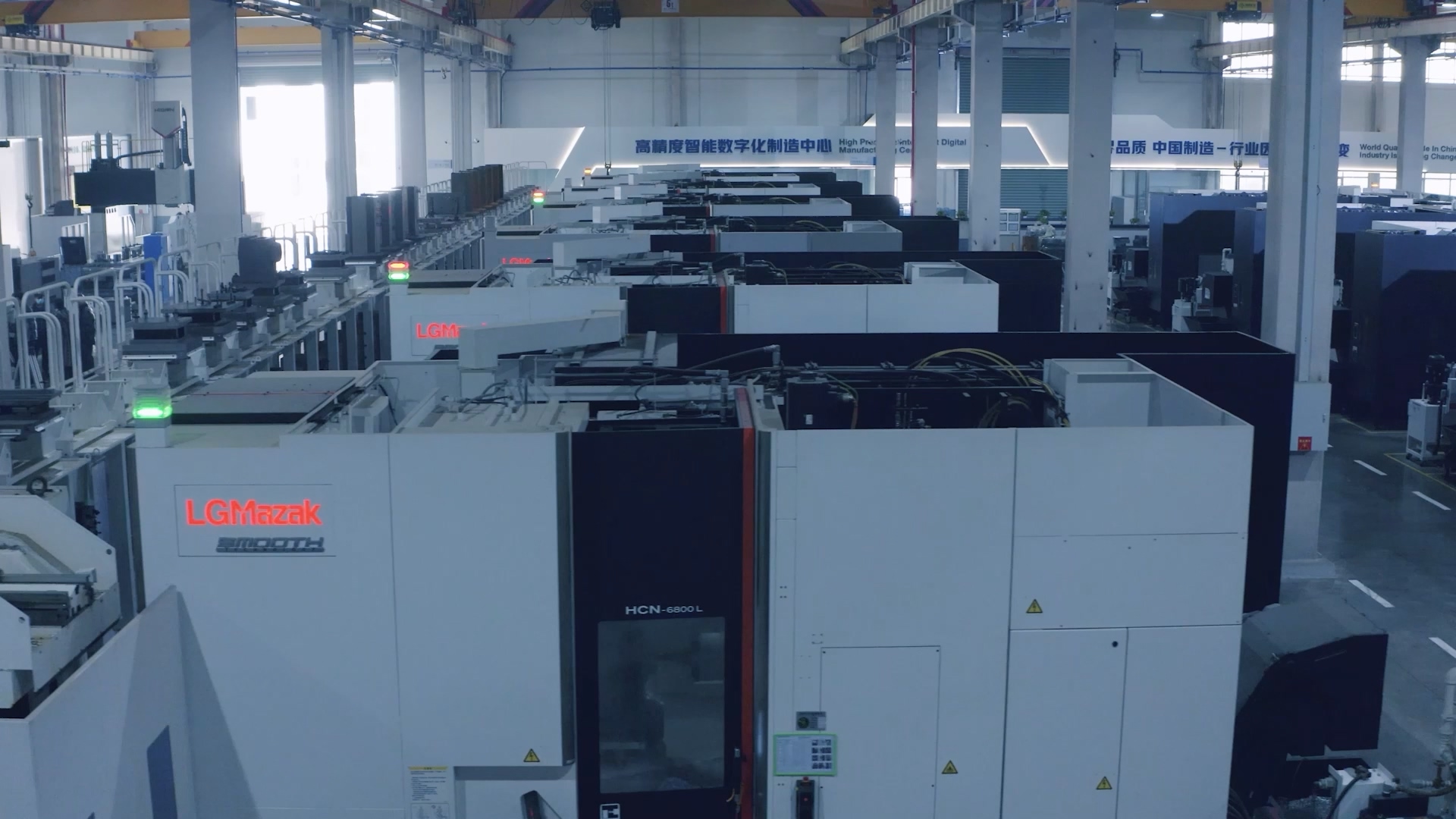
Figure 1: Automated Japanese MAZAK flexible CNC production line machining structural side panels inside OYANG’s 130,000 m² manufacturing complex.
Inside OYANG’s manufacturing base, all machine structural wall panels, knife mandrels, and bottom folding cylinders are machined using Japanese MAZAK and OKUMA CNC multi-axis centers to flatness and concentricity tolerances of ≤ 0.015 mm. This structural rigidity guarantees true shaft parallelism, enabling OYANG converting lines to run continuously at 220 bags/min while maintaining material waste below 1.2%.
Product Catalog: Review full engineering blueprints, speed capabilities, and utility requirements in the OYANG Paper Bag Machine Solution Brochure (PDF).
Video Demonstration: Observe high-speed SOS converting in action: OYANG 16A Automatic Paper Bag Machine Operation Video.
Related Engineering Guides & Technical Resources
Frequently Asked Questions (FAQ)
What is a paper bag machine?
A paper bag machine is an automated industrial converting system that pulls kraft paper from reels or sheets, applies longitudinal adhesive, folds the web into a continuous tube, cuts it to pitch via rotary shear blades, and glues the bottom to produce block-bottom (SOS) or sharp-bottom bags.
What are paper making machines called?
Machines that create raw paper from wood pulp are called Fourdrinier machines or paper mills. In contrast, machines that fold and glue finished paper into commercial packaging bags are classified as paper converting machines or paper bag making machines.
What is the cost of automatic bag making machine in India?
In India, automatic paper bag making machines range from ₹15 Lakhs to ₹45 Lakhs ($18,000 to $55,000 USD) for regional mechanical-cam models, while imported European-standard multi-axis servo lines with inline printing and handle capabilities range from ₹90 Lakhs to ₹2.3 Crore ($110,000 to $280,000 USD).
What is the price of Hanje or Prakash paper bag machines?
Domestic Indian paper bag machines manufactured by brands like Prakash and Hanje typically cost between ₹18 Lakhs and ₹40 Lakhs depending on width specifications, featuring mechanical line shaft drive systems suitable for small-to-medium regional manufacturing runs.
What machines are needed to make paper bags in a commercial plant?
A complete industrial line requires a primary roll-fed square-bottom paper bag machine, an inline flexographic printing press, a paper roll slitter rewinder, an automatic paper rope handle pasting unit, and an automated flat-belt collection and bundling station.
What is the price of a paper carry bag manufacturing machine?
A fully automatic paper carry bag machine equipped with inline twisted or flat handle applicators typically costs between $110,000 and $190,000 for standard speeds (130 to 180 bags/min), and up to $280,000 for high-speed automated size-change models operating above 200 bags/min.