

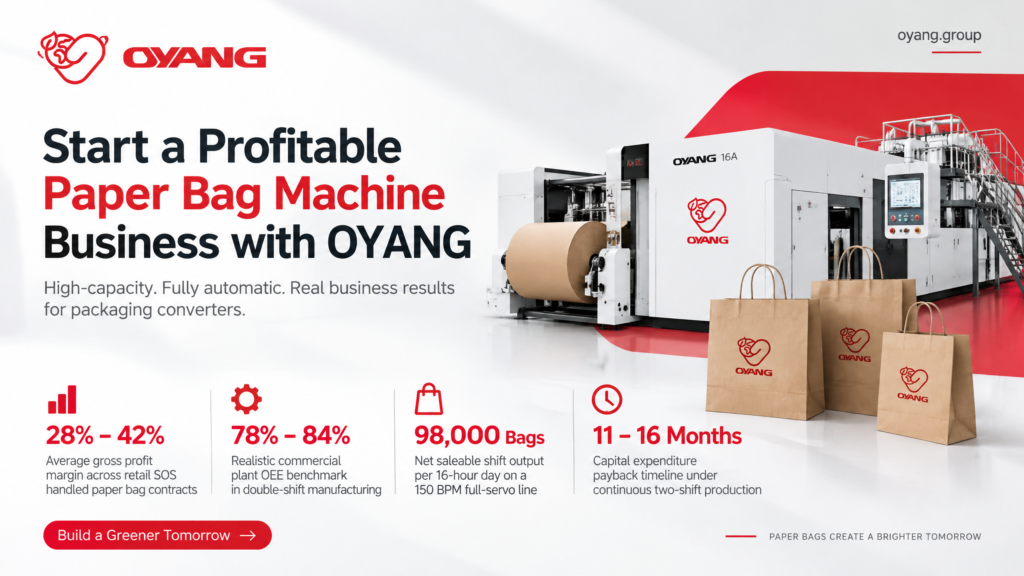
Launching an industrial paper bag making machine business (evaluated by packaging converters as establishing a paper bag machine business with a high-capacity paper bag production machine, paper bags production machine, or paper bag producing machine) yields typical gross operating margins of 28% to 42% and a full capital payback period of 11 to 16 months. Operating a fully automatic roll-fed platform like the OYANG 16A or SMART-17 across standard two-shift schedules (16 operating hours/day) at 78% Overall Equipment Effectiveness (OEE) generates 95,000 to 110,000 finished handled bags per day. With single-unit production costs averaging $0.068 to $0.075 USD for handled retail sacks against wholesale market contract values of $0.115 to $0.150 USD, an optimized converting facility delivers daily gross operating profits of $4,300 to $6,800 USD, enabling reliable capital amortization within 12 to 18 months of commercial launch.
Unit Economics: Bill of Materials & Converting Cost Per Bag
Sustaining commercial viability in a paper bag machine business requires managing raw material inputs and waste scrap. Unlike general print operations where labor dominates operational expense, paper bag conversion is material-intensive: raw kraft paper reels account for 65% to 75% of total variable expense.
The cost breakdown below details the manufacturing expenses for producing 1,000 standard retail shopping bags (Size: 280 mm Face × 150 mm Gusset × 320 mm Tube Height, 100 GSM virgin sack kraft, twisted paper handles) running on an OYANG 16A Paper Bag Machine:
| Input Material / Cost Item | Technical Consumption Metric | Cost Per 1,000 Bags (USD) | Unit Cost Per Bag (USD) |
|---|---|---|---|
| Virgin Kraft Paper Web (100 GSM) | 57.8 kg net paper (includes 1.8% trim scrap) | $49.13 USD ($850/ton benchmark) | $0.0491 USD |
| Twisted Paper Rope & Kraft Patches | 720 m rope (dia. 4.0 mm) + 7.8 kg patch strip | $11.80 USD | $0.0118 USD |
| Water-Based PVAc Seam & Bottom Glue | 2.2 kg liquid cold emulsion (1,400 mPa·s) | $3.52 USD ($1.60/kg) | $0.0035 USD |
| EVA Fast-Setting Hot-Melt Adhesive | 0.55 kg adhesive for handle patch bonding | $1.43 USD ($2.60/kg) | $0.0014 USD |
| Electrical Power & Pneumatic Air | 17.2 kWh line power + compressor utility | $2.24 USD ($0.13/kWh) | $0.0022 USD |
| Direct Production Labor Overhead | 1 Operator + 1 Packing Helper (110 BPM net) | $1.82 USD ($12.00/hr blended) | $0.0018 USD |
| Machinery Depreciation Reserve | Straight-line 7-year CapEx amortization | $1.65 USD | $0.0016 USD |
| Total Manufacturing Cost (COGS) | 1,000 Finished Carrier Bags | $71.59 USD | $0.0716 USD / Bag |
For mathematical models examining how paper grammage and trim margins influence production expenses, read our detailed analysis on how much does it cost to produce a paper bag: Cost calculation formulas.
To evaluate variations between flat food bags, satchels, and handled shopping sacks, review our factory pricing guide on paper bag manufacturing cost: Unit cost and pricing guide.
Two-Shift Industrial Production & OEE Efficiency Modeling
Financial projections that assume 100% continuous runtime often encounter operational friction on the factory floor. Realistic business planning must incorporate Overall Equipment Effectiveness (OEE), which tracks availability, performance efficiency, and product quality:
1. Operational Availability Factor (A = 88.5%)
In a typical 16-hour double-shift day (960 total gross operating minutes), non-operating periods include: master roll changeovers (35 minutes across 7 jumbo reels), daily adhesive replenishment and doctor blade cleaning (25 minutes), shift handover inspections (20 minutes), and minor paper web-break clearances (30 minutes). Net productive run time averages 850 minutes per day.
2. Kinematic Performance Factor (P = 91.2%)
While a modern machine like the OYANG 16A possesses a maximum mechanical velocity of 150 bags/min, continuous operational production on 100 GSM kraft paper is balanced at a sustained running speed of 130 bags per minute to prevent web flutter and glue misting. Theoretical output over 850 operating minutes yields 110,500 bags; net converted output is 100,776 bags per day.
3. Quality Yield Factor (Q = 98.2%)
Thanks to closed-loop ultrasonic edge positioning, servo tension dancers, and electronic camming cutoffs, total process scrap (including roll startup tails, splice transitions, and print mark sensor re-indexing) is restricted to ≤ 1.8%. Net saleable, commercial-grade bags total 98,962 units per working day, generating an overall OEE of 79.3%.
Engineering Video: High-Speed Paper Bag Converting Line Workshop Running
Observe continuous roll feeding, automatic tension control, inline handle creation, and high-speed bag collection in this production video:
Video 1: Commercial SOS carrier bag manufacturing running on the OYANG 16A automatic converting line.
12- to 18-Month Financial Payback Schedule (ROI Model)
The investment model below outlines the capital amortization timeline for a commercial packaging facility commissioning an OYANG 16A Line ($138,000 USD FOB + $48,000 USD utility, shipping, and initial working capital = $186,000 USD Total Turnkey CapEx). The model assumes 24 operating days per month across two 8-hour shifts:
| Operational Phase | Monthly Output (Units) | Monthly Gross Revenue | Net Operating Profit | Cumulative Capital Balance |
|---|---|---|---|---|
| Month 1: Ramp-Up | 950,000 bags (40% load) | $114,000 USD (@$0.120) | $6,840 USD | -$179,160 USD |
| Month 2: Calibration | 1,450,000 bags (60% load) | $174,000 USD | $12,320 USD | -$166,840 USD |
| Month 3–4: Commercial Steady | 2,050,000 bags/mo (85% load) | $246,000 USD / mo | $18,450 USD / mo | -$129,940 USD |
| Month 5–8: Contract Optimization | 2,375,000 bags/mo (Target OEE) | $285,000 USD / mo | $22,560 USD / mo | -$39,700 USD |
| Month 9–10: Full Production | 2,375,000 bags/mo | $285,000 USD / mo | $22,560 USD / mo | +$5,420 USD (Breakeven Achieved) |
| Month 12–14: Pure Operating Profit | 2,375,000 bags/mo | $285,000 USD / mo | $22,560 USD / mo | +$73,100 to +$118,220 Net Cash |
This commercial financial projection confirms that a well-managed paper bag converting operation amortizes its total turnkey equipment investment within 9.8 to 11.5 months under standard double-shift schedules, achieving pure operating free cash flows of over $22,000 USD per month thereafter.
For detailed advice on factory facility zoning, cleanroom HVAC considerations, and master roll handling layouts, explore our complete setup resource on paper bag manufacturing business setup: Complete CapEx & ROI guide.
For converters reviewing comparative economics across international packaging markets, consult our comprehensive report on paper packaging profitability and global machinery cost guide.
Related Technical Guides & Business Resources
- → Paper Bag Manufacturing Business Setup & ROI Guide: Strategic roadmap covering break-even modeling, factory layout footprints, and paper inventory working capital.
- → Paper Bag Manufacturing Cost: Unit Cost & Pricing Guide: Cost modeling across substrates, adhesive consumption, and inline versus offline handle assembly.
- → How Much Does It Cost to Produce a Paper Bag? Cost Formulas: Practical formulas for calculating electrical consumption, trim margins, and adhesive application thicknesses.
- → Paper Packaging Profitability & Global Cost Guide: Equipment economics comparing domestic mechanical lines with high-speed automated machinery.
Frequently Asked Questions (FAQ)
Is starting a paper bag making machine business profitable?
Yes. Industrial paper bag manufacturing delivers gross operating margins ranging from 28% to 42%. With standard retail carrier bags costing between $0.068 and $0.075 USD to manufacture and selling for $0.115 to $0.150 USD in commercial wholesale quantities, an automated line operating double shifts generates daily gross profit of $4,300 to $6,800 USD.
What is a realistic OEE benchmark for a double-shift paper bag production machine?
A realistic commercial OEE benchmark ranges between 78% and 84%. Over a 16-hour double shift (960 operating minutes), accounting for master roll changes, glue refills, shift handovers, and trim scrap, a machine rated for 150 bags/min will deliver approximately 95,000 to 105,000 finished, commercially saleable bags per day.
How long does it take to recoup the initial capital investment in a paper bag production line?
Under commercial conditions operating two shifts per day with secured retail or grocery packaging supply contracts, an automated line like the OYANG 16A typically achieves full capital payback within 11 to 16 months. The payback window depends on factory OEE, paper substrate scrap rates, and wholesale contract pricing.
What constitutes the largest ongoing cost in a paper bag manufacturing business?
Raw kraft paper roll inventory represents the largest ongoing cost, accounting for 65% to 75% of total unit manufacturing expense. For this reason, optimizing web tension control and maintaining trim scrap rates below 2.0% are the primary mechanical factors in maintaining profitability.