

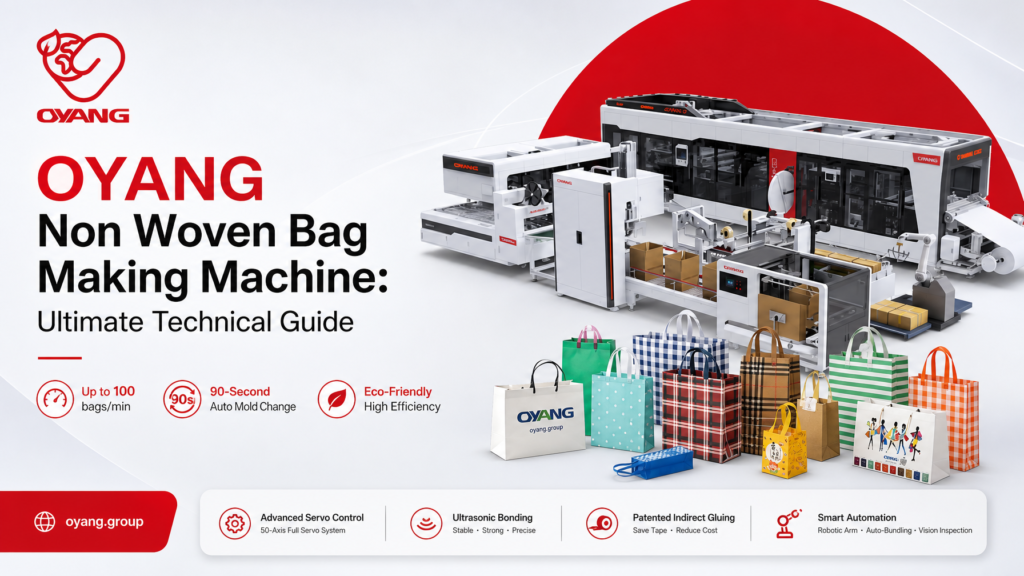
An OYANG non woven bag making machine is an automated, multi-axis servo converting line engineered to process 30 to 120 GSM polypropylene (PP) spunbond non-woven fabric and recyclable RPET rollstock into finished 3D box bags, D-cut flat bags, and soft-loop handle carry bags. Operating at verified velocities of up to 90 to 100 bags per minute, OYANG flagship platforms (including the TECH 23 and TECH 26) incorporate a patented 50-axis servo 90-second motorized automatic mold changeover system, cutting dimensional setup downtime by 95%. Coordinated via closed-loop auto-tuning ultrasonic generators and stress-relieved HT250 gray cast-iron frames machined to ≤ 0.015 mm tolerances on Japanese MAZAK and OKUMA 5-axis CNC centers, these lines restrict fabric waste to under 1.5% while integrating intermittent indirect glue saving.
Core Engineering Challenges in High-Speed Nonwoven Converting
In high-speed eco-packaging manufacturing, traditional conversion setups face three critical operational bottlenecks: excessive downtime during dimensional mold changeovers, runaway hot-melt or double-sided tape consumption, and mechanical frame deflection that destabilizes ultrasonic horn welding when line speeds exceed 60 bags/min.
Ultrasonic Sealing Stability: Dynamic Resonance & Horn Tuning
Ultrasonic bonding relies on high-frequency acoustic friction (typically 20 kHz) to melt thermoplastic fibers at microscopic contact points within milliseconds. In continuous conversion lines, if chassis wall panels vibrate by even ±0.05 mm, dynamic horn gap pressure fluctuates erratically, triggering joint crystallization failures or fabric pinhole burn-through.
OYANG replaces open-loop mechanics with a closed-loop digital acoustic architecture synchronized directly to the line’s master EtherCAT multi-axis servo bus:
Auto-Tuning Frequency Lock
Digital generators track sonotrode thermal expansion in real time, maintaining resonance within a tight ±10 Hz window to prevent acoustic impedance mismatch trips at 100 bags/min.
Dynamic Amplitude Compensation
Closed-loop power regulation modulates horn vibration amplitude across 30 to 120 GSM fabric fluctuations, producing hermetic corner-gusset welds without fabric scorch.
Milled Titanium Sonotrodes
Precision titanium alloy horns deliver uniform energy distribution across multi-layer handle welds, consistently exceeding 150 N tensile pull resistance.
By machining all structural wallboards on Japanese MAZAK CNC lines to flatness tolerances within ≤ 0.015 mm, harmonic frame resonance is eliminated, holding overall fabric scrap rates strictly under 1.5%.
Technical Comparison: OYANG High-Speed Nonwoven Box Bag Machines
Equipment selection depends upon planned output volumes, target bag configurations, and downstream packaging automation. Below is the technical specification matrix across OYANG’s flagship 3D box bag series:
| Technical Parameter | OYANG SMART 19 | OYANG TECH 23 (Flagship) | OYANG TECH 26 |
|---|---|---|---|
| Max Production Speed | 80 – 100 bags/min | 90 – 100 bags/min | 90 – 100 bags/min |
| Mold Changeover Time | Assisted Guided Setup | 90 Seconds (Fully Automatic) | 90 Seconds (Fully Automatic) |
| Servo Motion Architecture | Multi-axis Bus Control | 50-Axis Full Servo Bus | Advanced Multi-Axis Full Servo |
| Adhesive Application System | Optional Indirect Applicator | Indirect Tape Applicator (Patented) | Indirect Tape Applicator (Patented) |
| Downstream Labor Integration | Standard Stacking Belt | Robotic Arm + Auto-Bundling | Robotic Arm + Auto-Bundling |
| Max Bag Forming Width | Up to 480 mm | Up to 500 mm | Up to 540 mm (Ultra-Wide) |
For detailed configuration pricing models and servo axis breakdowns across these platforms, consult our comprehensive guide on non woven box bag machine price models and servo specifications.
Patented Indirect Gluing: Consumable Cost Reduction Model
Conventional non-woven box bag machines apply double-sided adhesive tape continuously across the full web width. OYANG’s patented Indirect Tape Applicator (standard on the OYANG 18 and TECH 23) intermittently dispenses adhesive tape, skipping the inward-folded side gussets where tape provides zero bonding utility.
Consumable Adhesive Cost Reduction Calculation
Annual Savings = Daily Bag Output × Annual Operating Days × Saved Gusset Tape Length × Unit Tape Cost
Industrial Baseline Parameters:
• Daily Output: 80,000 bags/day (two 10-hour shifts at 80–100 bags/min running at 85% OEE)
• Annual Production Days: 300 operating days/year (24,000,000 total finished bags)
• Saved Tape Length per Bag: 140 mm (0.14 m) skipped across both side gussets
• Industrial Tape Unit Cost: $0.0049 USD per meter ($4.90 USD per 1,000-meter commercial spool)
Engineering Result: Eliminating continuous tape prevents cutter gumming shutdowns while recovering over $16,800 USD in liquid operating capital annually per machine.
For a deep dive into the pneumatic cam retraction physics and sensor synchronization, review our dedicated guide on non woven box bag machines with indirect tape applicators and our plant-wide non-woven bag manufacturing profit margin and cost breakdown.
Why Precision Machining Determines Machine Working Lifespan
A fully automatic 3D box bag line is a complex mechatronic assembly operating under continuous mechanical cyclic stresses. Within OYANG’s 130,000 m² smart manufacturing base, all load-bearing chassis frames and drive shafts are machined in temperature-controlled bays to preserve dynamic geometry across 15+ years of continuous service:
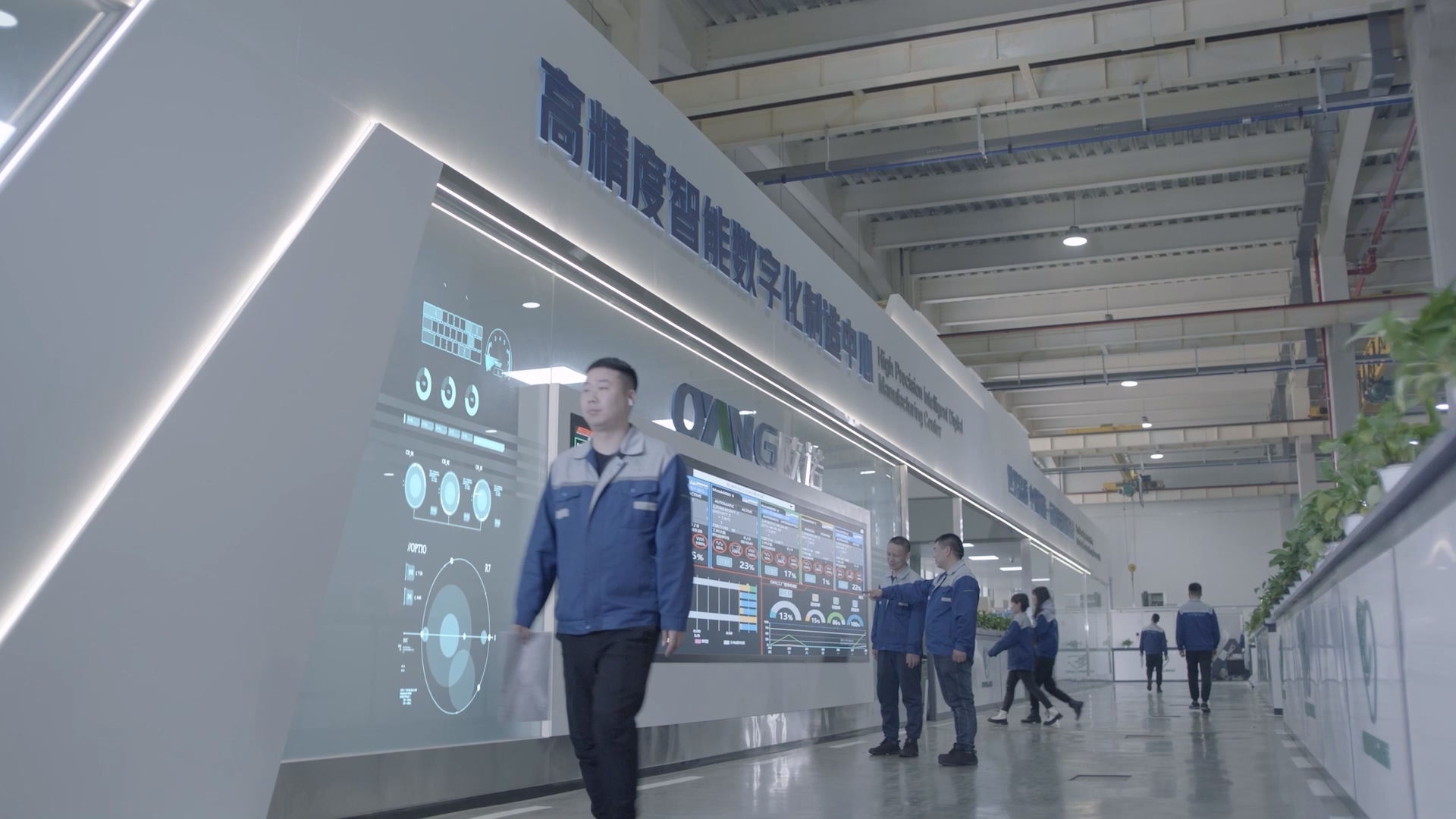
Figure 1: Digital manufacturing operations management center supervising Japanese MAZAK CNC cells at OYANG Group.
All chassis side plates, gear housings, and horn slide guides are cast from stress-relieved HT250 gray cast iron and machined on Japanese MAZAK and OKUMA 5-axis CNC machining centers. Holding cumulative datum tolerances to ≤ 0.015 mm eliminates mechanical backlash, ensures smooth web tracking, and protects ultrasonic transducers from premature acoustic failure.
Featured Flagship Nonwoven Converting Platforms

Figure 2: The OYANG TECH 23 Fully Automatic Nonwoven Box Bag Making Machine converting 90–100 bags/min with patented 90-second automated mold changeover.
- 90-Second Motorized Mold Change: Single-touch dimensional adjustment powered by a 50-axis servo topology, eliminating manual mechanical alignment.
- Turnkey Downstream Labor Reduction: Integrated inline robotic stacking and automatic bundling reduce manual packing labor by 2 operators per shift.
- Inline Machine Vision Inspection: Industrial high-speed cameras verify handle weld integrity, print registration, and gusset fold symmetry, automatically diverting non-conforming items.

Figure 3: The OYANG TECH 26 Ultra-Wide Format Box Bag Machine delivering bag widths up to 540 mm at 100 bags/min continuous velocity.
Video 1: Factory demonstration of the OYANG TECH 23 machine showcasing continuous 100 BPM box bag forming, 90-second motorized changeover, and inline soft-loop handle welding.
Related Technical Guides & Converting Resources
- → Non Woven Box Bag Machine Price & Specs: Detailed servo topology breakdown, mold changeover mechanics, and official procurement cost tiers.
- → Non Woven Box Bag Machine with Indirect Tape Applicator: Dual-sensor intermittent skip taping, cam retraction kinetics, and $16,800/year adhesive cost model.
- → Non-Woven Bag Manufacturing Profit Margin & Cost Guide: Raw PP granulate vs fabric conversion costs, plant electricity metrics, and finished bag unit pricing.
Frequently Asked Questions (FAQ)
How long does it take to change bag sizes on an OYANG machine?
On traditional mechanical bag machines, changing bag specifications requires 30 to 60 minutes of manual tool adjustment. On the OYANG TECH 23 and TECH 26 models, the integrated 50-axis servo system enables a fully automatic motorized mold changeover in under 90 seconds via the central touchscreen HMI.
What raw materials are required for 3D box bag production?
The primary raw material is PP (Polypropylene) spunbond nonwoven fabric rollstock (30–120 GSM). For high-end laminated packaging, BOPP printed film laminated nonwoven fabric is utilized. OYANG machines also support 100% recyclable RPET (Recycled Polyethylene Terephthalate) fabrics, which deliver over 5 times the operational durability of standard disposable bags.
Does OYANG provide complete smart factory solutions?
Yes, OYANG is a full-chain converting supplier. Beyond bag makers, we manufacture PP spunbond nonwoven production lines, high-speed fabric slitting machines, inline flexographic and screen printing units, and downstream automated bagging systems (such as the ONL-BP500) integrated directly into automated 3D warehouses.
How does precision machining impact ultrasonic welding consistency?
All OYANG machine chassis side plates are cast from stress-relieved HT250 iron and machined on Japanese MAZAK and OKUMA 5-axis CNC machining centers to tolerances of ≤ 0.015 mm. This structural rigidity suppresses harmonic frame vibration during high-speed runs, preventing ultrasonic horn misalignment and acoustic frequency drift.