350x97.png)
350x97.png)
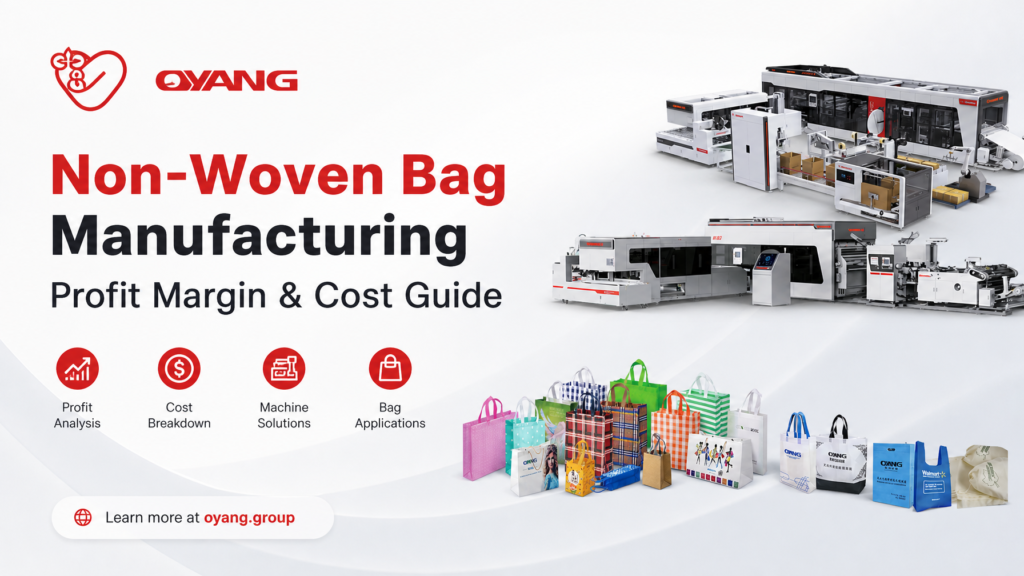
Non-Woven Bag Manufacturing Profit Margin & Financial Feasibility Analysis
The typical profit margin for non-woven bag manufacturing ranges between 12% and 22% for fully automatic 3D box bags, compared to 5% to 8% for commoditized D-cut carry bags. A standard 60 GSM non-woven shopping bag costs between $0.052 and $0.068 to manufacture, generating a net profit of $0.012 to $0.024 per unit. For high-speed production lines operating at 80,000 to 100,000 bags per day, the average capital payback period is 9 to 14 months.
Is Bag Making a Profitable Business? Margin Breakdown Across Bag Architectures
Non-woven conversion is driven by global single-use plastic bans and retail demand for durable, reusable carrier packaging. However, plant profitability is fundamentally determined by equipment topology and bag structure rather than simple raw material weight.
Converters operating legacy semi-automatic lines face intense commoditization on flat D-cut bags, where gross margins often sit below 10%. In contrast, industrial converters running automated 3D box bag production lines capture premium commercial pricing by delivering superior structural box aesthetics, reinforced ultrasonic handle welding, and inline flexographic or gravure printing.
| Bag Format | Fabric Weight (GSM) | Avg. Wholesale Selling Price (USD) | Total Production Cost (USD) | Typical Net Margin (%) |
|---|---|---|---|---|
| Flat D-Cut Shopping Bag | 40–60 GSM | $0.045 – $0.058 | $0.041 – $0.053 | 6% – 9% |
| W-Cut / T-Shirt Grocery Bag | 30–50 GSM | $0.038 – $0.048 | $0.035 – $0.044 | 5% – 8% |
| Fully Automatic 3D Box Bag (Standard) | 60–80 GSM | $0.085 – $0.115 | $0.068 – $0.088 | 16% – 22% |
| Laminated Box Bag with Handle | 70–120 GSM (BOPP/PP) | $0.140 – $0.220 | $0.105 – $0.165 | 18% – 25% |
What is the Manufacturing Cost of Non-Woven Bags? (60, 70, and 80 GSM Model)
To establish an accurate cost-of-goods-sold (COGS) model, we calculate unit economics based on an industrial non-woven carrier bag measuring 320mm (Width) × 280mm (Height) × 100mm (Bottom/Side Gusset) with a 450mm × 25mm ultrasonic welded handle loop.
Calculations reflect baseline polypropylene (PP) spunbond roll costs at $1.40/kg, industrial electricity at $0.12/kWh, and factory labor amortized over automated 2-shift operations:
| Cost Component | 60 GSM 3D Box Bag | 70 GSM 3D Box Bag | 80 GSM 3D Box Bag |
|---|---|---|---|
| Raw Fabric Substrate (PP Spunbond) | $0.0392 (approx. 28.0g) | $0.0458 (approx. 32.7g) | $0.0524 (approx. 37.4g) |
| Ultrasonic Handle Material | $0.0042 | $0.0049 | $0.0056 |
| Power & Ultrasonic Consumption | $0.0028 | $0.0031 | $0.0035 |
| Direct Labor (1 Operator per Line) | $0.0032 | $0.0032 | $0.0032 |
| Equipment Depreciation (5-Year Amort.) | $0.0025 | $0.0025 | $0.0025 |
| Factory Overhead & Packaging Scrap | $0.0021 | $0.0024 | $0.0027 |
| Total Manufacturing Cost (COGS) | $0.0540 / unit | $0.0619 / unit | $0.0699 / unit |
What is the price of a 60 GSM non-woven bag? Wholesale market selling prices for a finished 60 GSM 3D box tote bag typically range from $0.075 to $0.095 USD. This yields a net operational margin of $0.021 to $0.041 per finished bag on fully automated production equipment.
Cash Flow Simulation: Payback Period for an 80,000–100,000 Daily Capacity Plant
An industrial conversion line, such as the OYANG 18 or SMART 19, operating at 90 bags/min over two 10-hour shifts with an Overall Equipment Effectiveness (OEE) of 88%, produces approximately 95,000 box bags per day.
- Daily Gross Production: 95,000 bags/day × 26 operating days/month = 2,470,000 bags/month.
- Monthly Revenue (@ $0.082 avg wholesale price): $202,540 USD.
- Monthly Total Manufacturing Costs (@ $0.062 COGS): $153,140 USD.
- Net Monthly Operating Profit (EBITDA): $49,400 USD.
- Capital Expenditure: OYANG 18 automated line ($99,000–$119,000 FOB export benchmark) + auxiliary slitting and air support ($15,000) = approx. $125,000 total machinery capex.
- Estimated Capital Payback Period: 2.5 to 4.5 Months under full order capacity, and 9 to 14 Months when factoring initial 60% production ramp-up, working capital, and supply chain lead times.
How to Start a Non-Woven Bag Manufacturing Business: 5 Engineering Steps
Establishing a high-throughput carry bag manufacturing operation requires disciplined site selection, power balancing, and supplier integration:
- Factory Footprint & Electrical Infrastructure: Allocate a minimum of 450–600 m² for one automated converting line, fabric roll warehouse, and palletized packing area. Ensure stable 3-phase industrial power (380V/415V, 50/60 Hz) with an installed load of 45–65 kW, plus a dedicated screw air compressor delivering 0.8–1.2 m³/min at 0.6–0.8 MPa.
- Upstream Substrate Sourcing: Secure direct relationships with PP spunbond fabric mills. Target rolls with cross-direction tensile strength ≥ 35 N/5cm and minimal thickness variance to prevent web stretch in continuous servo pulling units.
- Machinery Selection (Box vs Flat): Avoid entry-level manual stitching setups. Manual assembly lines require 15–20 sewing operators to match a single automated machine, suffering scrap rates of 8%–12% compared to ≤ 1.5% on precision servo-driven ultrasonic converting lines.
- Environmental & Compliance Certification: Obtain local industrial manufacturing permits, pollution control clearances (non-woven ultrasonic bonding produces zero liquid effluent and minimal fumes), and ISO 9001 / CE certifications for retail export contracts.
- Automated Packing & Warehouse Logistics: Integrate inline automatic bundle packing (such as the ONL-BP500) to feed finished bags directly into balers, keeping handling labor strictly capped at 1 operator per converting line.
Why Mechanical Precision Drives Plant Profitability: The OYANG Advantage
In high-speed conversion, equipment vibration is the primary driver of unexpected scrap. When a line cycles 100 times per minute, minute deviations in dynamic alignment cause ultrasonic horn frequency drift, unbonded bag gussets, and continuous operator stops.
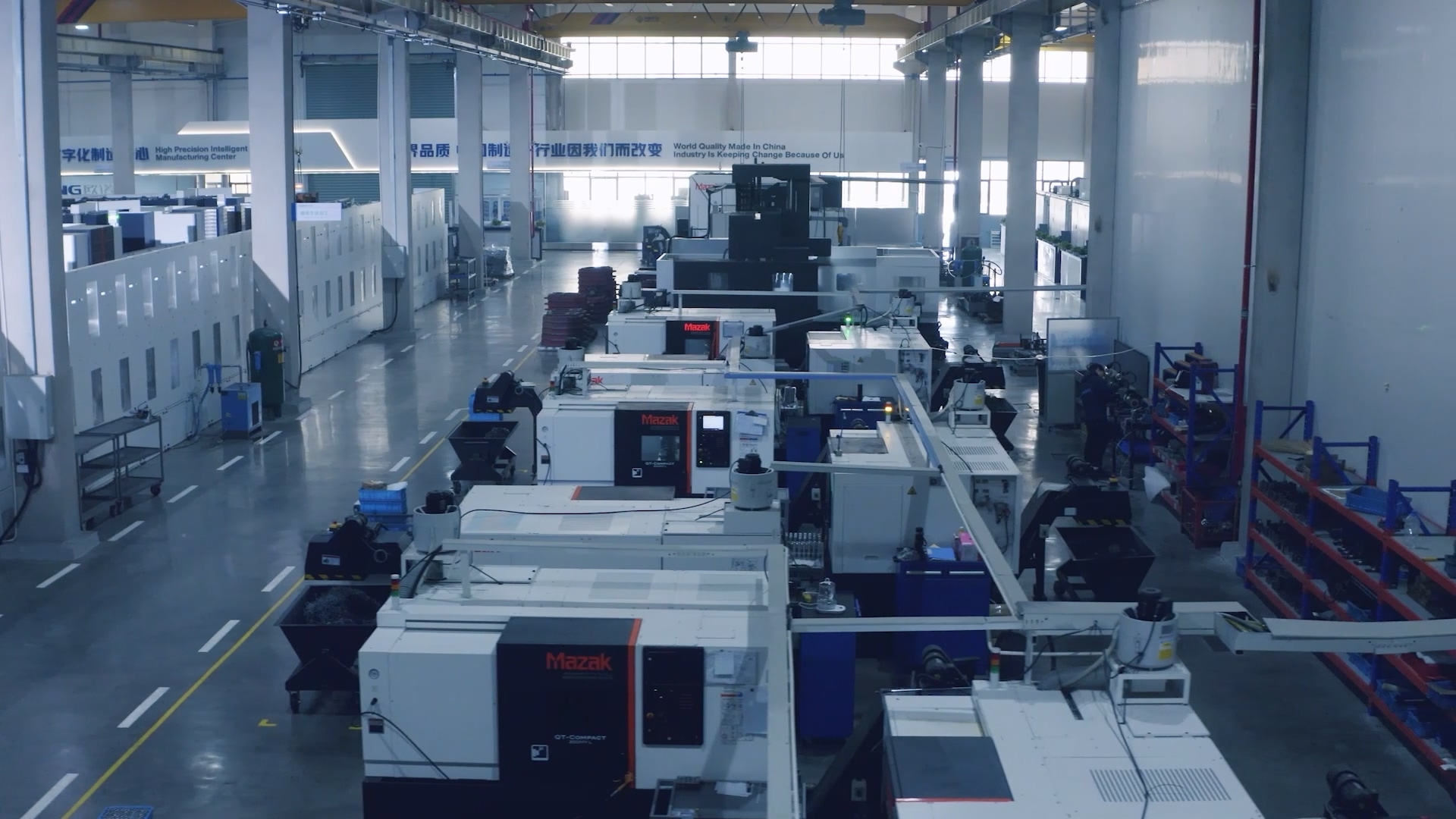
OYANG Group eliminates structural resonance by processing all chassis wall panels, eccentric shafts, and cutting housings on Japanese MAZAK and OKUMA CNC machining lines to flatness tolerances within ≤ 0.015mm. This guarantees consistent ultrasonic welding pressure across shifts, lowering fabric waste from industry averages of 5% down to under 1.5%, directly preserving converter gross margins.
Recommended Converting Machinery for High-Margin Bag Production

OYANG-18 Automatic Box Bag Machine
Operates at 80–100 pcs/min with inline indirect tape application and reinforced handle sealing. The industry benchmark for commercial shopping bag conversion.
View Machine Specifications
TECH-23 Flagship Box Bag Cell
Features 90-second automated mold changeover and continuous bus-servo synchronism running 90–100 bags/min. Engineered for rapid order switching and export volumes.
View Machine Specifications
XB700/800 5-in-1 Multi-Format Line
Flexible conversion line running flat bags, D-cut shopping bags, and shoe bags at 40–100 pcs/min. Ideal entry point for regional packaging suppliers.
View Machine Specifications