350x97.png)
350x97.png)
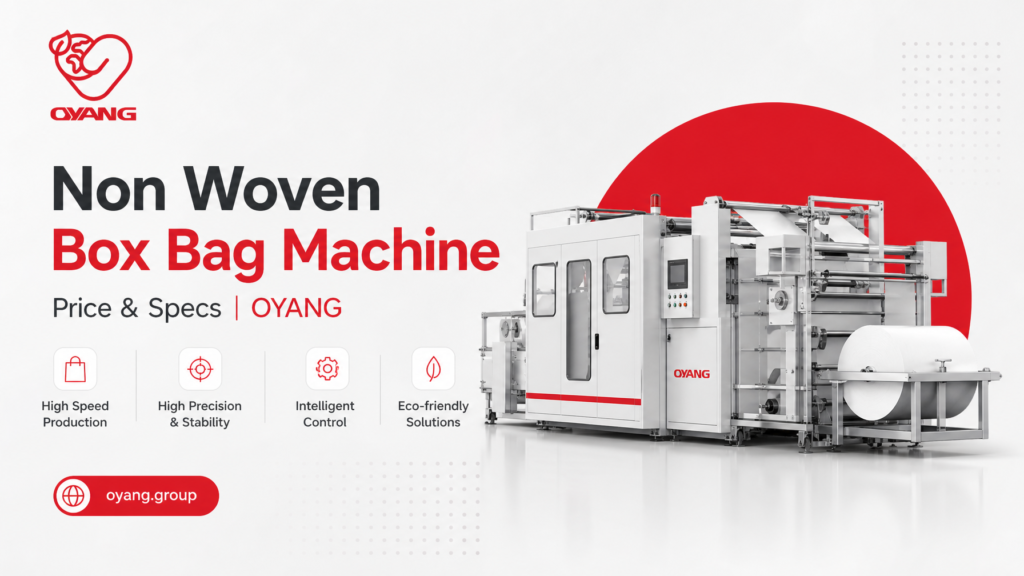
Fully Automatic Non Woven Bag Making Machine Price & Configuration Breakdown
The investment budget for a commercial fully automatic non woven bag making machine price ranges between $55,000 and $130,000+ USD on standard FOB terms, primarily determined by multi-axis servo topology (scaling from 15 to 46+ axes), structural wallboard casting thickness (25 mm to 35 mm), and integrated automation modules such as indirect tape applicators and automated mold changeover. While entry-level 15-servo converting cells operating at 60 to 80 bags/min sit in the $65,000 to $75,000 USD bracket, industrial-grade bus-synchronized 36-to-46-servo flagships delivering 90 to 100+ bags/min command between $95,000 and $130,000 USD.
The Engineering Behind Machine Pricing: Where Does the Capital Go?
When evaluating an official box bag machine price list from Chinese manufacturers, significant price discrepancies stem from internal mechanical, electrical, and structural hardware differences:
Precision Mechanical & Structural Castings
Heavy grey cast iron wallboards (25–35 mm) precision-milled on 5-axis Japanese CNC centers prevent harmonic vibration at 100 BPM, directly defining machine longevity and bearing seat alignment.
Multi-Axis Servo & Fieldbus Topology
Moving from line-shaft mechanical chains to 24, 36, or 46 independent synchronous servo drives (Inovance / Schneider / Siemens) with EtherCAT or PROFINET communication dramatically raises component hardware value.
Ultrasonic Sonotrodes & Auto-Tuning Generators
High-grade aviation titanium alloys and digital auto-tracking 15/20 kHz ultrasonic generators ensure uniform seam strength, eliminating thermal burn-through during line ramp-up.
Assembly Calibration & Multi-Shift FAT Testing
Rigorous 72-hour continuous pre-shipment Factory Acceptance Testing (FAT), dynamic laser alignment, and CE compliance certification ensure zero on-site commissioning delays.
Equipment Configuration Matrix: Machine Tiers & Budget Allocations
To assist procurement executives in comparing machine models, the table below provides engineering configurations, rated velocities, and price brackets:
| Machine Model / Generation | Servo Axis Topology | Core Mechatronic Features | Rated Speed | Typical Defect Rate | Budget Range (FOB USD) |
|---|---|---|---|---|---|
| OYANG 15 / 16S Series | 15 – 20 Servos | Auto handle centering, bag mouth EPC, manual format adjustments | 60 – 80 bags/min | ≤ 5.0‰ | $62,000 – $75,000 |
| OYANG 16 / 18 Series | 24 Servos | Patented indirect tape applicator, automatic handle centering, digital web tracking | 80 – 100 bags/min | ≤ 4.0‰ | $78,000 – $92,000 |
| OYANG 17 / SMART 19 Series | 36 Servos | Auto-adjusting folder, indirect gluing, guided HMI recipes, auto edge trim | 90 – 100 bags/min | ≤ 3.5‰ | $95,000 – $112,000 |
| TECH 23 Flagship Platform | 46 Servos | Full EtherCAT bus control, 90-second motorized auto mold change, indirect tape | 90 – 100 bags/min | ≤ 3.0‰ | $115,000 – $130,000 |
| TECH 26 Premium Concept Line | Full Servo (~100 axes) | Rivet attachment, bottom tuck-in, ribbon handle, auto packing & auto reject | Up to 120 bags/min | ≤ 0.25‰ | $260,000 – $290,000 |
Engineering Analysis: What Causes a $30,000 Price Difference?
First-time buyers often ask why an entry-level platform costs around $65,000 while advanced models reach $100,000+. The mechanical distinctions directly impact operational profitability:
1. Structural Frame: Fabricated Steel Tubes vs Solid Meehanite Cast Iron
Budget machines utilize welded square steel tubing that distorts after 12 to 18 months of continuous cyclic loading. OYANG utilizes stress-relieved solid Meehanite cast wallboards (up to 35 mm thick) machined to ±0.015 mm tolerances, completely absorbing vibration when running at 100 bags/min.
2. Drive Topology: Line-Shaft Chains vs Distributed EtherCAT Servos
Older machines rely on a single central AC motor driving long mechanical shafts, chains, and bevel gears. Mechanical backlash increases with wear, causing eye-mark registration to drift ±3.0 mm and creating high scrap rates. Fully independent servo networks synchronize axis positions down to 0.1 milliseconds over digital fieldbus lines, holding cut accuracy strictly within ±0.5 mm.
3. Adhesive Consumable Optimization: Continuous vs Indirect Tape Applicator
Continuous tape mechanisms waste adhesive across the side gusset. OYANG machines equipped with patented indirect tape applicators intermittently skip the gusset, saving approximately 140 mm of tape per bag and recovering up to $16,800 USD annually in consumable expenses.
Japanese MAZAK & OKUMA CNC Manufacturing Guarantees Machinery Residual Value
Equipment depreciation and five-year residual value depend heavily on initial manufacturing tolerances. A converting line with sloppy gear backlash loses 70% of its asset value within three years.
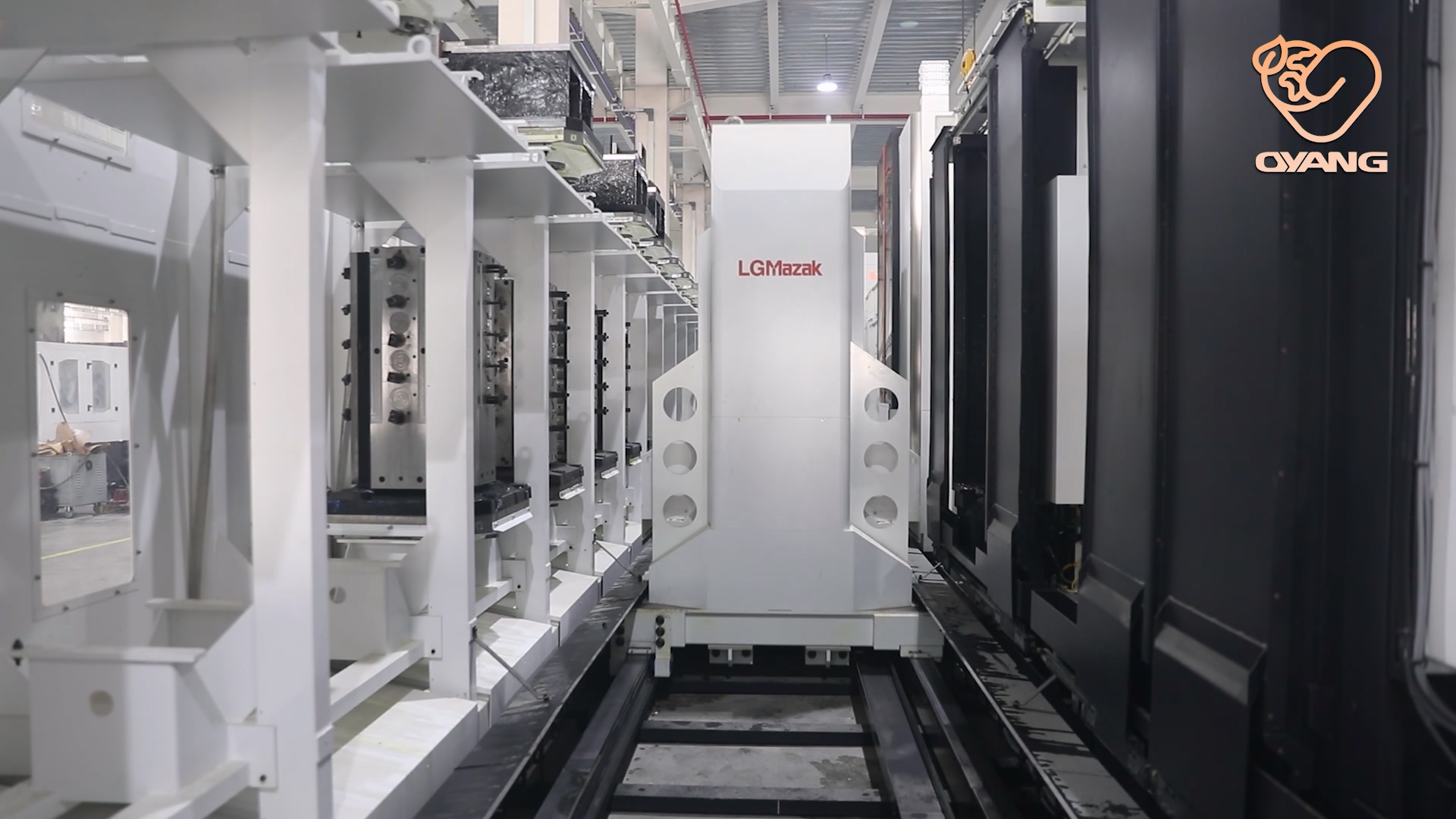
Flexible CNC manufacturing cell at OYANG: Precision processing of machine frames on Japanese MAZAK equipment.
Every structural wallboard, cam track, and guide assembly produced at OYANG is machined on Japanese MAZAK and OKUMA 5-axis CNC machining centers. Holding planar tolerances within ≤ 0.015 mm ensures mechanical harmonics remain balanced, enabling round-the-clock converting at maximum design velocity and preserving high secondary-market resale value.
Featured Converting Machinery Platforms

OYANG 16S Compact Converting Platform
Entry-level automatic box bag platform. 15-servo configuration delivering 60–80 bags/min, dual-mode 3D/flat conversion, and an economical investment threshold.
Explore 16S Specs
TECH-23 High-Speed Flagship Line
46-servo industrial mega-line. Delivers 90–100 bags/min, 90-second motorized automatic mold changeovers, indirect tape application, and low defect rates (≤3‰).
Explore TECH-23 Specs
SMART 19 Advanced Converter
36-servo motion platform. Offers guided touchscreen format recipes, automatic folder adjustments, and balanced high-speed production economics.
Explore SMART 19 SpecsFrequently Asked Questions (FAQ)
What is the price range of a fully automatic non woven bag making machine?
A fully automatic non woven box bag making machine typically ranges from $55,000 to $130,000+ USD on FOB terms, depending on servo axis count, operational speed (60 to 100+ bags/min), and advanced options like motorized auto mold change and indirect tape applicators.
Why are 36-to-46 servo bag machines more expensive than 15-servo models?
Machines with 36 to 46 servos replace mechanical chains and line-shafts with independent electronic motion axes, delivering higher operating speeds (90–100 BPM), faster recipe changeovers, lower defect rates below 3.5 per thousand, and digital format synchronization.
What commercial incoterms and payment terms are standard for machine purchases?
Most international industrial equipment transactions are quoted on FOB Ningbo or CIF destination port terms, with standard payment terms structured as 30% T/T deposit upon order confirmation and 70% balance payment upon successful factory acceptance testing (FAT) prior to shipment.
Does the machine price include installation and on-site operator training?
Standard quotations cover complete factory pre-assembly, running FAT trials, and remote video commissioning; on-site engineer dispatch for physical installation and operator training is readily available with travel and accommodation expenses arranged per customer contract.
What auxiliary equipment is needed alongside the primary box bag machine?
A complete operational plant typically requires a rotary screw air compressor (11 to 22 kW with refrigerated air dryer), roll slitting machinery, and roll-to-roll flexographic or rotogravure printing presses if pre-printed fabric rolls are not purchased from external suppliers.
Request an Itemized Proforma Invoice & Layout Proposal
Receive an official equipment price list, detailed electrical consumption breakdown, and technical layout customized to your target bag dimensions and volume requirements. Contact OYANG’s international engineering sales team.