350x97.png)
350x97.png)
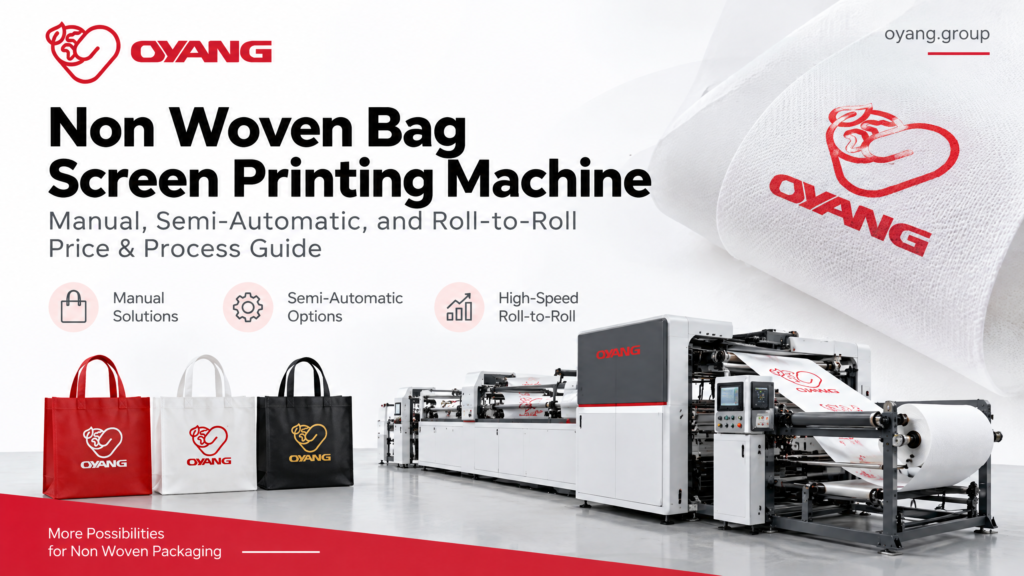
Non Woven Bag Screen Printing Machine: Manual, Semi-Automatic, and Roll-to-Roll Price & Process Guide
Engineered for high-opacity ink laydowns on textured synthetic textiles, an industrial non woven bag screen printing machine delivers ink film thicknesses up to 35 μm—ideal for dense white logos and metallic pigments on dark substrates. While entry-level manual and semi-automatic flatbed presses output 600–900 bags/hour, OYANG’s automated roll-to-roll screen printing lines exceed 3,000 to 4,500 prints/hour using low-temperature IR tunnels and cold-UV curing that eliminate fabric thermal shrink.
1. Operational Throughput: Manual Beds vs. Semi-Auto Flatbeds vs. Roll-to-Roll Automation
For converting facilities producing promotional retail totes, grocery shopping bags, and premium gift sacks, ink deposit opacity often dictates process selection. Flexographic presses apply thin ink films (1.5–3.5 μm), which struggle to produce opaque whites or vibrant gold and silver graphics on colored polypropylene spunbond fabrics. A screen printing machine for non woven bags resolves this opacity deficit by transferring thick paste inks through precision polyester mesh stencils.
However, operating speed varies drastically across machine tiers. A workshop utilizing a non woven bag manual printing machine relies entirely on manual substrate positioning and manual squeegee strokes, resulting in inconsistent pressure and labor fatigue. Transitioning to a continuous roll-to-roll screen printing line removes manual loading entirely, feeding unprinted parent rolls through automated screen stations and drying tunnels before rewinding or feeding straight into bag formers.

Figure 1: OYANG Roll-to-Roll Fully Automatic Nonwoven Screen Printing Machine with closed web tension control.
| Technical Evaluation Vector | Manual Screen Printing Station | Semi Automatic Non Woven Bag Printing Machine | OYANG Roll-to-Roll Automatic Screen Line |
|---|---|---|---|
| Substrate Feed Format | Pre-cut piece or pre-made bag (manual hand lay) | Pre-made bag / cut sheet (hand lay, vacuum bed hold) | Continuous non-woven parent roll (continuous unwinding) |
| Squeegee Stroke Drive | Manual hand stroke (variable speed and angle) | Pneumatic rodless cylinder / variable AC gear motor | High-precision linear servo drive with constant depth lock |
| Practical Output Capacity | 200 – 400 prints/hour (operator dependent) | 600 – 900 bags/hour (limited by hand loading pace) | 3,000 – 4,500 prints/hour (continuous web indexing) |
| Ink Film Thickness Laydown | 12 – 40 μm (uncontrolled film variation) | 18 – 30 μm (consistent pneumatic pressure) | 20 – 35 μm (micrometric micrometer squeegee gauge) |
| Labor Requirement | 1 operator per single color station | 1 operator loading + 1 unloading to rack | 1 supervisory technician for full unwinding/curing line |
If your target capacity demands continuous single-pass bag forming alongside printing, compare this process with our integrated guide on non woven bag making machine with printing. For high-speed rotary printing alternatives on roll goods, review our evaluation of non-woven flexo printing machine: CI vs Stack.
2. Screen Print Mechanics: Squeegee Hardness, Mesh Selection, and Web Thermal Control
Screen printing on a non woven screen printing machine requires precise mechanical setup due to the porous, textured fibrous web of polypropylene spunbond. Insufficient squeegee pressure leads to ink pooling on surface peaks, while excessive force forces ink entirely through the porous interstices, creating ghosting or under-side web contamination.

Figure 2: OYANG Double-Color Roll-to-Roll Nonwoven Screen Printing Press with inline tension guide.
A. Mesh Count & Squeegee Durometer Calibration
- Mesh Specification: Use high-tension low-elongation monofilament polyester mesh. For opaque white and metallics on dark non-woven fabric, calibrate mesh between 80 to 120 mesh/inch (32 to 48 threads/cm). For fine text down to 8pt, step up to 150 to 180 mesh/inch.
- Squeegee Durometer: Polyurethane squeegee blades with a 65° to 75° Shore A hardness profile provide optimal deflection across irregular spunbond surfaces. Squeegee angles should be locked between 65° and 75° with a 2–3mm snap-off off-contact distance.
- Ink Viscosity Management: Water-based non-woven printing pastes must be maintained at 15,000 to 25,000 mPa·s to maintain sharp border edges without dripping through web pores during flood strokes.
B. Thermal Shrink Prevention in IR and UV Drying Chambers
Polypropylene begins thermal deformation at > 65°C and softens rapidly around 130°C. Traditional curing ovens running at 100°C+ will cause irreversible transverse shrinkage, skewing the fabric roll and preventing proper downstream ultrasonic bag forming.
OYANG roll-to-roll screen systems deploy multi-stage low-temperature drying tunnels. These combine medium-wave infrared (IR) emitters held below 55°C with high-velocity air recirculation (20 m/s), or Cold-UV curing lamps equipped with dichroic cold-mirror reflectors. Dichroic reflectors absorb infrared heat rays while passing only photochemical UV radiation (365–395 nm), eliminating thermal stress on the substrate. To study post-press ultrasonic handle and gusset welding, consult our engineering guide on ultrasonic non woven bag sealing machine vs heat seal.
3. Equipment Tiers & Non Woven Bag Screen Printing Machine Price Matrix
Screen printing equipment investments scale from artisan manual carousels to multi-color industrial web presses. Below is an engineering FOB price breakdown across current manufacturing models:
| Machine Category & Configuration | Indicative Price (USD FOB) | Hourly Real Output | Primary Production Intent & Setup |
|---|---|---|---|
| Manual Non Woven Bag Printing Machine (1 to 4 Color Station) | $1,200 – $2,800 | 200 – 400 bags/hr | Micro-lot printing, pre-made fabric bag printing machine customization |
| Semi Automatic Non Woven Bag Printing Machine (Flatbed Clamshell) | $4,500 – $8,500 | 600 – 900 bags/hr | Flat D-cut carry bags, small batch promotional orders with vacuum table |
| OYANG Single-Color Roll-to-Roll Screen Printing Press | $18,000 – $24,000 | 3,000 – 4,500 prints/hr | Continuous high-volume parent rolls, auto photocell indexing, IR tunnel |
| OYANG Double-Color Roll-to-Roll Screen Printing Press | $28,000 – $36,000 | 2,500 – 3,800 prints/hr | Two-color high-opacity retail carry bags, intermediate IR/UV drying bridge |
Printing Labor Cost per Bag Formula:
Unit Labor Cost ($/Bag) = (Hourly Operator Wage × Number of Handlers) ÷ Net Hourly Bag Output
*Example Analysis: At a $12/hour operator wage, a semi-automatic press producing 700 bags/hr with two handlers (loading + racking) incurs an direct labor cost of $0.034 per bag. An OYANG roll-to-roll line producing 3,500 bags/hr with a single supervisor reduces labor overhead to just $0.0034 per bag—saving $30.60 per operating hour in human costs alone. For full plant capitalization insights, view our guide on non woven bag making machine price and landed costs.
4. Machine Rigidity: CNC Processing and Screen Registration Stability
In roll-to-roll screen printing, indexing the web intermittently between squeegee passes places cyclic shear stress on the machine chassis. If linear guide rails or pneumatic clamps lack rigidity, harmonic deflection will cause the screen stencil to scrub the fabric during off-contact peel, creating blurred line edges and pinhole voids.
At OYANG’s 130,000 m² smart manufacturing hub, all printing beds, screen clamp rails, and web traction rollers are machined on five-axis Japanese MAZAK & OKUMA CNC systems to an engineering flatness tolerance of ≤ 0.015mm. Servo-driven ballscrews control squeegee travel without backlash, maintaining uniform ink deposit across non woven carry bag printing machine applications.
If pre-slit parent fabric reels are required prior to reel screen printing, view our auxiliary slitting line on the ONL-XE1800 nonwoven fabric slitter. For specialized handle ribbon fabrication, examine our breakdown on non woven bag handle sealing machine manual vs auto systems.
Operational Shop Floor Videos & Machinery Certifications
Watch continuous roll-to-roll screen inking, squeegee travel, and low-temperature curing tunnels live on the OYANG factory test line:
Related Engineering Guides & Technical Resources
Broaden your converting plant engineering expertise with complementary resources from OYANG:
- Continuous Flexo Converting: Stack vs CI roll flexography for high-volume jobs → Non-Woven Flexo Printing Machine: CI vs Stack Analysis.
- Inline Production Systems: Synchronizing flexo printing units directly with bag formers → Non-Woven Bag Making Machine with Printing: D-Cut & W-Cut Guide.
- Handle Fastening Automation: Manual attachment vs continuous ultrasonic loop sealers → Non-Woven Bag Handle Sealing Machine: Manual vs Auto Comparison.
- Capitalization & Landed Costs: Plant infrastructure, electrical loads, and machine landed costs → Non-Woven Bag Making Machine Price & Landed Cost Analysis.
5. Frequently Asked Questions (FAQ)
What is the price of an automatic roll-to-roll non-woven screen printing machine?
FOB China pricing for an industrial OYANG roll-to-roll automatic non-woven screen printing machine ranges from $18,000 to $24,000 for a single-color unit, and from $28,000 to $36,000 for a double-color line with integrated IR/UV curing tunnels and automatic web tension regulation.
Why is screen printing preferred over flexo printing for dark non-woven carry bags?
Screen printing delivers an ink film thickness of 18 to 35 μm, compared to only 1.5 to 3.5 μm achieved by rotary flexography. This heavy laydown provides the high opacity required for solid white text, vibrant fluorescent pigments, and metallic gold or silver inks to fully cover dark blue, black, or red non-woven fabrics without letting background fiber show through.
How do OYANG roll-to-roll screen printing lines prevent thermal fabric shrinkage?
Polypropylene non-woven web shrinks and warps when exposed to temperatures exceeding 65°C. OYANG drying systems combine low-temperature infrared heaters governed under 55°C with high-speed 20 m/s air recirculation knives, or deploy Cold-UV lamps fitted with dichroic cold-mirror reflectors that filter out infrared heat, curing inks photochemically without thermal web distortion.
What is the hourly production difference between a semi-automatic bag printer and a roll-to-roll screen machine?
A semi-automatic flatbed clamshell screen printer is restricted by manual piece loading to 600–900 bags/hour and requires two operators (one loading, one stacking to drying racks). A fully automatic roll-to-roll screen printing line indexes continuously from parent rolls at 3,000 to 4,500 prints/hour under the supervision of a single technician, cutting unit labor costs by up to 90%.