

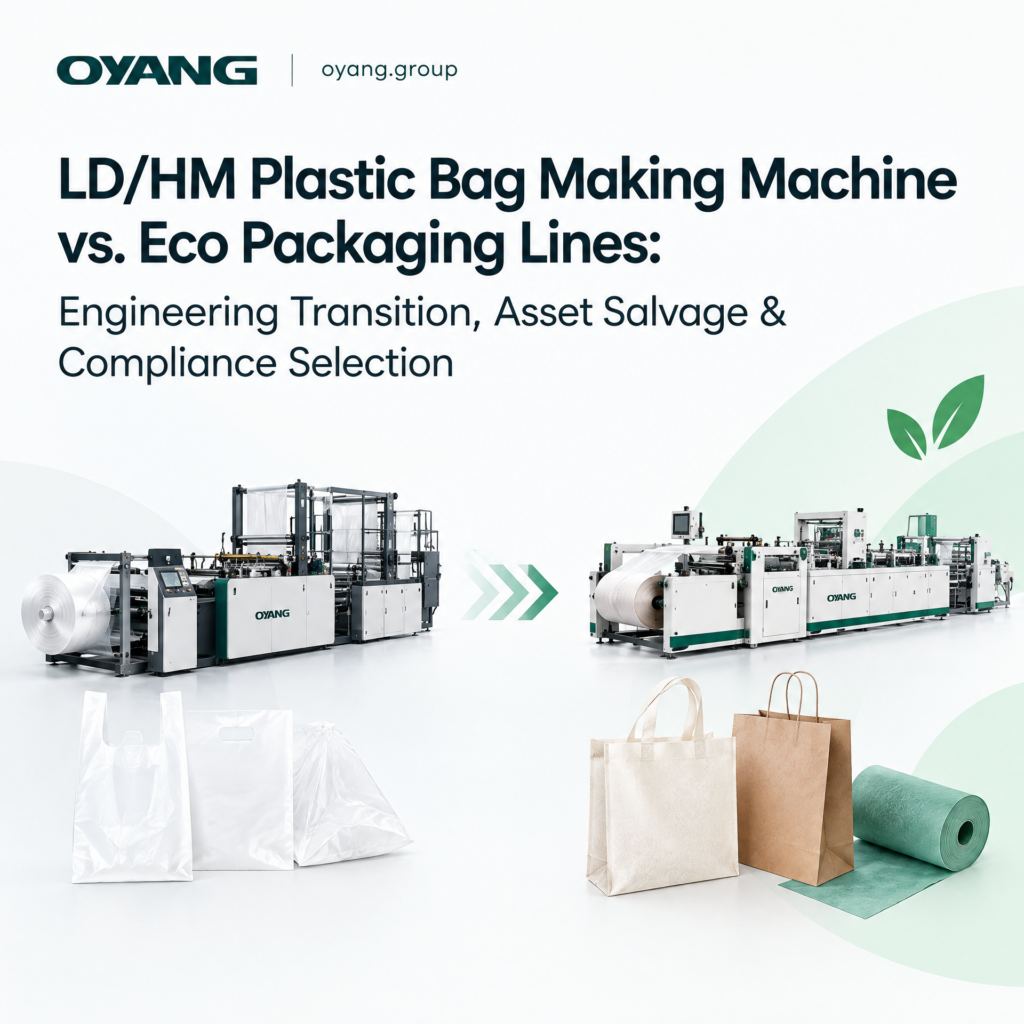
Faced with tightening Extended Producer Responsibility (EPR) mandates and global single-use plastic restrictions, converters operating conventional ld bag making machine units and hm carry bag making machine lines face shrinking margins and legislative phase-outs. Transitioning to sustainable packaging requires critical technical trade-offs: modifying existing blown film screws for narrow-window PBAT/PLA bioplastics, replacing carbonizing copper hot knives with 20 kHz ultrasonic cold welding, or migrating factory floors to fully automated spunbond nonwoven and roll-fed kraft paper bag production. Plant engineers can salvage up to 65% of auxiliary infrastructure to amortize conversion CAPEX within 10 to 16 operating months.
Copper Hot Knife (HSCC) vs. Ultrasonic Cold Welding: Thermal & Seam Benchmarks
Conventional polyethylene converting machinery relies on electrically heated copper sealing bars paired with mechanical flying shears (Hot Sealing Cold Cutting – HSCC). While viable for neat low-density polyethylene films, continuous thermal conduction causes severe process instability when handling shear-sensitive bioplastics or fibrous nonwoven webs:
| Engineering Parameter | Resistance Copper Hot Knife (HSCC) | OYANG 20 kHz Ultrasonic Cold Welding |
|---|---|---|
| Sealing Energy Source | Continuous conductive thermal contact (180°C – 240°C) | High-frequency mechanical friction resonance (20 kHz) |
| Heat-Affected Zone (HAZ) | Wide thermal dissipation (3.0 – 6.0 mm), causes web distortion | Precision focal fusion (< 0.8 mm), zero molecular shrinkage |
| Monomer Build-up & Fumes | Frequent polymer carbonization; noxious polyolefin smoke | Zero polymer burning; no hazardous smoke or blade scraping |
| Substrate Adaptability | Limited to polyolefin films (LDPE, HDPE, LLDPE) | PP spunbond nonwoven, PLA blends, and multi-ply laminated webs |
| Sealing Cycle / Dwell | 120 – 250 ms thermal conduction delay (line speed bottleneck) | 15 – 40 ms instant dynamic fusion (supports 90–100 bags/min) |
Mechanical Friction vs. Thermal Degradation: Why Biopolymers Fail on Copper Bars
When converting heat-sensitive polymers such as polybutylene adipate terephthalate (PBAT) or polylactic acid (PLA) compounds on a legacy plastic bag making machine, resistance copper knives introduce severe thermal transfer lag. Excess conductive thermal energy triggers immediate molecular chain scission in PBAT, causing pinhole perforations, burn-through, and sticky polymer build-up along the sealing edge.
Conversely, ultrasonic generators apply high-frequency acoustic micro-vibrations strictly at the polymer contact interface. Interfacial friction melts the resin internally within 15 to 40 milliseconds, fusing the seam before ambient heat dissipates into adjacent film plies. For deeper rheological parameters and screw configurations, review our engineering guide on corn starch bag making machine extrusion and zero-stringing sealing retrofits.
Processing PBAT/PLA on Existing Blown Film Lines: The Narrowed Engineering Window
Retrofitting an existing blown film extruder upstream of an ld bag making machine requires tight thermal and kinematic regulation to overcome low melt strength and thermal degradation:
- Extruder Melt Temperature Reduction: Standard LDPE processing operates between 170°C and 210°C. Biodegradable PBAT/PLA/corn-starch compounds require a depressed temperature profile of 135°C to 160°C across all barrel zones to prevent thermal degradation and rapid melt fracture.
- Screw Shear & Compression Ratio: High-shear barrier screws designed for high-density polyethylene generate excessive shear-heating in biopolymers. Standard metering screws with an L/D ratio of 28:1 to 32:1 and low compression ratios (< 2.5:1) are mandatory to prevent transesterification.
- Intense Bubble Cooling: PBAT exhibits slow crystallization kinetics and low melt tension. Internal Bubble Cooling (IBC) or dual-lip air rings must supply chilled air at 15°C to 18°C. Elevated ambient air temperatures cause the bubble to oscillate and collapse above a Blow-Up Ratio (BUR) of 2.5:1.
- Moisture Management: Bio-resins are hygroscopic. Granule moisture content exceeding 0.02% (200 ppm) triggers hydrolytic cleavage inside the barrel, leading to bubble instability, severe gauge variation (±15%), and brittle seam strength on downstream bag converting lines.
Transition to Nonwoven & Paper Bags: Asset Salvage & Plant Retrofit Feasibility
Plant owners replacing legacy polyethylene converting equipment rarely need to write off their entire plant assets. Evaluating plant-wide capital recovery helps optimize the transition to nonwoven or roll-fed paper bag production:
| Legacy Factory Asset | Salvage Viability | Required Retrofits / Asset Repurposing |
|---|---|---|
| Blown Film Extruders | Low (Downstream replacement) | Repurpose for agricultural film or switch to outsourced certified parent rolls (PP non-woven fabric rolls or brown/white kraft paper rolls). |
| Slitting & Rewinding Units | High (75% – 90% Reuse) | Retrofit circular shear-slitting knives to replace razor blades for heavier nonwoven webs or kraft paper roll conversion. |
| Rotary Screw Compressors & Dryers | 100% Fully Reusable | Directly drives pneumatic grippers, ultrasonic actuators, and automatic stacking systems on high-speed bag converting lines (6–8 bar supply). |
| Water Chillers & Cooling Towers | 85% Reusable | Diverted to cool ultrasonic generator cabinets, cold-glue circulation systems, or inline printing press chill rolls. |
| Flexographic Roll Printers | Moderate (50% Reusable) | Re-tune web tension loops for heavier substrates; convert solvent-based ink fluidics to water-based ink formulations for paper and nonwovens. |
Factory Payback Period & Operational Amortization Model
Payback Period (Months) = Total Conversion Capital ÷ [(Output × Eco Margin Premium) + (Scrap Reduction × Resin Cost) + Labor Savings]
Industrial Reality: A conventional hm carry bag making machine delivers razor-thin margins with line scrap rates averaging 6% to 10% during hot-knife carbonization clean-downs. In contrast, modern automated nonwoven box bag and paper bag converting lines run continuously at scrap rates under 1.5%, delivering double the gross margin per finished unit. For complete capital breakdown tables, see our report on eco friendly bag making machine price models and factory ROI.
OYANG Engineering Practice: Sustainable Converting Equipment
Converting structural paper rolls and multi-ply spunbond nonwoven fabrics requires mechanical stability far exceeding lightweight polyolefin film machines. Across OYANG’s 130,000 m² manufacturing complex, machine wall panels, forming carriages, and rotary drive housings are machined on Japanese MAZAK and OKUMA 5-axis CNC systems to strict geometric tolerances within ≤ 0.015 mm. This structural rigidity prevents harmonic vibration and preserves precise ultrasonic horn alignment across sustained shifts.

Figure 1: The TECH 26 Fully Automatic Nonwoven Box Bag Making Machine delivering 90–100 bags/min with full servo-driven ultrasonic cold welding for retail shopping bags.

Figure 2: The TECH-18 Auto Size Change Paper Bag Machine featuring automated recipe-based dimensional changeover in ≤ 120 seconds for square-bottom SOS packaging.
Video 1: Machine run of the OYANG TECH-18 roll-fed paper bag production line, showcasing automated size changeover, tube formation, and square-bottom SOS bag delivery.
Related Technical Guides & Converting Resources
- → Corn Starch Bag Making Machine & Extrusion Engineering: Processing PBAT Blends: Processing temperature profiles, melt fracture solutions, and anti-stick knife retrofit parameters for starch biopolymers.
- → Eco Friendly Bag Making Machine: PLA & Bio Converting Guide: Detailed review of EN 13432 and ASTM D6400 industrial compostability standards and servo web handling for brittle biopolymer rolls.
- → Eco Friendly Bag Making Machine Price & Plant ROI Analysis: Full equipment capital breakdown, resin BOM models, and multi-year factory amortization formulas for converting managers.
Frequently Asked Questions (FAQ)
Can my existing LD bag making machine be converted to process PBAT/PLA biodegradable films?
Yes, but it requires significant modification of the sealing assembly and film feed systems. Conventional resistance copper hot knives cause PBAT film melting and nozzle fouling. You must install precision PID temperature controllers with ±1°C accuracy, lower the sealing bar temperature to 135°C–155°C, apply Teflon anti-stick coatings, and add motorized rubber nip tension relaxers to accommodate the low tensile strength of biodegradable webs.
What are the main plant auxiliary systems that can be reused when transitioning to nonwoven bag production?
Up to 65% of plant auxiliary assets can be preserved during migration. Centralized rotary screw air compressors and desiccant dryers can be directly connected to drive the pneumatics on nonwoven bag machines. Industrial water chillers can be repurposed to cool ultrasonic horn generators. In addition, existing high-tonnage slitter-rewinders and warehouse material-handling equipment remain fully viable with minor knife upgrades.
Why does ultrasonic cold welding replace copper hot sealing in eco-friendly bag manufacturing?
Ultrasonic cold welding uses 20 kHz acoustic energy to produce instantaneous frictional heat exclusively at the material interface, keeping adjacent web surfaces cold and structurally sound. Unlike conductive copper hot knives, it does not burn or weaken fibrous nonwoven substrates, generates zero toxic monomer fumes, eliminates blade scraping, and shortens cycle dwell times to under 40 milliseconds for line speeds up to 100 bags/min.
How long is the typical investment payback period when moving from thin film plastic to nonwoven packaging?
Based on real-world factory retrofits, the payback period averages 10 to 16 months. While a legacy plastic bag making machine operates under thin margins and heavy environmental penalties, automatic nonwoven box bag lines (such as the OYANG TECH 26) produce multi-use shopping bags with higher market value, lower labor requirements (1 operator replaces 4 manual packers), and reduced operational scrap below 1.5%.