350x97.png)
350x97.png)
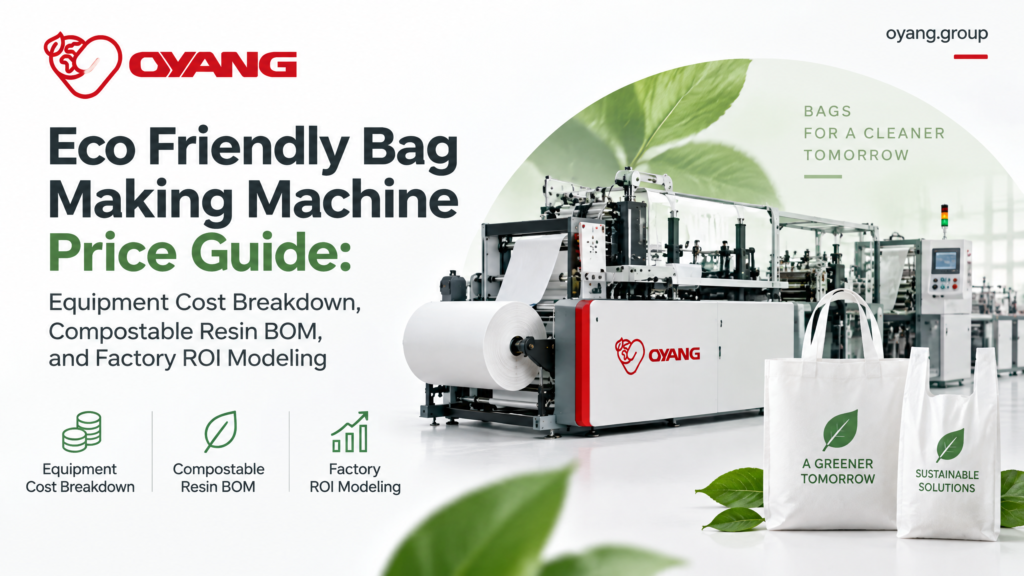
Eco Friendly Bag Making Machine Price Guide: Equipment Cost Breakdown, Compostable Resin BOM, and Factory ROI Modeling
Capital expenditure for an industrial eco friendly bag making machine varies significantly based on kinematic architecture, servo synchronization, and automated punch integration. While entry-level semi-automatic punching setups start between $8,500 and $14,500, fully integrated multi-axis servo lines for certified compostable carrier bags range from $28,000 to over $68,000. With raw biodegradable PBAT/PLA/cornstarch compounds priced at $2,600 to $3,200 per metric ton, selecting machinery with scrap rates under 1.5% and low labor requirements is the single most critical factor in achieving commercial payback within an 8- to 14-month timeframe.
Equipment Investment Matrix: Eco Friendly Carry Bag Making Machine Price & Tiers
When evaluating an eco friendly bags manufacturing machine cost, converters must balance upfront machinery pricing against ongoing labor overhead, scrap generation, and line speeds. The table below outlines technical tiers across the commercial market:
| Machinery Automation Tier | Typical Capital Cost (USD) | Rated Speed & Output | Drive Topology & Servo Axes | Labor Requirement |
|---|---|---|---|---|
| Tier 1: Semi-Automatic / Manual Punch | $8,500 – $14,500 | 40–60 bags/min (interrupted) | Stepper motor or single-axis pulse drive; mechanical clutch | 2–3 operators (manual transfer to punch) |
| Tier 2: High-Speed Auto T-Shirt / Bio Vest Line | $28,000 – $45,000 | 100–160 bags/min (continuous) | 4–6 axis bus-synchronized servo (Siemens / Yaskawa); dual PID heat | 1 operator (automated stack and pack) |
| Tier 3: Multi-Functional Box & Loop Handle Line | $48,000 – $68,000+ | 80–100 3D box bags/min | Multi-axis EtherCAT servo bus; ultrasonic horn resonance tracking | 1 operator per 2 production lines |
Why Low-Cost Mechanical Machines Destroy Profit Margins on Bio Resins
A low initial bio bag manufacturing machine price often conceals severe ongoing operating costs. Semi-automatic machines relying on manual hydraulic punchers generate 8% to 14% edge scrap due to imprecise indexing. With conventional polyethylene, regrind scrap can be recycled immediately. However, with PBAT/cornstarch resins costing nearly triple the price of virgin PE, high material scrap directly eliminates operational profitability.
Granular Unit Economics: Cost-per-Bag BOM Breakdown for Compostable Packaging
Accurate financial modeling requires evaluating direct bill-of-materials (BOM), energy usage, and labor per thousand finished units. Below is an engineering cost audit for an 18-gram standard retail grocery bag (Width 300 mm × Height 500 mm × Gusset 120 mm, 22 μm film thickness):
Cost Breakdown for 1,000 Finished Bio Carry Bags (18 kg Net Resin)
- Bio-Resin Compound (PBAT/PLA/Starch): 18.27 kg gross input (accounting for 1.5% machine scrap on OYANG CP lines) × $2.85/kg = $52.07 (74.2% of total cost).
- Electrical Power Consumption: Extrusion blowing (0.35 kWh/kg) + Converting machine drive & PID sealing heaters (0.08 kWh/kg) = 7.85 kWh total × $0.12/kWh = $2.91 (4.1% of total cost).
- Direct Shop-Floor Labor: 1 automated line operator ($25/hr loaded wage) producing 7,200 bags/hr (120 bags/min sustained speed) = $5.83 per 1,000 bags (8.3% of total cost).
- Masterbatch Pigment & In-Line Ink: Water-based certified compostable flexo ink for single-color retail branding = $3.20 (4.6% of total cost).
- Equipment Depreciation & Factory Overhead: 5-year straight-line equipment depreciation plus plant floor allocation = $6.15 (8.8% of total cost).
Plant Amortization Model: Mathematical Payback in 8 to 14 Months
Commercial margins for certified compostable carrier bags are substantially higher than legacy thin-film plastic bags. While commodity PE bags trade with gross margins of 5% to 8%, certified compostable carry bags command selling prices between $0.095 and $0.120 per unit across major supermarket chains, yielding gross unit margins of $0.025 to $0.050.
Example Calculation (Single OYANG CP-700 Line):
Daily Production (2 shifts @ 80% OEE) = 115,000 finished bags/day
Monthly Production (26 operational days) = 2,990,000 bags
Net Operating Margin per Bag = $0.018 (after distribution & admin)
Monthly Operating Profit = 2,990,000 × $0.018 = $53,820
Total Turnkey Investment (Machine + Extruder + Tooling) = $110,000
Payback Period = $110,000 ÷ $53,820 ≈ 2.04 Months (Equipment) / 8.5 Months (Total Plant CAPEX)
Even after factoring in facility infrastructure, auxiliary chillers, and initial resin inventory financing, an efficient converter utilizing high-yield eco friendly bag machine price configurations achieves full capital recovery within an 8- to 14-month production cycle.
OYANG Precision Machinery: High OEE Platforms for Eco Packaging
High-speed converting of flexible bio-films requires structural frame stability to prevent dynamic vibration. At OYANG’s 130,000 m² production complex, side-frame wall panels are processed on Japanese MAZAK and OKUMA 5-axis CNC lines to a geometric flatness tolerance of ≤ 0.015 mm. This mechanical precision prevents cutter wear and maintains uniform nip clamping across delicate biodegradable films.
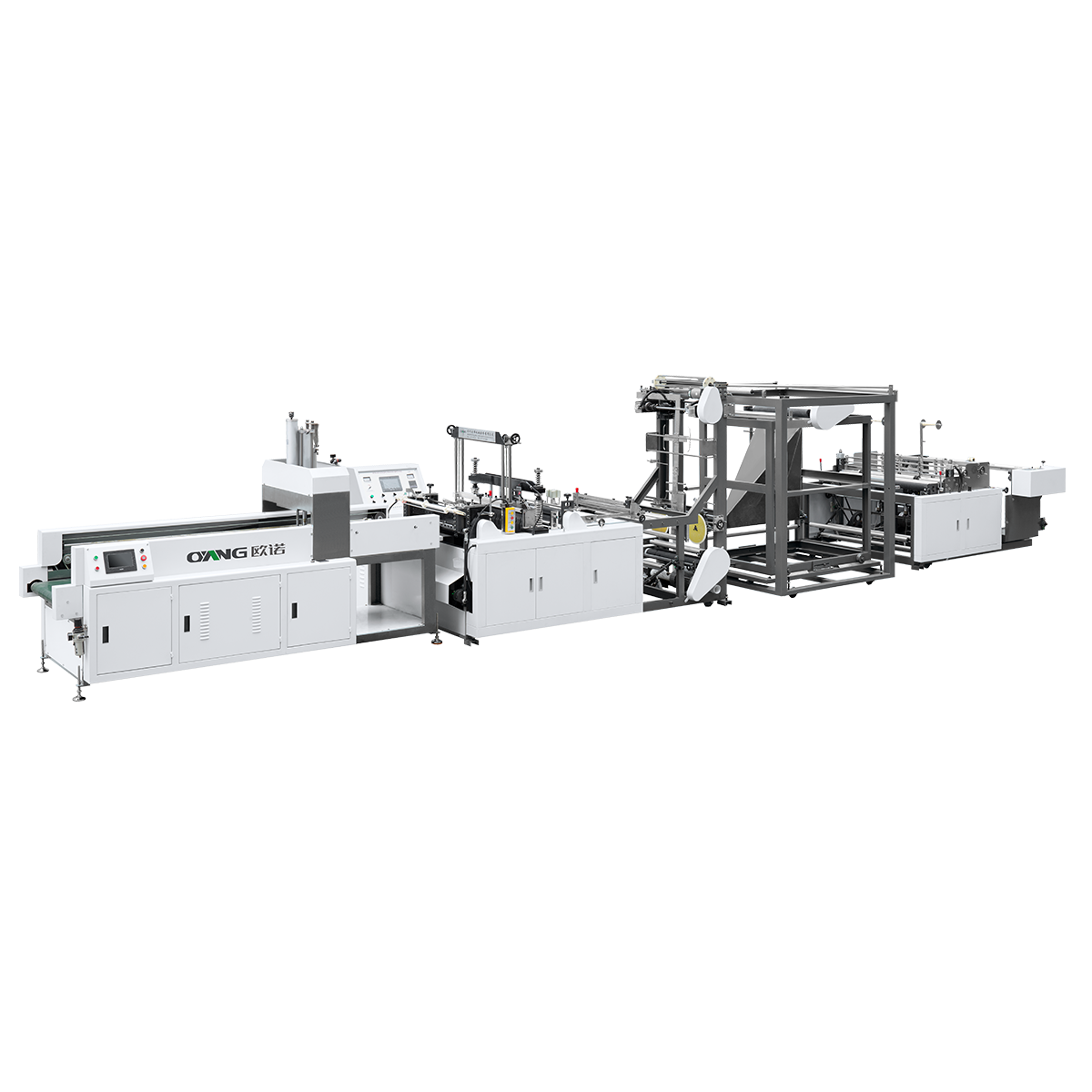
CP-700/800 Series: Fully Automatic Biodegradable T-Shirt Bag Machine
Engineered to maximize output on PBAT/PLA compounds and nonwoven fabrics. Features synchronized servo pull rolls, zero-clearance hydraulic punch stations, and PID microcomputer temperature control (± 1°C) to eliminate seal burn-through.
- Production Speed: 100–160 bags/min continuous converting
- Tension System: Low-inertia floating dancer arm with closed-loop servo feedback
- Scrap Efficiency: Automated vacuum waste collection keeps net scrap under 1.5%

TECH 23: High-Speed 3D Box Bag Machine (90–100 pcs/min)
Designed for high-value reusable box bags. Incorporates 90-second automated mold changeover, inline loop handle welding, and localized ultrasonic cold welding to eliminate glue consumables and reduce energy use.
- Changeover Efficiency: Automated recipe-based sizing completed in ≤ 90 seconds
- Operating Speed: 90–100 finished box bags per minute
- Ultrasonic Architecture: Multi-generator localized welding stations
Manufacturing Verification & Technical Catalogs
Explore factory video documentation and complete machinery catalogs from our smart manufacturing campus:
Frequently Asked Questions (FAQ)
What is the average price of an industrial eco friendly bag making machine?
An industrial eco friendly bag making machine typically costs between $8,500 and $14,500 for semi-automatic entry-level systems with manual punching. Fully automatic, multi-axis servo lines designed for high-speed continuous T-shirt and vest bags range from $28,000 to $45,000. Advanced modular 3D box bag lines with automatic changeovers and localized ultrasonic welding range from $48,000 to over $68,000 depending on optional in-line printing and packaging attachments.
How does high raw material cost affect the choice between semi-automatic and fully automatic bio bag machines?
Biodegradable compounds (PBAT/PLA/cornstarch) cost $2,600 to $3,200 per metric ton—nearly triple standard polyethylene. Semi-automatic machines generate 8% to 14% manual punch scrap, causing substantial financial losses because bioplastic regrind cannot be easily re-extruded. Fully automatic lines like the OYANG CP series restrict net scrap below 1.5% through synchronized servo feeding and automated vacuum waste trimming, saving thousands of dollars in material costs monthly.
What is the typical investment payback period for a new biodegradable carry bag plant?
Most packaging plants recover their capital investment within 8 to 14 months. Certified compostable carrier bags command a retail premium of $0.095 to $0.120 per unit compared to commodity plastic. Running an automated converting line producing 110,000 to 140,000 bags daily yields monthly gross operating contributions between $40,000 and $55,000, quickly amortizing machinery CAPEX and plant utility investments.
How much does it cost to manufacture a single compostable shopping bag?
A standard 18-gram compostable grocery carry bag costs approximately $0.070 to produce on an automated line. Direct resin material accounts for 74.2% ($0.052), electrical power contributes 4.1% ($0.0029), direct labor comprises 8.3% ($0.0058), compostable printing ink adds 4.6% ($0.0032), and facility depreciation and overhead account for the remaining 8.8% ($0.0061).
Request an Official Equipment Quotation & Feasibility Report
Submit your target daily output, bag specifications, and regional power standards to receive a detailed FOB/CIF pricing proposal and a customized plant ROI cash flow model.