

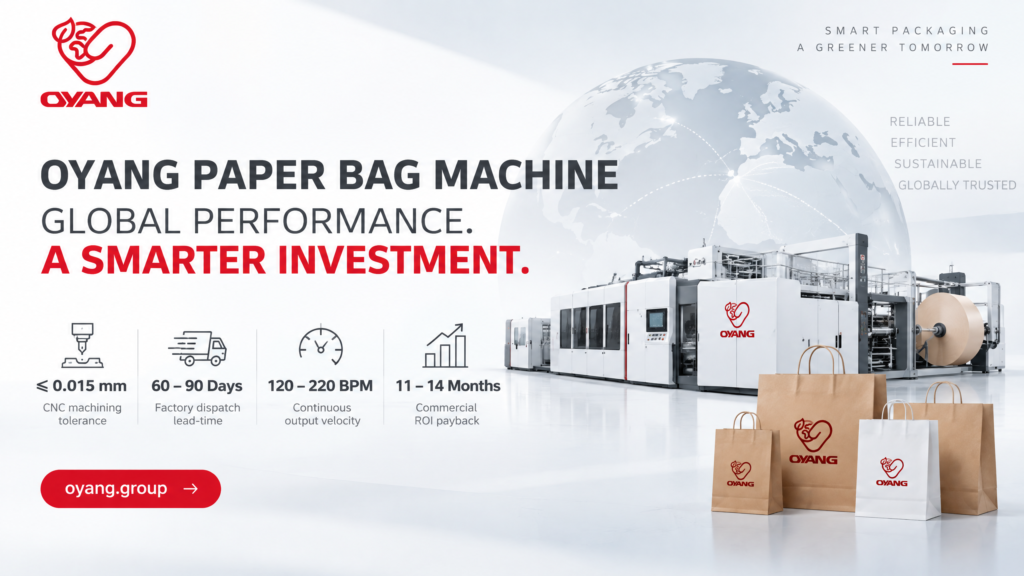
When procuring industrial packaging converters, factory plant directors evaluate heritage European lines—such as a garant paper bag machine (from the Windmöller & Hölscher Group), w&h paper bag making machine, holweg paper bag machine, fischer krecke paper bag machine, or weber paper bag machine—against Japanese precision converters like Newlong and leading Asian manufacturers such as OYANG Group. While legacy European lines deliver precision engineering at continuous converting velocities of 200 to 250 bags/min, their premium initial capital expenditure (€550,000 to €1,200,000 EUR), extended lead-times of 10 to 14 months, and high-cost proprietary spares elevate the 5-year Total Cost of Ownership (TCO). In contrast, OYANG Group bridges the engineering performance gap by utilizing HT250 gray cast iron wall panels processed on Japanese MAZAK and OKUMA 5-axis CNC centers to tolerances of ≤ 0.015 mm. Backed by multi-axis EtherCAT digital servos (SMART-17 Series at 120 to 220 bags/min), an OYANG production line delivers comparable structural rigidity at $115,000 to $185,000 USD (FOB) with a rapid 60-to-90-day dispatch, securing full commercial ROI payback within 11 to 14 months.
Global Brand Landscape: Engineering Philosophies & Heritage Tiers
The international paper bag converting market divides into distinct engineering tiers based on geographic manufacturing hubs, metallurgical tolerances, and automation architectures:
- Tier-1 European Heritage (Garant, W&H, Holweg, Weber): German and French manufacturers like Garant Maschinen (a Windmöller & Hölscher subsidiary) and Holweg-Weber represent the historical gold standard of mechanical engineering. These machines feature heavy-duty line-shaft metallurgy and proprietary motion controllers capable of long-term continuous operation. However, procurement costs are steep (often exceeding €800,000 EUR for a single handled shopping bag line), and changeover cycles frequently depend on mechanical gearing setups.
- Japanese Precision Engineering (Newlong Industrial): Japan’s Newlong represents mechanical longevity and compact kinematics. Their converting lines provide reliable tension control and durable gear trains. Nevertheless, high domestic labor costs keep their export prices elevated, and software interfaces have been slower to migrate to open-architecture digital EtherCAT motion buses.
- Mediterranean & Regional Converters (Somtas, Manzoni, Beasley French): Regional European builders offer intermediate pricing but face supply-chain limitations on standardized components, leading to localized maintenance dependencies outside their home territories.
- High-Precision Chinese Leaders (OYANG Group, Zenbo, Sunhope): Representing modern digital converting, leading Chinese industrial manufacturers have transitioned from budget equipment to advanced smart manufacturing. OYANG operates a 130,000 m2 smart manufacturing facility outfitted with multi-axis Japanese CNC lines. By pairing military-grade cast iron machining with global open-bus electronics (Siemens / Inovance / Schneider), OYANG matches European output speeds and registration tolerances at a fraction of the capital expenditure.
For deeper insight into how continuous web feeds, draw rollers, and rotary knives synchronize mechanically, review our foundational guide on how does a paper bag machine work: Mechanics and workflow.
Technical Benchmark: Global Brand Comparison Matrix
The technical table below benchmarks mechanical engineering specifications, machine dynamics, and financial investment profiles across tier-1 manufacturers worldwide:
| Brand / Manufacturer | Origin & Core Platform | Rated SOS Speed | Average Lead-Time | FOB / Ex-Works CapEx |
|---|---|---|---|---|
| Garant Maschinen (W&H Group) | Germany TRIUMPH Series SOS | 180 – 250 bags/min | 10 – 14 Months | €650,000 – €1,100,000 EUR |
| Holweg Weber | France / USA RS / SOS Converting Lines | 160 – 220 bags/min | 9 – 12 Months | €580,000 – €950,000 EUR |
| Newlong Industrial | Japan NPI Series High-Precision | 150 – 200 bags/min | 7 – 10 Months | $380,000 – $550,000 USD |
| Somtas Packaging | Turkey BagMaster Series | 120 – 180 bags/min | 5 – 7 Months | $180,000 – $260,000 USD |
| Zenbo / Sunhope | China Sheet-fed / Roll-fed Lines | 100 – 160 bags/min | 3 – 4 Months | $125,000 – $170,000 USD |
| OYANG Group (SMART-17 / 16A) | China (130,000 m2 Base) MAZAK/OKUMA CNC Machined | 120 – 220 bags/min | 60 – 90 Days | $115,000 – $185,000 USD |
To budget ocean freight rates, wooden container crating, customs tariffs, and air compressor sizing, review our capital guide on how much does a paper bag making machine cost: Landed CapEx analysis.
Financial Analysis: 5-Year Total Cost of Ownership (TCO) Breakdown
Looking solely at initial machinery acquisition prices obscures the long-term cash flow profile. A comprehensive 5-year TCO calculation incorporates equipment depreciation, maintenance parts consumption, scheduled service engineer dispatch rates, and production downtime losses:
1. Initial Capital Outlay & Financial Amortization
A Tier-1 European line (Garant / W&H) demands roughly $850,000 USD landed capital. Even amortized over 10 years, annual capital servicing exceeds $110,000 USD. An OYANG 16A automatic line with handle pasting requires roughly $135,000 USD landed, reducing annual capital amortization to roughly $18,000 USD. This frees up operational working capital for jumbo paper reel procurement.
2. Proprietary Spare Parts vs. Globally Sourced COTS Components
European machines utilize proprietary electronic drive modules, branded servomotors, and customized gear assemblies that must be air-shipped from Europe at premium vendor rates. OYANG designs its converting systems on open-architecture commercial off-the-shelf (COTS) industrial components: Siemens / Inovance motion controls, Schneider low-voltage switchgear, NSK bearings, and SMC pneumatics. Replacement components can be sourced locally in virtually any industrial market worldwide, reducing unplanned line downtime.
3. Service Technician Day-Rates & Commissioning Agility
Dispatching a field service technician from Central Europe averages €1,800 to €2,500 EUR per day plus business-class travel, with service queues taking 4 to 8 weeks to clear. OYANG provides remote IoT visual telemetry and maintains localized engineering support hubs across Latin America, Southeast Asia, the Middle East, and Europe, dispatching technicians within 48 to 72 hours at competitive daily rates.
For mathematical models examining raw paper grammage, slitting waste, and unit production cost structures, read our detailed analysis on how much does it cost to produce a paper bag: Cost calculation formulas.
The Engineering Difference: OYANG’s 130,000 m2 Manufacturing Center
A primary misconception among buyers is that Asian equipment compromises on structural stability compared to German machinery. While true for small-workshop assemblers who use welded steel plates, OYANG manufactures all core structural converting modules under rigorous aerospace-grade tolerances:
- Cast Iron Metallurgy (HT250 Gray Iron): Rather than using welded mild steel that warps and transmits harmonic vibrations, OYANG casts all primary machine wall panels, bottom-forming drums, and folding mandrels from HT250 gray cast iron. Castings undergo prolonged outdoor aging followed by thermal stress-relief annealing furnaces to eliminate internal metallurgical stresses.
- Japanese MAZAK & OKUMA 5-Axis CNC Precision: Wall panels and bearing housings are machined in a single clamping setup on Japanese MAZAK horizontal machining centers and OKUMA portal milling lines. Tolerances for bore concentricity, bearing face perpendicularity, and datum flatness are held to ≤ 0.015 mm. This structural accuracy ensures that shafts remain parallel, completely preventing web-tracking skew and premature gear wear across billions of continuous operating revolutions.
- Multi-Axis EtherCAT Servo Synchronization: By pairing this heavy-duty cast frame with an EtherCAT real-time bus running closed-loop servo synchronization, OYANG matches the cutting precision (±0.5 mm) and operational speeds (up to 220 bags/min) of top European equipment.
Engineering Video: Precision Manufacturing & Assembly at OYANG Headquarters
Tour OYANG’s 130,000 m2 smart manufacturing campus, examining Japanese MAZAK machining lines, quality inspection protocols, and fully automatic SOS paper bag machine assembly:
Video 1: Advanced manufacturing, MAZAK CNC precision machining, and paper bag machine testing at OYANG Group.
For comprehensive civil engineering blueprints, workshop crane capacities, transformer sizing, and complete turnkey factory setup budgeting, review our feasibility guide on paper bag manufacturing plant cost: Factory setup & utility feasibility guide.
Related Technical Guides & Converting Resources
- → How Much Does a Paper Bag Making Machine Cost?: Granular financial breakdown covering FOB factory costs, container shipping rates, import duties, and ancillary compressor sizing.
- → How Much Does It Cost to Produce a Paper Bag? Cost Formulas: Practical formulas for calculating electrical consumption, trim margins, and adhesive application thicknesses.
- → Semi-Automatic vs. Fully Automatic Bag Machines: Evaluating capital expenditure, format changeover agility, and direct labor allocation for packaging operations.
- → Paper Bag Manufacturing Plant Cost: Factory Setup & Utility Guide: Complete turnkey budget guide covering civil layout, 380V power drops, and air compressor piping.
Frequently Asked Questions (FAQ)
How does an OYANG paper bag machine compare to a Garant or W&H line?
While Garant (W&H Group) offers high brand recognition and top-tier mechanical speeds (200 to 250 bags/min), an OYANG line (120 to 220 bags/min) delivers comparable structural precision and stability by using HT250 gray cast iron side panels machined on Japanese MAZAK and OKUMA 5-axis CNC centers (tolerance ≤ 0.015 mm). OYANG reduces equipment CapEx by 60% to 75% and shortens equipment delivery times from 12+ months down to 60 to 90 days.
Why do European paper bag machines have higher Total Cost of Ownership (TCO)?
European machines carry significantly higher initial purchase prices (€550,000 to €1,200,000 EUR), proprietary electronic and mechanical parts that require expensive overseas air-freight, and specialized field service engineers commanding daily rates of €1,800 to €2,500 EUR plus travel. OYANG utilizes globally available off-the-shelf industrial automation parts (Siemens, Schneider, NSK), reducing maintenance overhead and long-term operating costs.
What are the typical lead times for European versus Chinese paper bag machines?
Tier-1 European manufacturers (such as Garant, Holweg, and Weber) typically have lead times ranging from 10 to 14 months due to centralized European manufacturing queues. In contrast, OYANG produces core frames and components within its 130,000 m² smart manufacturing center, offering factory dispatch within 60 to 90 days of order confirmation.
What is the expected commercial payback period (ROI) on an OYANG automatic line?
Operating two 8-hour production shifts daily at 75% Overall Equipment Effectiveness (OEE), an OYANG 16A automatic paper bag machine typically recovers its initial capital investment within 11 to 14 months. European machines running identical shifts and retail contracts typically require 36 to 48 months to achieve full payback due to higher capital amortization.