

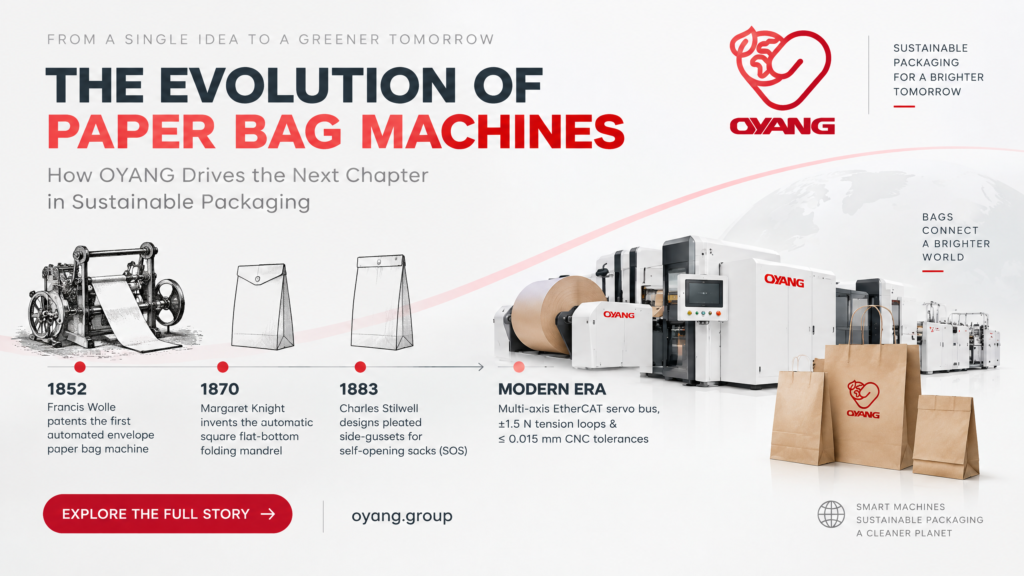
The global packaging manufacturing sector owes its existence to the foundational patent of the francis wolle paper bag machine, granted to American educator and inventor Francis Wolle on October 5, 1852 (U.S. Patent No. 9,355). As the world’s first commercial automated bag paper making machine, Wolle’s reciprocating gear-and-lever apparatus transformed commercial grocery distribution by feeding, pasting, folding, and severing continuous paper tubes into envelope-style flat bags at roughly 2,000 bags per hour—surpassing manual glue workers by more than tenfold. This breakthrough paved the way for Margaret Knight’s seminal 1870 flat-bottom mandrel invention and Charles Stilwell’s 1883 self-opening sack (SOS). Today, this mechanical lineage reaches its modern zenith in the advanced machine for manufacturing paper bags engineered by OYANG Group, where physical line-shafts and mechanical gears are replaced with distributed multi-axis electronic camming (E-Cam) and sub-0.015 mm CNC structural rigidity to achieve continuous converting speeds of 120 to 220 bags/min.
1852: Francis Wolle and the Dawn of Mechanical Converting
Before the 1850s, paper packaging was an expensive handicraft. Dry goods merchants, grocers, and hardware retailers wrapped dry goods into conical twists of sheet paper or hired home workers to hand-paste flat paper envelopes. This process capped shopkeeper efficiency and created an acute bottleneck across industrializing economies.
In Bethlehem, Pennsylvania, schoolteacher Francis Wolle, working in collaboration with his brother August Wolle, set out to mechanize this tedious task. On October 5, 1852, Wolle was issued U.S. Patent No. 9,355 for his “Machine for Making Bags of Paper.” His machine represented a brilliant leap in kinematic synchronization:
- Intermittent Web Draw & Tensioning: Rather than feeding pre-cut individual sheets, Wolle’s converter drew paper directly from a continuous master roll. Intermittent feed rollers, driven by mechanical ratchets and pawls, indexed a measured web length forward before coming to a complete dwell.
- Pinch-Cut Shearing: While the paper paused, a weighted, lever-actuated serrated knife severed the tube crosswise. This mechanical pinch-and-cut concept remains the direct ancestor of modern high-speed V-bottom rotary cutters.
- Transfer Flap Pasting: A reciprocating paste blade dipped into an open reservoir of starch glue, applied a narrow stripe across the trailing bottom lip of the tube, and a mechanical flap finger folded the glued lip over to seal the pouch bottom.
Wolle’s machine achieved a rate of roughly 2,000 to 3,000 bags per hour. In 1869, Francis and August Wolle joined with fellow inventors to establish the Union Paper Bag Machine Company, creating the corporate foundation of the American packaging industry.
To explore how Wolle’s original envelope fold evolved into today’s rotary high-speed cut-off mechanisms for food packaging, read our detailed guide on V-bottom paper bag making machines: Rotary serrated cutoff and food packaging guide.
Kinematic Evolution: Key Milestones in Bag Machine Engineering
The table below outlines the mechanical innovations that transformed paper bag conversion from early 19th-century cast-iron levers to modern distributed multi-axis servo robotics:
| Era / Inventor | Core Patent / Mechanism | Kinematic Architecture | Converting Limitation Overcome |
|---|---|---|---|
| 1852 Francis Wolle | U.S. Patent 9,355 (Envelope Bag Machine) | Ratchet-driven draw rollers; reciprocating gravity drop knife; mechanical paste wiper. | Replaced manual sheet-cutting and hand-gluing of flat grocery envelopes. |
| 1870 Margaret Knight | U.S. Patent 116,233 (Flat Bottom Former) | Synchronized iron folding mandrel; rotating wing guides; diamond bottom crease bar. | Eliminated narrow envelope bottoms; produced freestanding square-bottom sacks. |
| 1883 Charles Stilwell | U.S. Patent 279,360 (Self-Opening Sack – SOS) | Inward-folding gusset wheels; continuous drum flattener; accordion side pleating. | Allowed bags to snap open with a wrist flick; compact flat shipping and bundling. |
| Mid-20th Century Industrial Era | Continuous Rotary Lines (Mechanical Line-Shaft) | Central high-mass line-shaft; bevel gearboxes; planetary gears; mechanical chain links. | Increased production speeds to 80–120 bags/min, but format changes required hours. |
| Modern Era OYANG Group | EtherCAT Multi-Axis Digital Servo Converting Platform | Electronic camming (E-Cam); active ultrasonic tension (±1.5 N); MAZAK/OKUMA CNC frame (≤0.015 mm). | Completely eliminated gear-train backlash; 2-minute digital changeovers at 220 bags/min. |
For deeper insight into how modern roll unwinding, continuous tube formation, and rotary bottom folding synchronize without physical gear-train connections, review our foundational guide on how does a paper bag machine work: Mechanics and workflow.
1870 to 1883: The Mechanics of the Freestanding Square Bottom
While Francis Wolle proved that paper could be mechanized into bags, his envelope-style design had a critical functional drawback: the bag had no volumetric depth and could not stand upright on shop counters. Customers were forced to hold the limp bags open with one hand while packing groceries with the other.
Margaret Knight’s Flat-Bottom Mandrel (1870)
Working at the Columbia Paper Bag Company in Springfield, Massachusetts, Margaret E. Knight analyzed the complex hand-movements of craft workers who folded paper tube ends into box-like bottoms. In 1868, Knight engineered a working wooden model of a machine that manipulated the paper tube over an expanding mandrel, folding and pasting a true flat, rectangular bottom.
A male machinist named Charles Annan attempted to steal her patent by arguing a woman could not understand converting machinery. Knight produced her engineering sketches, wood patterns, and witness logs in court, decisively winning the dispute. On July 11, 1871, Knight was granted U.S. Patent No. 116,233 for her iron-gear flat-bottom bag machine. Her innovation created the modern grocery shopping bag, establishing a geometry that remains standard today.
Charles Stilwell’s Self-Opening Sack (SOS) (1883)
In 1883, mechanical engineer Charles Stilwell advanced Knight’s geometry by introducing inward-pleated side gussets (U.S. Patent No. 279,360). Stilwell’s Self-Opening Sack (SOS) allowed square-bottom bags to fold completely flat for compact warehousing, while enabling retail clerks to pop the bag open with a single snap of the wrist. Stilwell’s folding pattern remains the foundation of virtually all commercial grocery carry bags produced globally today.
To evaluate how semi-automatic legacy systems compare with fully automated lines in direct labor, changeover speed, and OEE, consult our analysis on semi-automatic vs. fully automatic bag machines: Labor vs. automation guide.
The Engineering Leap: From Mechanical Line-Shafts to Multi-Axis Digital Servo Bus
Throughout the 20th century, high-speed bag converting lines relied on a massive longitudinal steel line-shaft running down the base of the machine. Bevel gearboxes, roller chains, and mechanical cam lobes branched off this single driveshaft to power the unwind, tube-former draw rollers, rotary cutoff knife, bottoming drum, and delivery wheels.
While functional, this mechanical architecture created persistent converting challenges:
- Backlash & Cumulative Torsional Play: With dozens of mechanical gear meshes between the prime mover and the rotary bottoming drum, tooth-to-tooth backlash inevitably accumulated. At line speeds above 120 bags/min, mechanical vibration caused bottom fold positions to wander by ±3 to 5 mm, creating crooked bottoms and glue smears.
- Tedious Format Changeover Times: Changing bag length required physically swapping out cast-iron change gears, unbolting heavy rotary knife cylinders, and manually adjusting mechanical cam profiles—a process that took 2 to 4 hours of machine downtime.
- The Digital E-Cam Revolution: In OYANG’s modern converting platforms (such as the OYANG 16A and SMART-17 Series), mechanical line-shafts and chains are completely eliminated. Every kinematic axis—unwind brake, draw nip, perforating cylinder, bottom drum, and handle inserter—is powered by an independent, high-torque AC synchronous servomotor linked over a real-time EtherCAT industrial bus. Electronic camming (E-Cam) curves execute format changeovers digitally via touchscreen in under 2 minutes, maintaining registration accuracy within ±0.5 mm at 220 bags/min.
For mathematical models examining how digital setup agility and web trim minimization reduce direct production expenses, read our detailed analysis on how much does it cost to produce a paper bag: Cost calculation formulas.
Engineering Video: Modern High-Speed Multi-Axis Servo Converting in Action
Examine the century-long evolution from Francis Wolle’s early wooden levers to modern automated rotary folding, inline handle assembly, and digital motion synchronization on the OYANG 16A:
Video 1: Commercial SOS carrier bag manufacturing running on the OYANG 16A automatic converting line.
Precision Manufacturing Heritage: Why Frame Rigidity Matters
Francis Wolle’s original 1852 machine operated inside a lightweight wooden frame that shook visibly under dynamic cutting loads, limiting cycle speeds to just 50 strokes per minute.
In contrast, modern high-speed converting lines running at linear speeds up to 200 m/min must absorb substantial rotary harmonic vibrations. OYANG casts all primary machine side frames, folding drums, and knife cylinders from high-density HT250 gray cast iron. Structural elements undergo thermal stress-relief annealing and are precision-machined in-house on Japanese MAZAK and OKUMA 5-axis CNC machining centers to a flatness tolerance of ≤ 0.015 mm. This structural rigidity ensures stable gear meshing and smooth mechanical operation across billions of converting cycles.
Related Technical Guides & Converting Resources
- → How Does a Paper Bag Machine Work? Mechanics & Workflow: Kinematic breakdown of roll unwinding, continuous tube formation, and rotary bottom folding.
- → V-Bottom Paper Bag Making Machine: Food Packaging Guide: Technical analysis of rotary serrated cut-off knives, greaseproof substrate handling, and high-speed bakery pouches.
- → Semi-Automatic vs. Fully Automatic Bag Machines: Evaluating capital expenditure, format changeover agility, and direct labor allocation for packaging operations.
- → How Much Does It Cost to Produce a Paper Bag? Cost Formulas: Practical formulas for calculating electrical consumption, trim margins, and adhesive application thicknesses.
Frequently Asked Questions (FAQ)
Who invented the first commercial paper bag machine?
Francis Wolle, an American schoolteacher and inventor from Bethlehem, Pennsylvania, patented the first commercial automated paper bag making machine on October 5, 1852 (U.S. Patent No. 9,355). His machine mechanized the feeding, folding, pasting, and cutting of flat, envelope-style paper grocery bags from continuous rolls.
How did Margaret Knight change the paper bag manufacturing industry?
In 1870, Margaret E. Knight invented a machine mechanism (U.S. Patent No. 116,233) that folded and pasted square, flat-bottomed paper bags. Before her invention, paper bags were flat, envelope-style pouches that could not stand upright on retail counters. Knight’s flat-bottom design created the modern grocery shopping bag.
What is a Self-Opening Sack (SOS) paper bag?
Patented in 1883 by Charles Stilwell, the Self-Opening Sack (SOS) improved Margaret Knight’s flat-bottom design by introducing pleated side gussets. This accordion-fold design allowed bags to ship and store completely flat, while enabling grocery clerks to snap the bag open with a single flick of the wrist.
How do modern electronic paper bag machines differ from early mechanical models?
Early machines relied on reciprocating mechanical levers, roller chains, and heavy longitudinal line-shafts, which suffered from gear backlash and required 2 to 4 hours of physical downtime for format changeovers. Modern industrial converters, such as the OYANG 16A, use distributed multi-axis electronic camming (E-Cam) driven by EtherCAT servo networks, enabling digital format changeovers in under 2 minutes and continuous production speeds of up to 220 bags per minute with ±0.5 mm cutoff precision.