

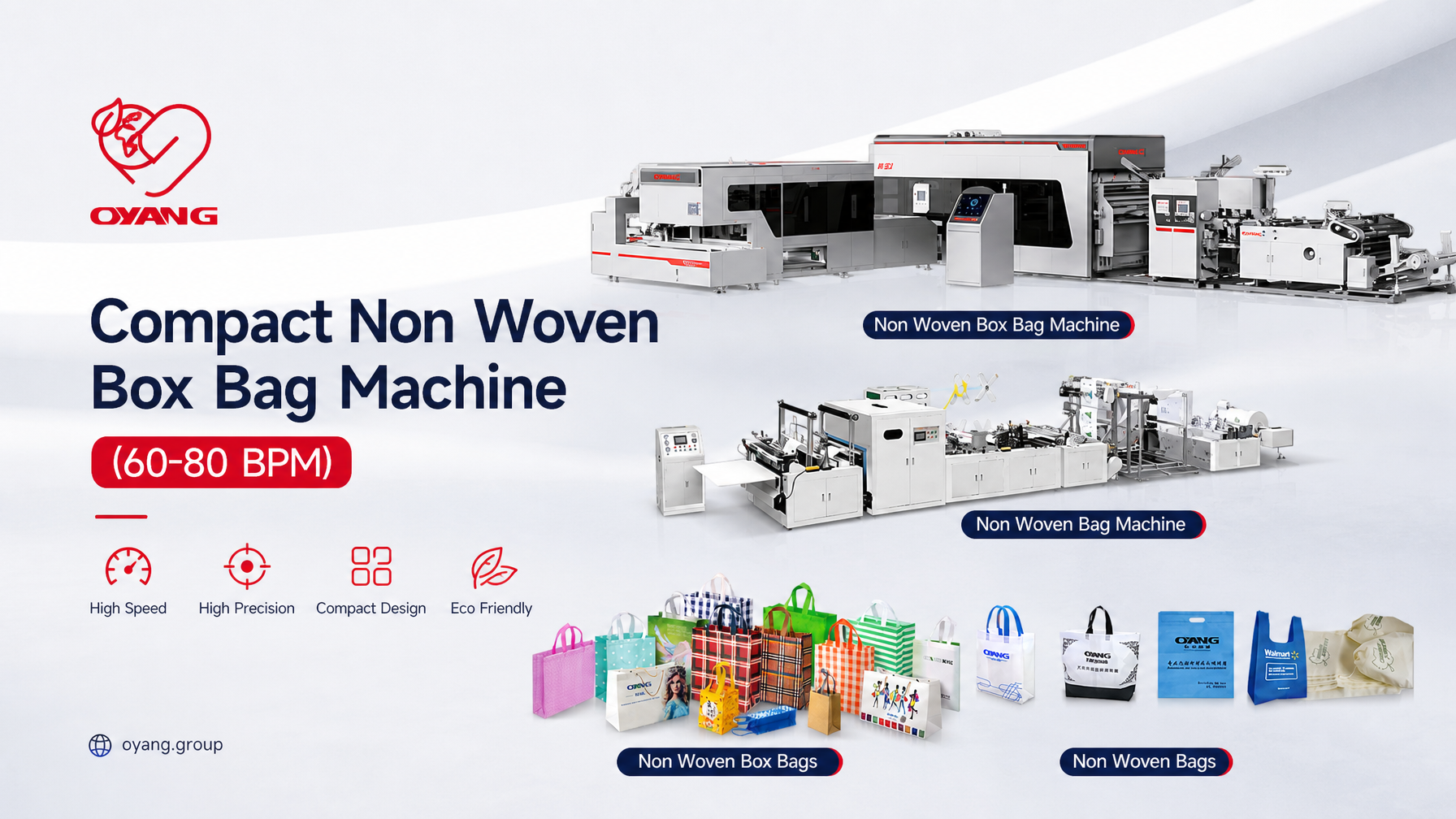
A compact non woven box bag making machine is an engineered converting platform designed for regional converters and contract packaging facilities constrained by factory bay spans and utility transformer capacities. Operating at a stable continuous velocity of 60 to 80 bags per minute, mid-tier systems like the OYANG 16S and SMART 19 compress the entire web-forming, ultrasonic sealing, and handle-attaching sequence into an overall line length of less than 9.5 meters (8,800 × 2,100 × 2,200 mm) with a low connected electrical draw of 18 to 22 kW. This architecture delivers dual-mode capability between 3D gusseted box bags and 2D flat merchandise bags while reducing initial capital equipment expenditure (Capex) by 35% to 45% compared to high-speed mega-lines.
Why Floor Space and Flexible Batch Sizing Dictate Machine Sizing
While flagship lines running at 100 bags/min dominate massive commodity retail orders, growing packaging plants face distinct physical and commercial parameters that favor a small footprint non woven bag machine:
Restricted Plant Bay Dimensions
Standard industrial lines measure 13.5 to 15 meters in line length, demanding large column spans. A compact machine under 9.5 meters fits comfortably inside standard 12-meter building grids, leaving adequate clearance for pallet staging and forklift lanes.
Factory Grid Electrical Load Limits
High-axis mega-cells often draw 35 to 50 kW, requiring costly transformer expansions. A medium speed box bag machine operates at 18 to 22 kW, allowing immediate connection to existing industrial electrical distribution panels.
Agile High-Mix Order Schedules
Contract converters handle diverse product mixes, from boutique promotional carry bags to takeout carriers and flat shopping sacks. Dual-mode mechanics allow rapid retooling between 3D box and 2D flat profiles without deploying duplicate machines.
Engineering Benchmark: Compact Machine vs. Flagship Converting Cell
Selecting between a compact line and an automated high-velocity line requires matching plant square footage and order volume against capital equipment payback:
| Engineering Parameter | OYANG 16S / SMART 19 (Compact Platform) | OYANG TECH 23 (Flagship Industrial Cell) |
|---|---|---|
| Rated Converting Velocity | 60 – 80 bags/min (Continuous) | 90 – 100 bags/min (Continuous) |
| Overall Machine Footprint (L × W × H) | 8,800 × 2,100 × 2,200 mm (< 9.5 m) | 13,200 × 2,400 × 2,400 mm |
| Connected Electrical Power | 18 – 22 kW (Low power draw) | 32 – 40 kW (Multi-axis servo cluster) |
| Dual-Mode Conversion | Full native support (3D Box + 2D Flat Bags) | Dedicated high-speed 3D box bag production |
| Format Mold Changeover | Guided mechanical adjustment (15–20 min) | 90-second automated motorized changeover |
| Typical Shift Output (10 Hours) | 30,000 – 45,000 bags/shift | 50,000 – 58,000 bags/shift |
| Machining Datum Tolerance | ≤ 0.015 mm (MAZAK / OKUMA 5-Axis) | ≤ 0.015 mm (MAZAK / OKUMA 5-Axis) |
For detailed configuration pricing across both tiers, see our industrial guides on non woven box bag machine price models and servo specifications and D-cut non woven bag machine continuous converting configurations.
Dual-Mode Kinematics: Reconfiguring Between 3D Box and 2D Flat Formats
An economical box bag machine achieves plant agility through an adaptable folding and sealing path:
1. 3D Box Bag Configuration
In box bag mode, the continuous non-woven web advances through secondary triangle folding horns and mechanical gusset-tucking fingers. A pneumatic bottom-forming mandrel engages, establishing crisp edge folds while dual 20 kHz ultrasonic horns seal the 3D corners. Concurrently, the integrated loop-handle feeder cuts, indexes, and ultrasonically bonds soft handles into the bag rim.
2. 2D Flat Bag & D-Cut Bypassing
When client orders require flat retail merchandise pouches or D-cut bags, the operator retracts the triangle expanders and disengages the 3D bottom mandrel via the touchscreen HMI. The web routes directly into transverse ultrasonic sealing bars and an integrated hydraulic punch module, eliminating the need to purchase a secondary converting machine.
Structural Precision: MAZAK & OKUMA CNC Processing
Compact machinery must not compromise on structural rigidity. When a 60 80 pcs min bag machine operates continuously across multiple shifts, mechanical vibration from welded steel frames causes ultrasonic sonotrode misalignment, leading to scorched seams or acoustic overload trips.
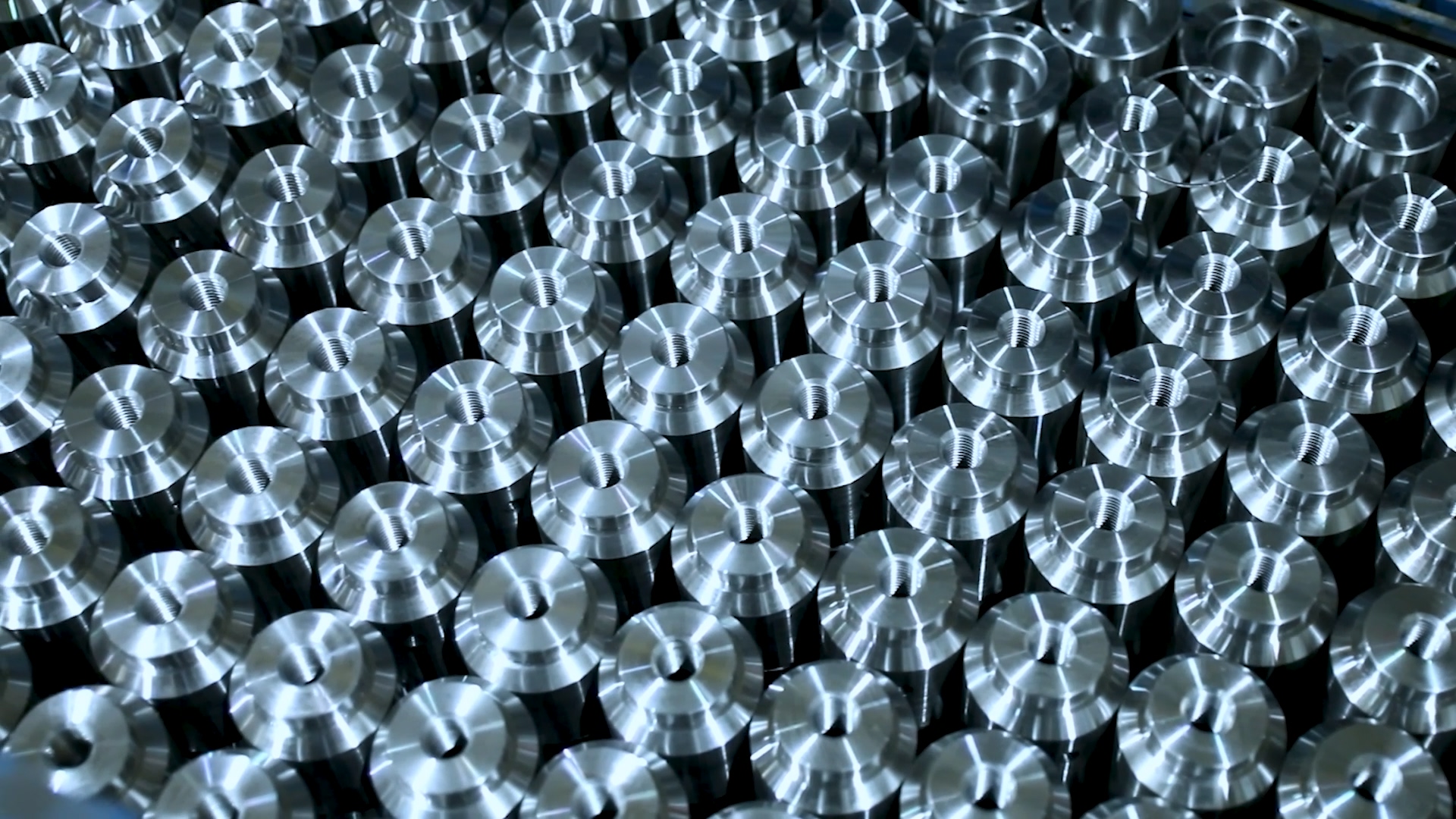
Figure 1: Precision machining of OYANG machine wall panels and shaft journals on Japanese CNC centers inside our 130,000 m² production complex.
Every OYANG 16S bag machine and SMART 19 non woven machine chassis utilizes stress-relieved HT250 gray cast iron side plates machined on Japanese MAZAK and OKUMA 5-axis CNC machining centers. Holding wallboard parallelism and bearing seat concentricity within ≤ 0.015 mm ensures smooth web tracking, minimal ultrasonic horn fatigue, and extended operational service life.
Featured Compact Converting Systems

Figure 2: The OYANG 16S Fully Automatic Nonwoven Box Bag Machine converting 60–80 bags/min with dual-mode 3D and flat bag versatility.

Figure 3: The SMART 19 Nonwoven Box Bag Machine featuring bus-synchronized motion control and rapid size changeovers.

Figure 4: The XB700/800 Multifunctional Nonwoven Bag Making Machine delivering 5-in-1 production for flat, D-cut, and handle carry bags.
Video 1: Factory demonstration of the OYANG 16S compact box bag machine showing continuous feeding, folding kinematics, and handle attachment.
Related Technical Guides & Converting Resources
- → Non Woven Box Bag Machine Price & Specs: Detailed breakdown of 15-axis to 46-axis servo configurations, machine castings, and official factory quotes.
- → D Cut Non Woven Bag Machine Price Guide: High-speed flat bag conversion, continuous web punching mechanics, and cost amortization.
- → Non-Woven Bag Manufacturing Profit Margin & Cost Guide: Raw PP fabric yield calculations, electrical consumption metrics, and net margin analyses.
Frequently Asked Questions (FAQ)
What is a compact non woven box bag making machine?
A compact non woven box bag making machine is a space-saving industrial converting system designed with a total line length under 9.5 meters, engineered to produce three-dimensional non-woven carrier bags at medium speeds between 60 and 80 bags per minute while occupying minimal floor space.
What is the production speed of the OYANG 16S bag machine?
The OYANG 16S bag machine operates at a verified production speed of 60 to 80 bags per minute for standard 3D box bag formats, yielding approximately 30,000 to 45,000 finished bags per 10-hour working shift.
Can a compact box bag machine produce flat bags as well as 3D box bags?
Yes, compact converting platforms like the OYANG 16S and SMART 19 feature dual-mode mechanical setups that allow operators to switch between 3D box bags with side gussets and 2D flat bags or D-cut bags on the same production line.
How much electrical power does an economical box bag machine require?
An economical box bag machine such as the OYANG 16S typically requires a total connected electrical power capacity of 18 to 22 kW, allowing it to operate efficiently on standard industrial utility feeds without requiring high-capacity electrical transformer upgrades.
How much floor space is required to install an OYANG 16S or SMART 19 line?
The core machine dimensions for an OYANG 16S are approximately 8.8 meters long by 2.1 meters wide. Including working clearances for roll loading, pallet stacking, and operator walkways, an installation space of roughly 12 meters by 4 meters (about 50 square meters) is recommended.