

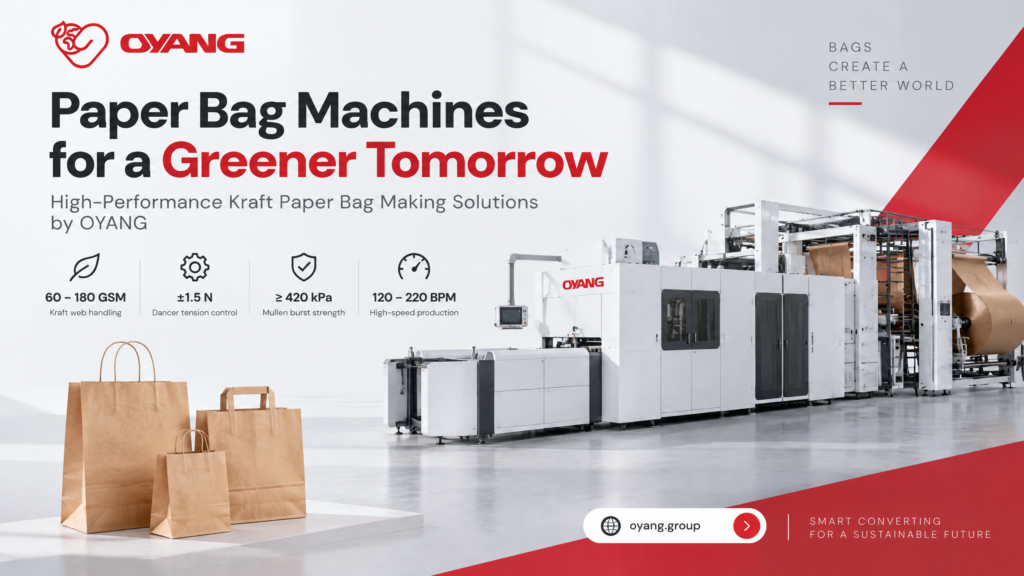
An industrial biodegradable bag making machine (internationally designated across packaging converting plants as a biodegradable bag machine, biodegradable carry bag machine, biodegradable carry bag making machine, or fully automatic biodegradable bag making machine) is an advanced converting line engineered to process 100% plastic-free, circular substrates into high-strength retail carrier bags. Driven by strict global Extended Producer Responsibility (EPR) regulations and Single-Use Plastics Directives (EU SUPD), modern production lines—such as the OYANG 16A Full-Auto Platform and SMART-17 High-Speed Line—convert FSC-certified unbleached kraft paper (60 to 160 GSM), plastic-free barrier dispersions, and modified starch/PVAc water-soluble cold adhesives into fully home-compostable shopping bags. By integrating lengthened bottom-compression conveyors with closed-loop tension control, certified equipment engineered by a premier biodegradable bag machine manufacturer overcomes the slower initial tack of eco-adhesives, operating stably at 120 to 220 bags/min to satisfy EN 13432, ASTM D6400, and OK Compost HOME standards.
The Shift to Biodegradable: Regulatory Drivers & EPR Mandates
Across North America, the European Union, and Australasia, municipal plastic bag bans have evolved into comprehensive extended producer responsibility frameworks. Retailers face punitive eco-taxes on non-recyclable multi-material packaging (such as poly-laminated paper bags or uncertified plastic films). Investing in a dedicated biodegradable bags manufacturing machine provides packaging converters with distinct regulatory and commercial advantages:
- Elimination of Single-Use Plastic Taxes: Conventional plastic carrier bags (including high-density polyethylene and oxo-degradable plastics that fragment into microplastics) face taxes up to $0.15–$0.30 USD per unit in major retail markets. Fully compostable paper bags made from certified cellulose substrates are exempt from these penalty fees.
- True Circular Compostability vs. “Greenwashing”: Major grocery and fashion chains demand third-party verifiable certifications—specifically FSC (Forest Stewardship Council) Chain of Custody, EN 13432 / ASTM D6400 (Industrial Composting), and TÜV Austria OK Compost HOME. A compliant carrier bag must disintegrate within 90 days and fully biodegrade into water, CO2, and biomass within 180 days with zero heavy metal ecotoxicity.
- Water-Based Dispersion Barrier Coatings: Rather than extruding non-degradable polyethylene (PE) or wax coatings for grease and moisture resistance, modern eco-converting utilizes aqueous dispersion coatings (water-based bio-polymers). These barrier coatings repulp completely in standard paper recycling mills and break down naturally in soil environments.
For deeper insight into how paper fiber orientation and bursting indices dictate structural bag durability, study our engineering analysis on kraft paper for paper bag making: GSM, tensile strength & bursting index guide.
Substrate & Consumable Matrix: Traditional vs. Fully Biodegradable Bag
The technical table below contrasts standard converting raw materials against certified biodegradable consumables running through high-speed automatic bag machinery:
| BOM Component | Conventional Packaging Construction | Certified Biodegradable Converting (OYANG Standard) |
|---|---|---|
| Primary Substrate | Generic uncertified kraft or PE/PP extruded laminated paper webs. | 100% FSC-certified virgin unbleached kraft (60–150 GSM) or water-based bio-barrier paper. |
| Seam & Bottom Adhesive | Synthetic petroleum-based PVAc emulsions with non-degradable cross-linkers. | Bio-based, water-soluble dextrin/starch modified PVAc cold glue (EN 13432 certified). |
| Handle Assembly | Synthetic polyester/PP woven cords bonded with EVA hot-melt glue blocks. | 100% twisted kraft paper rope with unbleached paper patch strips and bio-hot melt. |
| Printing Inks | Solvent-based or heavy-metal petroleum-derived flexo inks. | Water-based, zero-VOC soy/vegetable-oil formulated inks compliant with food contact norms. |
| End-of-Life Lifecycle | Landfill bound; persistent microplastic degradation taking 50–100+ years. | 100% Home/Industrial Compostable in ≤ 180 days; 100% repulpable in paper recycling streams. |
For mathematical models examining how paper grammage and trim margins influence production expenses, read our detailed analysis on how much does it cost to produce a paper bag: Cost calculation formulas.
Converting Mechanics: Overcoming Bio-Adhesive Green-Tack Bottlenecks
The primary technical challenge in running a high-speed machine for biodegradable bags involves adhesive kinematics. Traditional petroleum-based hot-melts set within 0.3 seconds. In contrast, certified biodegradable water-based adhesives exhibit a 30% to 50% slower initial bond (green-tack). Running high machine speeds without specialized engineering creates bottom-fold spring-back, seam misalignment, and glue transfer:
1. Lengthened Dual-Belt Bottom Compression Conveyors
To guarantee seam integrity on 100% biodegradable shopping bags, OYANG platforms lengthen the bottom compression conveyor zone by 45% compared to conventional machines. Symmetrical pneumatic compression belts maintain calibrated, uniform pressure (0.25 to 0.40 MPa) over the newly glued square bottoms for an extended duration, allowing starch-PVAc hybrid molecules to cross-link before bags are discharged into the collection hopper.
2. Micro-Metering Gravure Glue Applicators
Excessive biodegradable cold glue wicks into porous kraft fibers, causing paper wrinkling, while insufficient glue yields dry joints. OYANG integrates laser-engraved ceramic anilox glue rollers equipped with micrometer-adjustable doctor blades. This system meters an exact 0.06 to 0.08 mm adhesive film thickness across both side seams and bottom gussets, ensuring 100% fiber-tearing structural joints with zero adhesive spatter at 200 m/min.
3. Low-Inertia Servo Tension Synchronization
Biodegradable and recycled kraft paper reels exhibit slight variations in moisture content and fiber elongation. The OYANG 16A Line employs a multi-axis EtherCAT servo bus topology (Siemens/Inovance) paired with ultrasonic dancer loops, keeping continuous web tension locked within ±1.5 N to eliminate paper web distortion and print misregistration.
For deeper insight into how continuous web feeds, draw rollers, and rotary knives synchronize mechanically, review our foundational guide on how does a paper bag machine work: Mechanics and workflow.
Machinery Selection Matrix: Industrial Biodegradable Bag Converting
The matrix below details certified industrial machinery engineered specifically for high-speed production of fully biodegradable and compostable paper packaging:
| Machine Series | Target Biodegradable Product | Rated Output Speed | Connected Power | FOB Factory Price |
|---|---|---|---|---|
| OYANG 16C V-Bottom Eco Food Line | Compostable bakery, pharmacy & grocery food bags (35–80 GSM) | 300 – 500 bags/min | 8.5 – 11.5 kW | $18,000 – $32,000 USD |
| OYANG 16B Semi-Auto SOS Square Bottom | Biodegradable delivery sacks, takeaway food bags (60–140 GSM) | 80 – 120 bags/min | 14.5 – 18.0 kW | $38,000 – $55,000 USD |
| OYANG 16A Full-Auto SOS with Paper Handles | 100% compostable retail shopping bags with twisted paper handles | 120 – 160 bags/min | 32.0 – 40.0 kW | $115,000 – $145,000 USD |
| SMART-17 High-Speed Industrial Carrier Line | Enterprise-scale biodegradable retail bags with inline handles | 180 – 220 bags/min | 42.0 – 52.0 kW | $145,000 – $185,000 USD |
To budget ocean freight rates, wooden container crating, customs tariffs, and air compressor sizing, review our capital guide on how much does a paper bag making machine cost: Landed CapEx analysis.
Engineering Video: Biodegradable Paper Bag Production Line in Operation
Examine 100% plastic-free raw kraft reel unwinding, inline twisted paper handle bonding, and high-speed SOS bottom folding on the OYANG 16A:
Video 1: Continuous production of 100% compostable carrier shopping bags running on the OYANG 16A automatic line.
Precision Tooling & Quality Control for Biodegradable Converting
Converting unbleached natural fibers and modified starch adhesives requires exceptional tooling precision. Substandard machinery often suffers from cutter jamming and adhesive buildup along guide bars.
As a premier biodegradable bag making machine manufacturer, OYANG machines all structural wall frames from HT250 gray cast iron, processed on Japanese MAZAK and OKUMA 5-axis CNC machining centers to a flatness tolerance of ≤ 0.015 mm. Cut-off knife assemblies are vacuum-heat-treated with specialized non-stick coatings, preventing bio-adhesive residue accumulation and guaranteeing clean, continuous cuts across millions of plastic-free bags.
Related Technical Guides & Converting Resources
- → Kraft Paper for Paper Bag Making: GSM, Tensile Strength & Bursting Index Guide: Structural testing benchmarks, fiber orientation, and mechanical parameters for converting.
- → How Much Does a Paper Bag Making Machine Cost?: Granular financial breakdown covering FOB factory costs, container shipping rates, import duties, and ancillary compressor sizing.
- → How Much Does It Cost to Produce a Paper Bag? Cost Formulas: Practical formulas for calculating electrical consumption, trim margins, and adhesive application thicknesses.
- → How Does a Paper Bag Machine Work? Mechanics & Workflow: Kinematic breakdown of roll unwinding, continuous tube formation, and rotary bottom folding.
Frequently Asked Questions (FAQ)
What makes a paper bag making machine certified for biodegradable bag manufacturing?
A certified biodegradable bag making machine is specifically engineered to process 100% plastic-free raw materials: handling unlaminated FSC-certified kraft paper, dispensing bio-based compostable water-soluble cold adhesives via micro-metering systems, using extended bottom compression belts to overcome the slower initial tack of eco-glues, and running heavy-metal-free water-based flexographic inks.
Which international environmental standards must biodegradable paper bags satisfy?
Compostable paper packaging must comply with EN 13432 (European industrial composting standard), ASTM D6400 (North American composting standard), and TÜV Austria OK Compost HOME certifications. Additionally, paper sourcing must maintain FSC-CoC (Forest Stewardship Council Chain of Custody) traceability to prove sustainable forestry management.
Can biodegradable cold adhesives run at the same speed as synthetic hot-melt glues?
Yes, when run on machinery with an extended bottom compression conveyor zone. While bio-based adhesives have a slower initial tack (setting in 1.2 to 2.0 seconds vs. 0.3 seconds for petroleum EVA hot melts), modern lines like the OYANG 16A extend the pressurized conveyor section by 45%, enabling continuous high-speed production of 120 to 160 bags/min without seam failure.
What is the typical price range for a fully automatic biodegradable bag making machine?
A fully automatic biodegradable paper bag making machine with inline twisted paper handle fabrication (such as the OYANG 16A or SMART-17) ranges from $115,000 to $185,000 USD (FOB). Compact sharp-bottom food bag converters for compostable bakery pouches range from $18,000 to $32,000 USD.