350x97.png)
350x97.png)
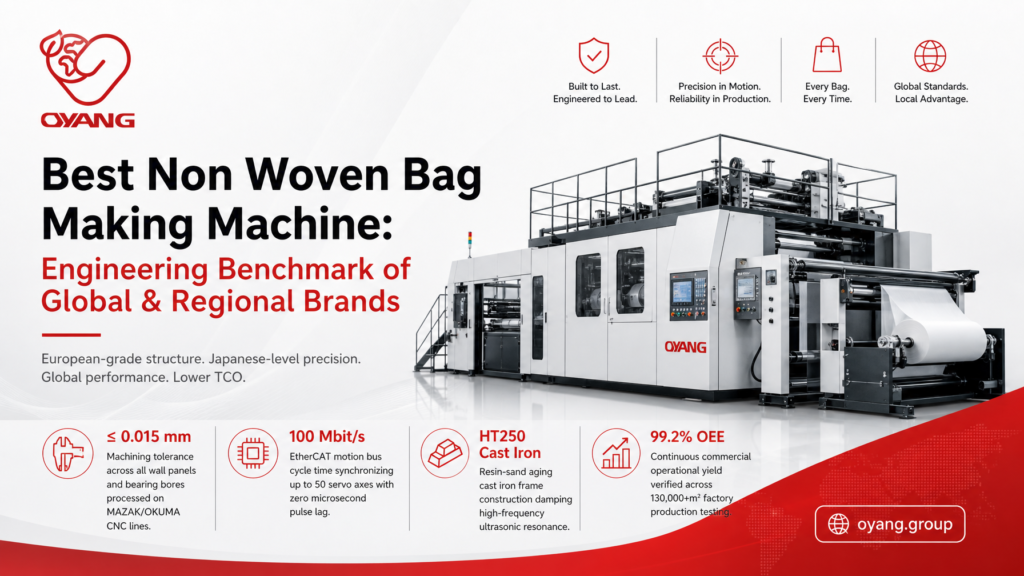
Best Non Woven Bag Making Machine: Engineering Benchmark of Global & Regional Brands
Determining the best non woven bag making machine requires objective mechanical analysis beyond commercial marketing claims. Industrial performance hinges on three physical baselines: monolithic HT250 gray cast iron frames that reduce harmonic vibration by >60% over welded steel channels, real-time 100-Mbit/s EtherCAT industrial bus servo synchronization eliminating pulse-signal drift, and CNC machining tolerances maintained within ≤ 0.015mm on Japanese MAZAK and OKUMA lines. While Japanese manufacturers like Totani lead high-barrier pouch converting at steep capital premiums, OYANG bridges the engineering gap by delivering European-grade structural stability, continuous 100 bags/min output, and 99.2% line yield at a significantly lower 5-year Total Cost of Ownership (TCO).
Machining tolerance across all wall panels and bearing bores processed on MAZAK/OKUMA CNC lines.
EtherCAT motion bus cycle time synchronizing up to 50 servo axes with zero microsecond pulse lag.
Resin-sand aging cast iron frame construction damping high-frequency ultrasonic resonance.
Continuous commercial operational yield verified across 130,000&mflat; factory production testing.
Chassis Metallurgy: Monolithic HT250 Cast Iron vs. Welded Channel Steel
In high-speed bag converting machinery, structural vibration is the primary cause of ultrasonic horn cracking, premature bearing failure, and seam misalignment. Operating at 100 bags per minute requires cyclical sealing forces exceeding 3,000 N every 0.6 seconds:
1. Welded Steel Channels (Common in Entry-Level Regional Assemblers)
Budget assemblers across regional markets (including low-cost workshops and local trading brands) construct frames by welding structural C-channels and square tubing. Welding introduces severe internal residual thermal stresses. Over 12 to 24 months of cyclic mechanical pounding, these stresses relieve unevenly, warping the machine bed by 0.08mm to 0.25mm. This minute twist causes ultrasonic horns and titanium anvils to lose parallelism, forcing operators to throttle line speeds down to 50–60 bags/min to prevent acoustic overload alarms.
2. One-Piece Aged HT250 Gray Cast Iron (The OYANG Standard)
OYANG manufactures main wall panels and structural side frames from high-density HT250 gray cast iron subjected to natural and thermal vibration stress-relief aging. The internal flake graphite microstructure provides 3 to 4 times the vibrational damping capacity of carbon steel. Under continuous 100 bags/min operation, acoustic shock waves from the 15/20 kHz ultrasonic generators are absorbed within the iron matrix, eliminating frame harmonic resonance and ensuring continuous ±0.2mm sealing seam precision over a 10-year machine design life.
Motion Control Topology: Deterministic Industrial Bus vs. Pulse-Train Servos
The electronic architecture dictates whether a machine maintains microsecond registration or drifts out of calibration when ambient shop-floor temperatures and electrical noise rise:
| Control Dimension | Traditional Pulse / Step-Driven Systems | Integrated EtherCAT / CANopen Bus Architecture (OYANG) | Top-Tier Japanese Architecture (e.g., Totani) |
|---|---|---|---|
| Communication Signal | Discrete High-Speed Pulse Trains (500 kHz) | 100-Mbit/s Real-Time Industrial Ethernet (EtherCAT) | Proprietary High-Speed Optical Bus Systems |
| Multi-Axis Synchronization | Asynchronous; cumulative pulse loss during ramp-up | Deterministic clock jitter < 1.0 μs across 50 axes | Deterministic sub-microsecond optical bus syncing |
| Wiring & Noise Immunity | Bundles of shielded copper lines; prone to EMI/EMC noise | Single shielded RJ45 daisy-chain; total EMI immunity | Noise-immune fiber optic cable routing |
| Diagnostic Telemetry | Limited error codes; requires physical multimeter testing | Real-time torque, temperature & error logging per servo | Advanced servo drive curve tracing |
| Registration Precision | ±1.0mm to ±2.0mm at high speeds | ±0.2mm to ±0.3mm across entire 100 bags/min cycle | ±0.1mm (Ultra-precision flexible web) |
Machining Verification: The Mazak & Okuma CNC Precision Baseline
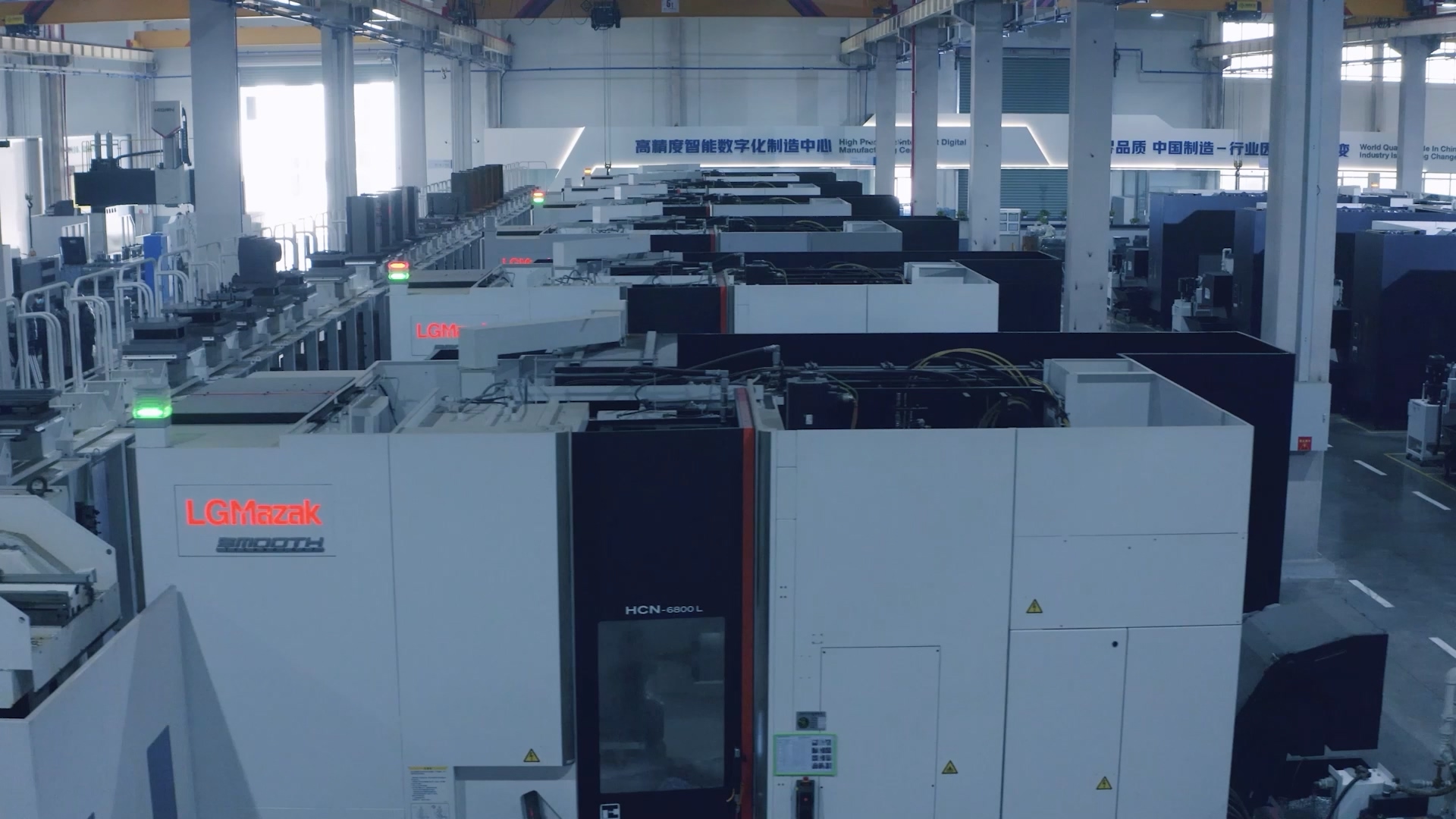
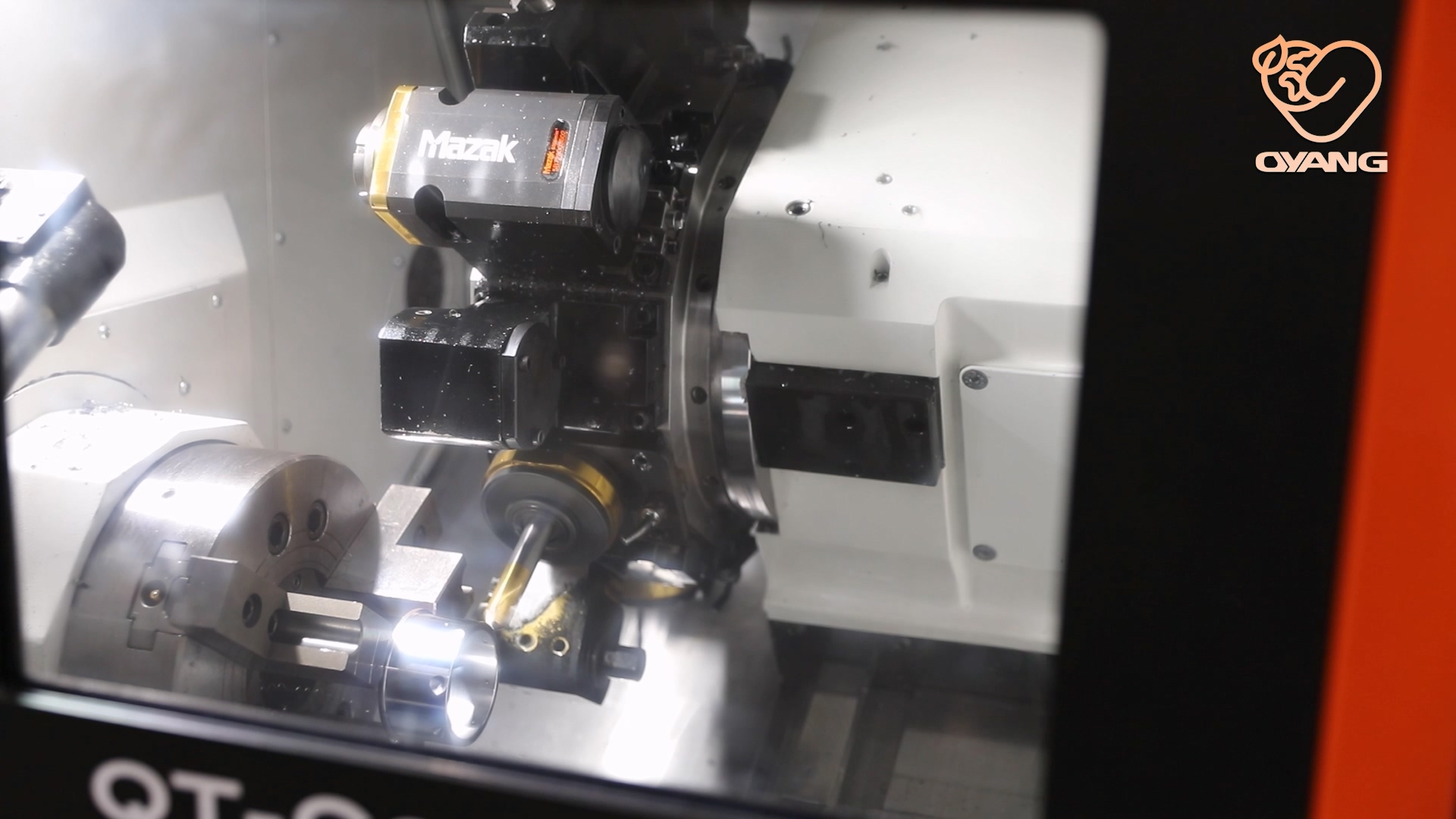
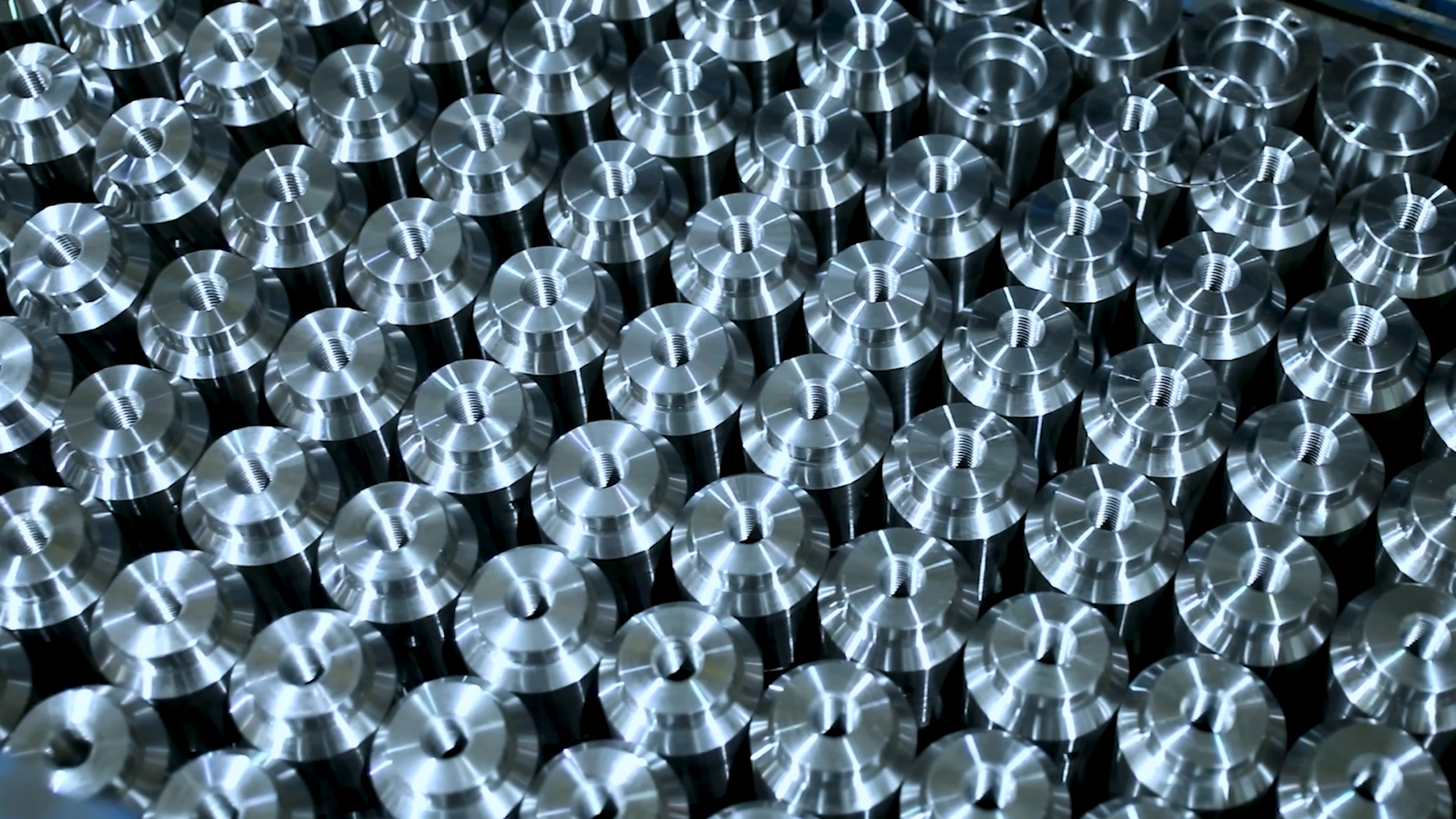
True equipment interchangeability cannot be achieved by hand-fitting parts with shims. Inside OYANG’s 130,000&mflat; intelligent production base, all structural frame panels, mechanical indexing levers, and servo motor mounting flanges are machined on flexible production lines supplied by Japan’s leading machine tool builders:
Brand Ecosystem Benchmark: OYANG vs. Global & Regional Competitors
To help procurement directors cut through sales hyperbole, the matrix below benchmarks the global converting equipment landscape across engineering design, operational reliability, and financial metrics:
| Benchmarking Factor | Regional Assemblers / Trading Brands (e.g., Local Indian Assembly) | OYANG Group (China High-End Industrial Base) | Top Japanese / European Brands (e.g., Totani / Garant) |
|---|---|---|---|
| Frame Architecture | Welded channel steel; manual drilling & shimming | Monolithic HT250 gray cast iron; MAZAK CNC milled | Stress-relieved cast alloy; aerospace machining |
| Motion & Servos | Low-cost pulse stepper or mixed hybrid servos | Full EtherCAT bus topology (Inovance / Siemens) | Proprietary servo bus (Yaskawa / Omron / Rexroth) |
| Continuous Stable Speed | 45–65 bags/min (Vibrations worsen over 70) | 80–100 bags/min (Box bags); 200+ bags/min (Paper) | 150–240 CPM (Pouch lines); high-speed benchmark |
| Auto Mold Change Time | Manual wrench adjust: 45–90 minutes | Digital auto-change: 90 Seconds to 2 Minutes | Motorized recipe changeover: 3–5 Minutes |
| Capital Entry Barrier (Capex) | Low ($18,000 – $40,000 USD) | Medium / Balanced ($50,000 – $120,000 USD) | Very High ($280,000 – $650,000+ USD) |
| 5-Year Operational Yield (OEE) | 65% – 78% (Frequent downtime, alignment drift) | 94% – 99.2% (Predictable continuous output) | 96% – 99.5% (Extremely high reliability) |
| Spare Parts Availability | Generic marketplace hunting; frequent batch mismatches | Standardized OEM stock from 130,000㎡ campus | Global network, but premium OEM spare pricing |
Total Cost of Ownership (TCO) Over 5 Years: The “Cheap Machine” Fallacy
Purchasing an entry-level regional machine to save $25,000 USD in initial capital expenditure routinely incurs severe operating penalties. Calculating scrap rates, downtime wages, and component replacements across 5 years of commercial production:
| TCO Cost Component (5-Year Window) | Budget Welded-Chassis Machine | OYANG Automated Industrial Line | 5-Year Net Difference |
|---|---|---|---|
| Initial Capital Investment (Capex) | $35,000 USD | $75,000 USD | +$40,000 USD (Higher initial investment) |
| Substrate Material Scrap (4% vs. 0.8% on 500 T/yr) | $128,000 USD (Wasted fabric) | $25,600 USD (Precision registration) | -$102,400 USD (OYANG saves fabric) |
| Unplanned Downtime Repairs (400 hrs vs. 45 hrs) | $36,000 USD (Lost margin & idle labor) | $4,050 USD | -$31,950 USD (OYANG prevents downtime) |
| Replacement Parts (Horns, drives, bearings) | $18,500 USD | $4,200 USD (Standard wear items) | -$14,300 USD (OYANG lowers part costs) |
| Net 5-Year Operating Cost (Opex + Capex) | $217,500 USD | $108,850 USD | OYANG Saves $108,650 USD Total |
Featured OYANG Industrial Packaging Lines
Engineered to deliver high uptime and rapid return on capital, OYANG’s flagship lines lead their respective converting categories across international manufacturing plants:

TECH 23: Smart Nonwoven Box Bag Machine
The global benchmark in high-speed nonwoven 3D box bag production. Features full-servo digital mold changing in under 90 seconds and continuous 100 bags/min velocity.
- Converting Velocity: 90–100 bags/min
- Mold Changeover: Fully automated motorized size change in 90s
- Structural Base: Integrated HT250 gray cast iron side frames

OYANG 20: Heavy-Duty Industrial Box Bag Line
Engineered for continuous 24/7 duty cycles on virgin and laminated composite nonwovens. Incorporates advanced acoustic sealing and automatic tension-compensated unwinds.
- Production Speed: 80–100 bags/min
- Control Interface: 50-axis EtherCAT servo bus topology
- Seam Integrity: Reinforced molecular welds supporting up to 20kg

650SZLL: Flexible Multi-Function Pouch Line
High-speed flexible barrier pouch making machine producing 3-side seal, stand-up Doypack, and zipper pouches at speeds up to 240 CPM, rivaling top Japanese pouch systems.
- Pouch Velocity: Up to 240 CPM continuous
- Sealing Tolerances: ±0.15mm optical tracking accuracy
- Film Compatibility: BOPP, PET, AL, and PE recyclable barrier laminates
Video Documentation: OYANG Smart Manufacturing, CNC Machining & R&D Excellence
Frequently Asked Questions (FAQ)
Experience Industrial Engineering Excellence Firsthand
Schedule a technical plant consultation with OYANG engineering directors or visit our 130,000&mflat; CNC digital manufacturing base to inspect our MAZAK and OKUMA machining centers in real-time operation.
Download Complete OYANG Corporate Brochure (PDF)