

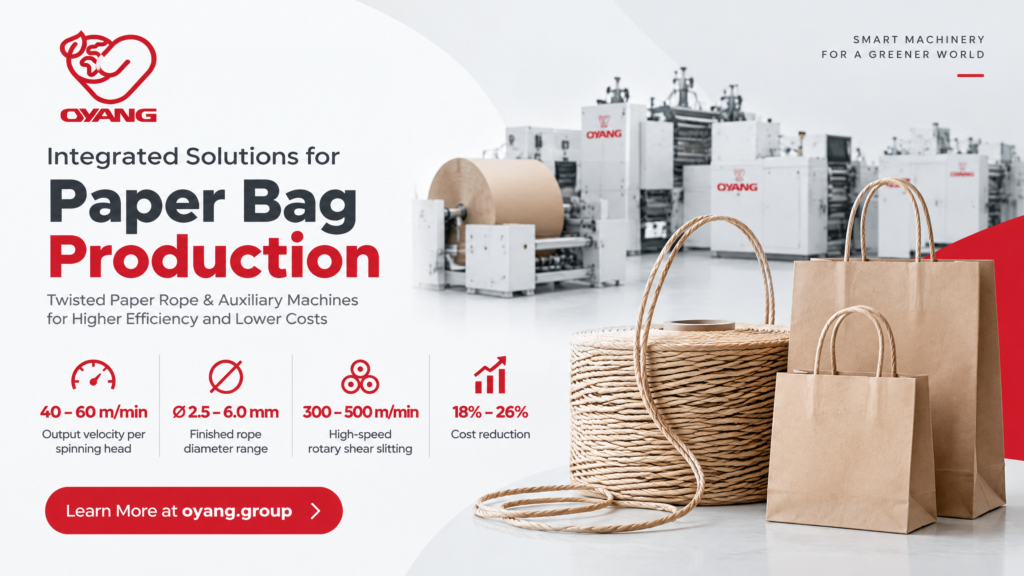
Deploying an industrial twisted paper rope making machine (integrated across converting workshops alongside a paper bag bottom gluing machine, paper bag bottom folding machine, paper bag pasting machine, paper bag bottom pasting machine, or paper bag gluing machine) eliminates supply-chain bottlenecks and reduces handle manufacturing costs by 18% to 26%. Rather than purchasing expensive pre-twisted cords or subcontracting small-batch bottom formation, high-capacity auxiliary units—such as the OYANG ONL-TW2 Double Station Machine and ONL-SL Series Paper Roll Slitter—convert narrow kraft slit reels (25 to 60 GSM) into uniform twisted cords (∅ 2.5 to 6.0 mm) at sustained velocities of 40 to 60 m/min per station. Operating in synchrony with precision reel rewinding, offline handle pasting (ONL-HFA / ONL-HRA), and automated secondary bundling lines (ONL-BP500), these auxiliary systems lower unit production expenses while offering standalone capital investments from $6,500 to $42,000 USD (FOB).
The Operational Bottleneck: Why Main Converting Lines Require Auxiliary Support
An enterprise paper bag converting operation does not function in isolation. While the primary roll-fed converting line (such as the OYANG 16A) converts webs into handled sacks, factory throughput frequently stalls upstream or downstream:
- The Slit Reel Premium Bottleneck: Paper mills sell jumbo master reels (width 1,300 to 1,800 mm) at base commodity rates ($800–$880 USD/ton). However, pre-slit narrow reels (width 280 to 520 mm) carry a vendor slitting surcharge of $80 to $130 USD per ton. Furthermore, customized widths require 4 to 6 weeks lead time. Operating an in-house slitter rewinder gives a plant total procurement freedom and unlocks bulk commodity pricing.
- Handle Cord Dimension Variance: Commercial shopping bags require precise paper cord diameters (±0.15 mm). Commercially outsourced cords often arrive with moisture fluctuations and uneven twist tensions, which causes cord jamming inside the inline handle folding fingers. In-house cord production ensures uniform density and tension.
- Short-Run SOS Bottoming Flexibility: High-speed automated lines require 1.5 to 2.5 hours for full bag-width changeovers. When local clients demand 5,000 to 15,000 custom boutique bags, running an enterprise line is commercially inefficient. Offline tube folding paired with a standalone paper bag bottom pasting machine allows plants to service high-margin short runs without disrupting primary line schedules.
For deeper insight into how primary converting lines synchronize web feeds, draw rollers, and rotary knives, review our foundational guide on how does a paper bag machine work: Mechanics and workflow.
Technical Benchmark: OYANG Auxiliary Machine Portfolio
The table below evaluates operational functions, mechanical throughput, connected power, and commercial FOB price points across OYANG’s paper packaging auxiliary machine matrix:
| Auxiliary Machine | Core Operational Function | Rated Output Velocity | Power & Footprint | FOB Factory Price |
|---|---|---|---|---|
| ONL-TW2 Double Station Rope Machine | High-speed water-assisted twisting of slit kraft paper into ∅ 2.5–6.0 mm cords | 40 – 60 m/min × 2 | 3.7 kW (2.2 m × 1.4 m) | $6,500 – $8,500 USD |
| ONL-RE Rope Rewinding Machine | Rewinding raw twisted paper rope into compact 5–10 kg master coils for line feeds | 80 – 120 m/min | 1.5 kW (1.5 m × 1.0 m) | $3,200 – $4,500 USD |
| ONL-SL1300/1600 High-Speed Slitter Rewinder | Master jumbo reel converting (width 1,300–1,600 mm) with automatic EPC web guiding | 300 – 500 m/min | 18.5 – 22.0 kW (4.2 m × 2.6 m) | $28,000 – $42,000 USD |
| ONL-HRA / HFA Handle Pasting Machine | Offline hot-melt and cold-glue pasting of round rope / flat paper handles to SOS bags | 35 – 45 bags/min | 3.5 – 4.5 kW (2.4 m × 1.3 m) | $12,000 – $16,500 USD |
| ONL-BP500 Automatic Packing Machine | Pneumatic compression stacking, PE bagging, and heat-sealing of finished paper bags | 15 – 25 bundles/min | 5.5 kW (3.0 m × 1.6 m) | $14,500 – $18,500 USD |
For comparative trade-offs between manual handle assembly and high-tier inline automated lines, consult our comprehensive report on semi-automatic vs. fully automatic bag machines: Labor vs. automation guide.
Mechanical Engineering: Rope Twisting & Roll Slitting Dynamics
Fabricating consistent paper rope and clean slit reels requires precise mechanical tension management:
1. High-Speed Water-Assisted Rope Twisting (ONL-TW2)
In an industrial paper rope bag making workcell, narrow slit kraft strips (width 25 to 60 mm, weight 30 to 50 GSM) are drawn through an adjustable moistening wheel. Light water-misting plasticizes the paper fibers, preventing fiber breakage during high-speed twisting. The strip passes into a high-rpm spinning flyer spindle rotating at 2,500 to 3,200 RPM. The rotary flyer twists the ribbon into a dense, cylindrical cord while an electronic traverse winding arm cross-layers the rope onto a core spool, maintaining uniform tensile strength (> 250 N breaking force for ∅ 4.0 mm cord).
2. Precision Shear Slitting & Rewind Tension (ONL-SL Series)
Master paper reels up to 1,600 mm wide are loaded via shaftless hydraulic chucks. The web passes through an ultrasonic edge-position control (EPC) system that corrects lateral reel runout within ±0.1 mm. Rotary upper and lower disc shear knives slit the paper at speeds up to 500 m/min. Dual differential friction shafts maintain constant rewinding torque as coil diameters expand, preventing web telescoping and edge dishing.
3. Automated Stacking & Compression Bundling (ONL-BP500)
When bags exit high-speed converters at 200 bags/min, manual packaging quickly becomes overwhelmed. The ONL-BP500 connects directly to the collection table. An integrated pneumatic press compresses 50-to-100 bag stacks, expelling trapped air to reduce bundle volume by 35%. The machine automatically sleeves the compressed stack in a protective poly film and heat-seals the package, protecting finished bags from dust and moisture during warehouse transit.
For mathematical models examining how paper grammage, slitting waste, and handle rope consumption dictate production expenses, read our detailed analysis on how much does it cost to produce a paper bag: Cost calculation formulas.
Engineering Video: Auxiliary Bundling & Automated Packaging Line Operation
Examine continuous bag collection, pneumatic compression stacking, automatic bagging, and heat sealing on the ONL-BP500 packaging cell:
Video 1: Automated bag compression, secondary packaging, and bundling running on the OYANG BP500 auxiliary line.
Turnkey Plant Integration: Allocating CapEx to Auxiliary Equipment
When setting up an industrial packaging facility, allocating capital solely to the primary converting line while ignoring auxiliary equipment often leads to compromised efficiency. In a balanced plant budget:
- 70% of Equipment CapEx: Dedicated to primary roll-fed converting machinery (e.g., OYANG 16A or SMART-17).
- 20% of Equipment CapEx: Invested in primary auxiliary units (1× ONL-SL1600 Slitter Rewinder + 2× ONL-TW2 Double Station Rope Makers + 1× ONL-BP500 Bundler).
- 10% of Equipment CapEx: Allocated to material handling (electric roll clamp trucks, bench scales, and air compressors).
This integrated approach ensures the plant purchases raw kraft reels at volume discounts, controls handle manufacturing costs internally, and packages finished bags with minimal direct labor.
For detailed facility zoning models, transformer requirements, and full plant investment projections, review our comprehensive feasibility resource on paper bag manufacturing plant cost: Factory setup & utility feasibility guide.
Related Technical Guides & Converting Resources
- → How Does a Paper Bag Machine Work? Mechanics & Workflow: Kinematic breakdown of roll unwinding, continuous tube formation, and rotary bottom folding.
- → Semi-Automatic vs. Fully Automatic Bag Machines: Evaluating capital expenditure, format changeover agility, and direct labor allocation for packaging operations.
- → How Much Does It Cost to Produce a Paper Bag? Cost Formulas: Practical formulas for calculating electrical consumption, trim margins, and adhesive application thicknesses.
- → Paper Bag Manufacturing Plant Cost: Factory Setup & Utility Guide: Complete turnkey budget guide covering civil layout, 380V power drops, and air compressor piping.
Frequently Asked Questions (FAQ)
What does a twisted paper rope making machine do?
A twisted paper rope making machine converts narrow slit kraft paper strips (width 20 to 60 mm, weight 25 to 60 GSM) into continuous twisted paper cords (diameters 2.5 to 6.0 mm). Using light water-misting and high-speed spinning flyer spindles (2,500 to 3,200 RPM), it winds dense, high-tensile paper ropes onto spools for handle making on shopping bag lines.
Why should a paper bag manufacturing plant invest in an in-house slitter rewinder?
An in-house slitter rewinder (such as the ONL-SL series) allows converters to buy master jumbo kraft reels (1,300 to 1,600 mm wide) at commodity bulk rates, avoiding supplier custom slitting fees of $80 to $130 USD per ton. It also eliminates 4-to-6-week supplier lead times for custom widths, increasing operational agility.
What is the role of an automatic bagging and packaging machine in an auxiliary cell?
An automatic packaging machine (such as the ONL-BP500) connects directly to the bag delivery conveyor, using pneumatic compression plates to compress stacks of 50 to 100 bags and expel trapped air (reducing bundle volume by up to 35%). It then automatically inserts the stack into a poly sleeve and heat-seals it, reducing manual labor overhead.
What is the typical price range for paper bag auxiliary machinery?
Factory-direct FOB prices for auxiliary equipment range from $3,200 to $42,000 USD depending on the machine function. Double-station twisted paper rope makers range from $6,500 to $8,500 USD; rope rewinding units cost $3,200 to $4,500 USD; semi-automatic handle pasting units cost $12,000 to $16,500 USD; automatic bundling machines range from $14,500 to $18,500 USD; and high-speed master roll slitter rewinders range from $28,000 to $42,000 USD.