

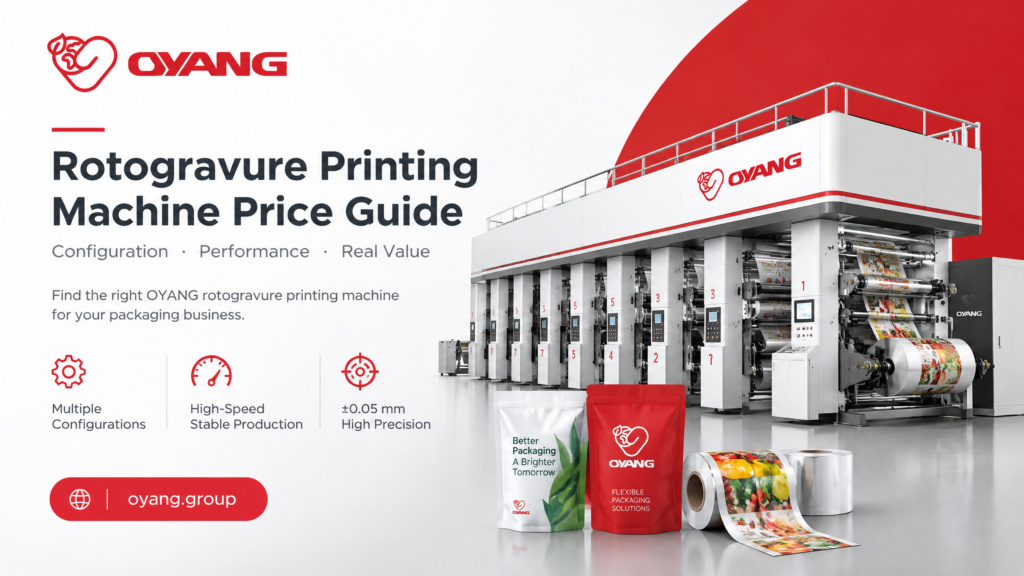
In global packaging converting, an industrial rotogravure printing machine price ranges from $28,000 to over $450,000 USD, dictated by print unit quantity (2 to 10 colors), web width, design velocity, and transmission architecture. While entry-level 2 to 4-color mechanical lines for commodity poly bag and panni printing range between $28,000 and $65,000, high-speed 6 to 8-color Electronic Line Shaft (ELS) presses operating at 250 to 350 m/min cost between $120,000 and $320,000. OYANG’s servo-synchronized rotogravure presses integrate independent Siemens S120 motion controls, maintaining color registration within ±0.05 mm and slashing startup substrate loss from 200 meters down to under 50 meters, delivering verified operational payback within 8 to 14 months.
Comprehensive Rotogravure Printing Machine Price Matrix by Color & Automation Tier
When evaluating equipment procurement for flexible pouches, plastic films, or shopping bags, buyers encounter vast pricing spreads. The capital investment directly reflects production throughput, web register precision, and automated reel splicing capabilities. Below is an engineering benchmark outlining realistic procurement budgets across standard configurations:
| Equipment Configuration | Deck Count & Drive | Operational Speed | Typical Budget (USD) | Primary Market Applications |
|---|---|---|---|---|
| Economy Poly Bag / Panni Press | 2 – 3 Colors · Manual Turret | 80 – 120 m/min | $28,000 – $42,000 | Local market shopping bags, basic LDPE trash liners, simple two-tone panni rolls |
| Commodity Packaging Line | 4 Colors · Mechanical Line Shaft | 120 – 160 m/min | $45,000 – $68,000 | Agricultural film, fertilizer sacks, salt bags, bleached kraft bread wraps |
| Industrial Converting Platform | 6 Colors · Hybrid / ELS Servo | 180 – 250 m/min | $78,000 – $145,000 | Detergent packaging, pillow pouches, snack wrappers with white background + brand spot |
| High-Speed Flexible Packaging Press | 8 Colors · Full Electronic Line Shaft | 280 – 350 m/min | $165,000 – $285,000 | Retail food pouches, stand-up zipper pouches, multi-layer barrier laminates, shrink sleeves |
| Ultra-High Barrier & Pharma Line | 9 – 10 Colors · Premium Servo ELS | 350 – 400 m/min | $295,000 – $450,000+ | Retort packaging, aluminum blister foils, luxury cosmetic tubes, cold-seal confectionery |
The Five Mechanical Engineering Factors Driving Rotogravure Cost
Sourcing managers assessing a gravure printing machine price or plastic pouch printing machine price must look past the initial invoice and inspect the mechanical assemblies that govern daily operational expenses (OpEx):
1. Drive Kinematics: Electronic Line Shaft (ELS) vs. Mechanical Gear Drive
Mechanical shaft machines rely on a central motor connected to bevel gearboxes and long drive shafts across all decks. Over time, gear backlash and thermal expansion introduce register fluctuations (> ±0.15 mm). In contrast, modern Electronic Line Shaft (ELS) presses integrate dedicated AC synchronous servo motors directly onto each plate cylinder spindle. While ELS technology increases machine CapEx by 25% to 35%, it reduces color registration drift to ±0.05 mm and cuts job changeover substrate waste by up to 70%. For a detailed technical comparison, explore our engineering audit on 8-color rotogravure printing machine specifications and ELS kinematics.
2. Automation on Unwind and Rewind (Flying Splice Turrets)
Manual roll changeovers require decelerating or halting the press, generating 80 to 150 meters of unprinted or misregistered film waste per roll transition. Fully automated turret unwinds and rewinds equipped with high-speed pneumatic rotary cutters and synchronous pre-drive motors execute seamless flying splices at full operating velocity (up to 350 m/min). This automation module accounts for $20,000 to $45,000 of the total machine price but adds 1.5 to 2 hours of productive printing uptime per 8-hour shift.
3. Drying Chamber Thermodynamics & Hot Air Recirculation
Solvent evaporation accounts for up to 45% of total press energy consumption. Entry-level machines utilize direct-exhaust single-pass electric heaters that waste thermal energy. High-tier OYANG presses feature aerodynamic drying tunnels with 70% hot air recirculation, proportional dampers, and high-velocity impingement air nozzles (30–35 m/s). This thermodynamic design lowers electrical heating loads by 30 kW/hour while ensuring residual solvent levels on food-grade packaging remain strictly below 3.0 mg/m².
4. Frame Rigidity & CNC Precision Machining
Chassis wall panels milled on standard manual boring mills frequently suffer from microscopic journal misalignments, inducing harmonic vibration and blade chatter lines at speeds exceeding 180 m/min. Premium presses utilize solid gray cast iron side panels processed on 5-axis Japanese CNC centers to tolerances of ≤ 0.015 mm, ensuring dynamic stability and extended cylinder life.
5. Pre-Press Tooling & Cylinder Inventory
Beyond the printing press itself, converters must account for cylinder tooling. Electromechanically engraved copper and hard-chrome-plated steel cylinders cost between $350 and $550 USD per color. Plant investors should balance their SKU complexity by reviewing our guide on 4-color and 6-color rotogravure configurations and tooling ROI before committing to expanded color stations.
Converting Break-Even & Scrap Reduction Equation
Annual Scrap Savings = Shifts/Year × Splices/Shift × (Mechanical Scrap − ELS Scrap in Meters) × Film Cost/Meter
Factory Benchmark: An enterprise operating 2 shifts daily (300 days/year) with 8 roll splices per shift saves 110 meters of film per splice by transitioning from a mechanical press (150 m scrap) to an OYANG ELS line (40 m scrap). At an average multi-layer barrier film cost of $0.12/meter, this saves $63,360 USD annually in raw substrate waste alone, amortizing the ELS price premium in under 11 months.
OYANG Engineering Foundation: Sub-0.015mm CNC Machining for Operational Longevity
A heavy-duty automatic pouch printing machine or roto printing machine represents a 10 to 15-year capital investment. Structural integrity under continuous multi-shift production determines whether registration tolerances hold or mechanical components degrade.
Inside OYANG’s 130,000 m² smart manufacturing base, all chassis side frames, precision linear guide rails, and impression cylinder assemblies for the HONOR 4.0 ELS Rotogravure Printing Machine and EASYPRINT 3.0 ELS Rotogravure Printing Machine are precision-machined on Japanese MAZAK and OKUMA 5-axis CNC systems.

Figure 1: The flagship OYANG HONOR 4.0 ELS Rotogravure Press (400 m/min, ±0.05 mm register) designed for ultra-high-speed converting of food and pharmaceutical packaging.
Video 1: Machine run of the OYANG HONOR 4.0 demonstrating high-speed automated registration, integrated defect detection, and continuous turret reel changes.
By executing all boring, milling, and tapping sequences across structural side panels in a single setup, dimensional datum tolerances are held strictly to ≤ 0.015 mm. This structural stability eliminates mechanical resonance at 400 m/min, extending impression rubber roller life and protecting plate cylinder chrome plating.
Printed rolls integrate directly with downstream forming lines, including the OYANG 650QSB Flat Bottom Pouch Making Machine for box pouches and pet food bags, and the High Speed Film & Label Slitting Machine ONL-SL for precision master roll slitting.
Related Technical Guides & Converting Resources
- → Rotogravure Printing Machine Cost: Price Factors & ROI Calculations: Granular financial breakdown covering operational energy consumption, ink yield, and total cost of ownership across full industrial converting lines.
- → 8-Color Rotogravure Printing Machine: Technical Specifications & Price Analysis: An in-depth engineering review of color deck sequencing, CMYK plus dual spot color management, and high-speed ELS registration controls.
- → 4-Color & 6-Color Rotogravure Printing Machine: Configurations & Converting ROI: Discover budget-friendly entry lines for regional packaging, single-layer films, and high-volume commodity bag manufacturing.
Frequently Asked Questions (FAQ)
What is the starting price for an industrial rotogravure printing machine?
Entry-level 2 to 4-color mechanical lines for commodity poly bags and panni packaging start from approximately $28,000 to $45,000 USD, while industrial 6 to 8-color Electronic Line Shaft (ELS) presses equipped with automatic flying splice turrets start from $120,000 to $285,000 USD.
What factors cause the biggest price differences in pouch printing machines?
The primary price drivers are the number of color printing units (from 2 up to 10 colors), the drive mechanism (mechanical lineshaft vs. independent AC servo ELS), maximum operating speed (120 m/min vs. 400 m/min), and whether unwinding and rewinding use manual shafts or automatic high-speed turret splicers.
How does an Electronic Line Shaft (ELS) press pay for its higher cost?
An ELS press uses dedicated servo motors on each station instead of physical gears, holding register within ±0.05 mm. This reduces startup substrate scrap from 150–200 meters down to under 50 meters per roll change, saving $40,000 to $65,000+ USD annually in wasted multi-layer film.
What substrates can an automatic pouch printing machine handle?
Modern rotogravure presses handle flexible packaging substrates ranging from thin barrier films (12–50 μm BOPP, PET, BOPA), aluminum foil (7–20 μm), and heat-sealable CPP/PE, to paper stocks and nonwoven fabrics.