

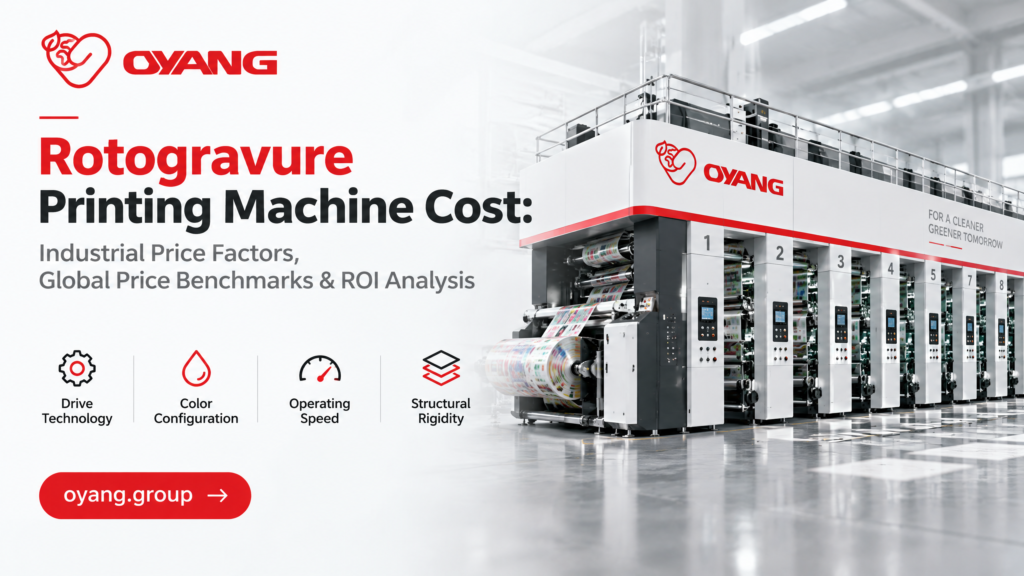
Rotogravure Printing Machine Cost: Industrial Price Factors, Global Price Benchmarks & ROI Analysis
The 4 Core Hardware Engineering Factors Dictating Machine Cost
In industrial packaging machinery procurement, evaluating equipment strictly by initial purchase quotation often conceals severe operational cost penalties. The valuation of a rotogravure press is determined by four foundational engineering sub-assemblies:
1. Drive Transmission Architecture: Mechanical Line Shaft (MLS) vs. Electronic Line Shaft (ELS)
Mechanical Line Shaft (Entry-Level): Utilizes a single primary motor connecting each printing station through a 25 to 35-meter longitudinal drive shaft, universal joints, and helical bevel gearboxes. While lower in initial purchase price by $40,000 to $80,000 USD, gear backlash leads to continuous registration hunting, resulting in 200 to 400 meters of scrap film per changeover.
Electronic Line Shaft (High-End Industrial): Replaces all mechanical cross-shafts with autonomous AC synchronous permanent magnet servo motors direct-coupled to each plate cylinder spindle. Controlled over a high-speed fieldbus, longitudinal registration accuracy holds within ±0.05 mm, slashing start-up scrap below 50 meters and saving tens of thousands of dollars in annual substrate waste.
2. Color Station Quantity & Web Width (4-Color vs. 8 to 10-Color Configurations)
Each additional color unit adds a complete printing deck: dual pneumatic impression rollers, SUS304 enclosed ink reservoirs, bi-directional oscillating doctor blade mechanisms, high-efficiency drying hoods, and dedicated electronic registration optics. Standard widths range from 800 mm to 1300 mm. An 8-color press requires roughly double the structural mass, electrical cabinet footprint, and ductwork compared to a basic 4-color press.
3. Operating Speed & Web Handling Automation (150 m/min vs. 400 m/min)
Transitioning from a 150–200 m/min press to a 350–400 m/min production system requires heavy dual-arm turret unwinds and rewinds capable of automated zero-speed linear flying splicing without machine deceleration. It also necessitates high-capacity multi-zone negative-pressure drying ovens with nozzle discharge air velocities exceeding 35 m/s to fully flash off solvents within fractions of a second.
4. Structural Rigidity: Japanese CNC Machined Side-Frames
Budget machinery often utilizes lightweight welded plate frames prone to harmonic vibration at speeds exceeding 180 m/min. Premium industrial equipment uses 70 to 90 mm thick solid cast-iron or stress-relieved steel side-frames machined on Japanese MAZAK and OKUMA CNC centers to tolerances of ≤ 0.015 mm, eliminating bearing misalignment and print chattering.
Master Industrial Price Matrix: Machine Tier Benchmarks
The following matrix outlines real-world price benchmarks, technical parameters, and typical applications across industrial rotogravure configurations:
| Equipment Tier & Model | Color Units | Drive System | Max Speed | Global CapEx (USD) | Estimated India CIF Price (INR) |
|---|---|---|---|---|---|
| Basic 4-Color Entry Line | 4 Colors | Mechanical Line Shaft | 120 – 150 m/min | $35,000 – $55,000 | ≈ ₹2,900,000 – ₹4,600,000 |
| Standard 6-Color Converting Line | 6 Colors | Mechanical / Semi-Servo | 180 – 220 m/min | $65,000 – $110,000 | ≈ ₹5,400,000 – ₹9,200,000 |
| OYANG EASYPRINT 3.0 | 8 – 10 Colors | ELS Servo System | 280 m/min | $150,000 – $240,000 | ≈ ₹12,500,000 – ₹20,000,000 |
| OYANG HONOR 3.5 PLUS | 8 – 10 Colors | ELS Full Servo Drive | 400 m/min | $240,000 – $380,000 | ≈ ₹20,000,000 – ₹31,500,000 |
| OYANG HONOR 4.0 Supreme | 10 – 12 Colors | Direct-Drive ELS + Auto Turret | 400 m/min | $320,000 – $480,000+ | ≈ ₹26,500,000 – ₹40,000,000+ |
For converters evaluating how rotogravure machine pricing compares with flexographic equipment across different configurations, consult our detailed guide on Packaging Printing Machine Prices, Types & Maker Standards.
What Is the Price of a Rotogravure Printing Machine in India? Import & Landed Cost Factors
Converters asking what is the price of a rotogravure printing machine in India must account for the total landed equipment cost (Total Landed Cost) beyond the factory EXW price. The Indian converting machinery landscape features domestic local builders (primarily producing mechanical shaft lines in Ahmedabad and Faridabad) alongside imported high-speed ELS converting equipment:
- Basic Domestic Lines (India Fabricated): Basic 4 to 6-color mechanical line shaft presses range between ₹25 Lakhs and ₹65 Lakhs INR ($30,000 to $78,000 USD). These are generally limited to speed ranges of 100–150 m/min with manual registration adjustments.
- Imported High-Speed ELS Systems: Precision 8 to 10-color ELS presses with automated register controls range from ₹1.5 Crores to over ₹3.5 Crores INR ($180,000 to $420,000 USD).
-
Customs, Tariffs & Freight Breakdown for India: When importing equipment under HS Code 8443.19:
• Basic Customs Duty (BCD): Typically 7.5% under capital goods tariff schedules.
• Integrated Goods and Services Tax (IGST): 18% (recoverable as Input Tax Credit – ITC for registered packaging manufacturers).
• Social Welfare Surcharge (SWS): 10% assessed on the BCD value.
• Ocean Freight & Port Clearance: 40-foot HQ open-top containers to Nhava Sheva (Mumbai) or Mundra port typically add $6,000 to $14,000 USD per complete line.
ROI & Payback Economics: Why ELS Direct-Drive Outperforms Mechanical Lines
While an Electronic Line Shaft press requires roughly $60,000 to $100,000 USD higher upfront CapEx than a mechanical-shaft machine, it generates rapid capital payback via substrate scrap reduction and higher production uptime (OEE):
Practical Payback Model (Based on 2-Shift Operation, 300 Production Days/Year):
- Substrate Scrap Reduction: An MLS press scraps ≈ 300 meters per job changeover. An ELS press with auto-preregistration consumes < 50 meters. At 3 changeovers per day, an ELS press saves 750 linear meters of film daily. On laminated barrier film valued at $0.15/meter, direct substrate savings equal $33,750 USD per year.
- Productivity Gain: Running at 350 m/min versus 180 m/min yields roughly 75% higher output per shift, allowing converters to accept high-volume multi-million meter orders without investing in a second production line.
- Payback Horizon: The incremental CapEx of upgrading to an ELS architecture is typically recouped within 14 to 18 operating months.
OYANG Engineering Practice: ELS Servo Stability Backed by Japanese CNC Machining
High printing speeds cannot compensate for unstable side-frames. If dynamic mechanical vibration causes doctor blade deflection or cylinder chatter, printing at 400 m/min quickly produces thousands of meters of ruined film.

Figure 1: OYANG HONOR 4.0 ELS Rotogravure Press delivering 400 m/min continuous web speeds with ±0.05 mm registration accuracy.
On the OYANG HONOR 4.0 ELS Rotogravure Press, every color station is driven by an independent AC synchronous servo motor with microsecond position feedback. Printed rolls feed directly into downstream high-speed pouch-making lines—such as the OYANG 650QSB Flat Bottom Box Pouch Machine—with zero pouch edge misalignment.
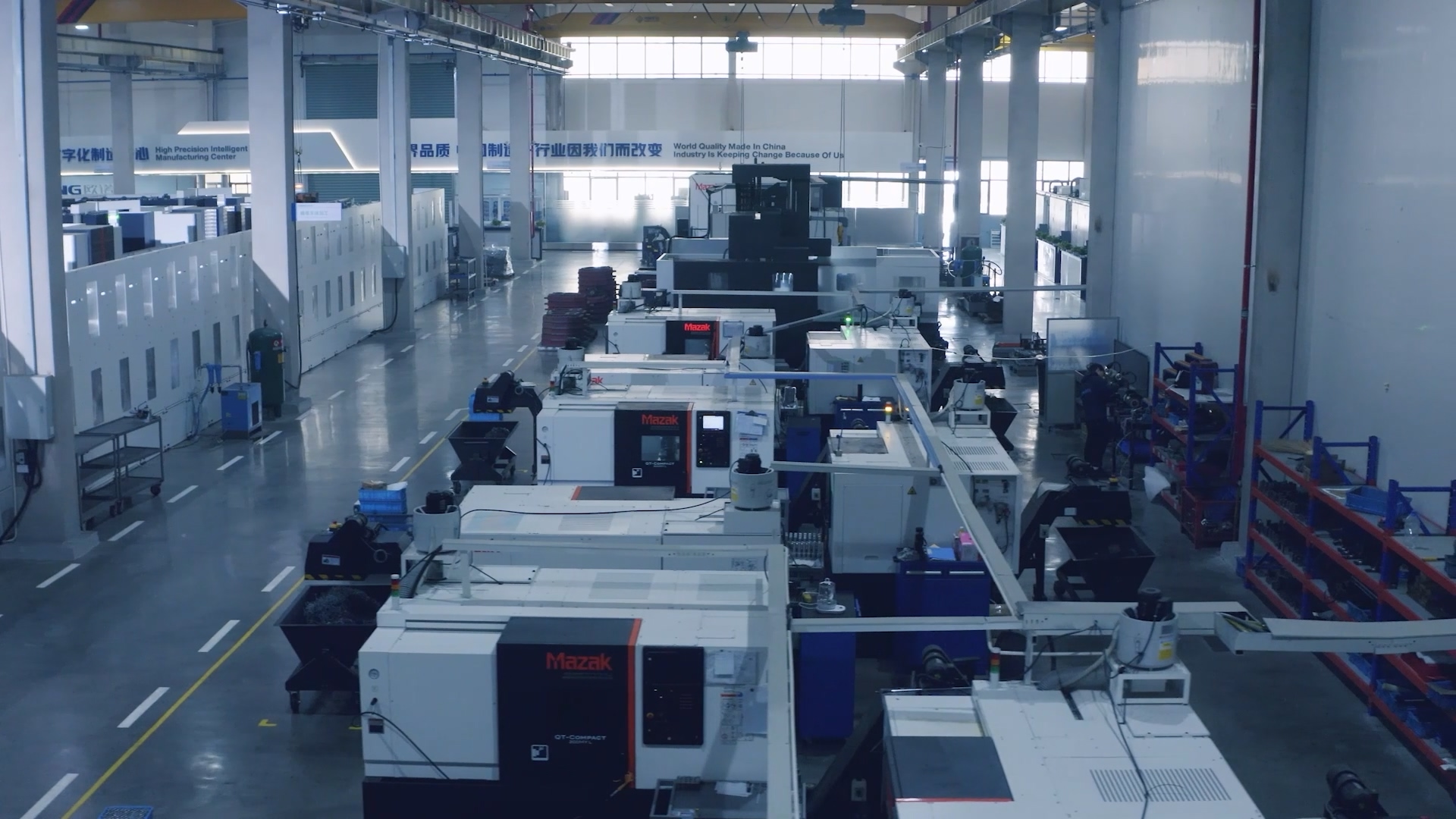
Figure 2: Heavy cast-iron machine side-frames and bearing assemblies machined on Japanese MAZAK multi-axis lines to ≤ 0.015 mm tolerances inside OYANG’s 130,000 m² production complex.
All heavy side-frames, drying plenums, and cylinder chucking mandrels are precision-machined on Japanese MAZAK and OKUMA CNC centers to geometric flatness tolerances of ≤ 0.015 mm. This structural rigidity prevents frame flexure and vibration chattering across full-speed converting runs.
Engineering Specifications: Download comprehensive footprints, power configurations, and technical specifications in the OYANG Rotogravure Printing Machine Solution Brochure (PDF).
Machine Demonstration: Watch real-time high-speed tension synchronization: OYANG HONOR 4.0 Factory Running Video.
Related Printing & Converting Systems
Frequently Asked Questions (FAQ)
How much does a rotogravure printing machine cost?
An industrial rotogravure printing machine costs between $35,000 and $650,000+ USD depending on specification. Basic 4 to 6-color mechanical shaft presses range from $35,000 to $95,000 USD, while high-speed 8 to 10-color Electronic Line Shaft (ELS) flexible packaging lines running at 350 to 400 m/min range from $180,000 to $480,000+ USD.
What is the price of a rotogravure printing machine in India?
In India, entry-level 4 to 6-color mechanical shaft rotogravure presses typically cost between 2,500,000 and 6,500,000 INR (25 to 65 Lakhs), while high-speed imported 8 to 10-color ELS servo rotogravure presses with automatic registration and turret splicing range from 15,000,000 to over 35,000,000 INR (1.5 to 3.5+ Crores).
How much does a rotary print machine cost?
A rotary print machine ranges from $30,000 USD for a basic continuous flexographic or rotary screen unit up to $500,000+ USD for multi-station continuous web rotogravure or CI flexographic packaging presses, depending on width, speed, and drive technology.
How much does a 4-color printing machine cost?
A standard 4-color mechanical web-fed rotogravure or flexographic printing machine costs between $35,000 and $75,000 USD, making it a cost-effective choice for kraft paper bags, simple carton preprint, or woven sack manufacturing.
How long is the typical return on investment (ROI) for an ELS rotogravure machine?
For high-volume converters running multiple shifts, upgrading to an ELS rotogravure machine typically delivers a full return on investment (ROI) within 14 to 18 operating months by cutting startup substrate scrap from over 300 meters down to under 50 meters and increasing line speed up to 400 m/min.