

Rotogravure Printing Ink Guide: Fluid Types, Viscosity Control Standards & Industrial Cost Benchmarks
What Type of Ink Is Used for Rotogravure Printing? Chemical Formulations
Unlike high-paste lithographic inks or thixotropic screen-printing pastes, rotogravure requires highly fluid, fast-drying inks capable of instantaneous cell cavitation and evacuation. The ink must flood millions of microscopic cylinder cells engraved at 175 to 300 lines per inch (LPI) and release fully within a contact nip window of under 0.002 seconds at 400 m/min.
Industrial converters deploy three primary fluid chemistry systems depending on substrate surface energy, barrier demands, and regulatory requirements:
1. Solvent-Based Inks (Ester & Alcohol Soluble)
Binder Chemistry: Modified polyurethanes (PU), nitrocellulose (NC), and polyamide resins dissolved in ethyl acetate, isopropyl alcohol (IPA), and propyl acetate blends.
Substrate Affinity: Superior wetting on low-surface-tension polymer films including corona-treated BOPP (≥ 38 dynes/cm), PET (≥ 50 dynes/cm), BOPA nylon, and bare aluminum foil.
Performance: Fast solvent flash-off, high optical gloss (> 80 GU), and extreme bond strength under autoclave retort conditions (121°C–135°C).
2. Water-Based Inks (Aqueous Acrylic Systems)
Binder Chemistry: Water-dispersible alkali-soluble acrylic resins and polyurethane hybrid emulsions using water and minor ethanol co-solvents (< 15%).
Substrate Affinity: Ideal for porous substrates like kraft paper bags, corrugated preprint liners, paperboard cartons, and coated barrier papers.
Performance: Non-flammable (no ATEX explosion-proof requirements), minimal VOC emissions, but requires higher drying nozzle air velocities (35–45 m/s) due to water’s high latent heat of vaporization (2260 kJ/kg).
3. Energy-Curable Inks (UV & Electron Beam – EB)
Binder Chemistry: Acrylated oligomers and reactive monomers that polymerize via free-radical crosslinking under UV lamps or high-energy electron beams.
Substrate Affinity: Shrink sleeves (PETG, PVC), high-end pharmaceutical laminates, and luxury cosmetic folding boxes.
Performance: 100% solid content (zero VOCs), zero ink drying inside cylinder cells during machine stops, exceptional chemical resistance, and sharp half-tone dot definition.
Viscosity Control: Why the 14–18 Second (Ford Cup #4) Window Dictates Run Quality
In rotogravure, fluid viscosity is the single most critical rheological parameter governing doctor blade wiping efficiency, cell emptying percentage, and color registration stability. On industrial presses, running viscosity is standardized at 14 to 18 seconds using a standard Ford Cup #4 at 25°C (or 18 to 22 seconds via a Zahn Cup #2).
| Viscosity State | Efflux Measurement | Mechanical Impact on Fluidics | Resulting Print Defect |
|---|---|---|---|
| Excessively High Viscosity | > 20 seconds (Ford #4) | Ink cannot completely fill small highlight cells (< 25μm depth); hydrodynamic lift forces doctor blade off cylinder lands. | Doctor blade streaks (scumming/fogging), severe ink foaming, missing highlight dots, and pinholing in solids. |
| Target Operating Window | 14 – 18 seconds (Ford #4) | Complete cell cavitation; smooth doctor blade shearing at 55°–65°; capillary draw achieves > 65% ink transfer. | Sharp line definition, uniform solid laydown (> 2.0 D optical density), and rapid flash-off drying. |
| Excessively Low Viscosity | < 13 seconds (Ford #4) | Low pigment solids; excessive volatile solvent volume; capillary wicking bleeds across substrate surface. | Low optical color density, dot fringe spreading (halos), dynamic solvent retention causing blocking in the rewind roll. |
Because solvents evaporate continuously inside open ink pans at 400 m/min, manual solvent dosing is incapable of maintaining this window. Modern converting lines must utilize closed-loop automated viscosity controllers featuring falling-ball, vibrating-rod, or ultrasonic transducers that inject corrective solvent automatically whenever viscosity shifts by ±0.5 seconds.
How Much Does Rotogravure Ink Cost? Industrial Bulk Price Benchmarks
Converters evaluating plant operating expenditures (OpEx) must assess ink cost by two metrics: purchase price per metric ton and effective coverage cost per square meter. The table below outlines real-world price benchmarks across bulk container shipments (200L steel drums or 1,000L IBC totes):
| Ink Formulation Type | Bulk Price per Metric Ton (USD) | Unit Price per Kg | Wet Laydown (g/m²) | Estimated Cost per 1,000 m² Printed |
|---|---|---|---|---|
| Solvent Opaque White (Titanium Dioxide) | $3,200 – $4,200 | $3.20 – $4.20 | 2.2 – 3.5 g/m² | $7.04 – $14.70 USD |
| Solvent Standard Process Colors (CMYK) | $3,800 – $5,500 | $3.80 – $5.50 | 0.8 – 1.4 g/m² | $3.04 – $7.70 USD (per color) |
| Water-Based Kraft Paper Bag Inks | $2,800 – $4,200 | $2.80 – $4.20 | 1.2 – 2.0 g/m² | $3.36 – $8.40 USD |
| Water-Based Film Inks (High Adhesion) | $4,800 – $7,200 | $4.80 – $7.20 | 1.0 – 1.6 g/m² | $4.80 – $11.52 USD |
| High-Barrier Retort Polyurethane Inks | $6,500 – $9,800 | $6.50 – $9.80 | 1.0 – 1.5 g/m² | $6.50 – $14.70 USD |
| Radiation-Curable (UV/EB) Systems | $9,000 – $14,500 | $9.00 – $14.50 | 0.6 – 1.0 g/m² | $5.40 – $14.50 USD |
For converters balancing capital equipment investment against consumable operating costs, compare market benchmarks in our detailed report on Packaging Printing Machine Prices, Types & Maker Standards.
OYANG Engineering Practice: Sealed Inking Chambers and Pneumatic Fluid Dynamics
At line speeds of 400 m/min, open ink trays create heavy fluid turbulence. High-velocity air currents generated by the rotating cylinder lead to premature solvent evaporation, skinning on the doctor blade edge, and micro-splattering.

Figure 1: OYANG HONOR 4.0 ELS Rotogravure Press equipped with fully enclosed stainless-steel ink applicator chambers and automatic viscosity circulation loops.
On the OYANG HONOR 4.0 ELS Rotogravure Press, engineering solutions isolate fluid transfer:
- Enclosed Inking Reservoir Design: Redesigned SUS304 fluid pans with vapor-trap seals cut passive solvent evaporation by over 30%, lowering plant solvent replenishment overhead.
- Dual-Pneumatic Diaphragm Ink Recirculation: Continuous high-volume fluid turnover prevents pigment sedimentation and micro-bubble generation in metallic and titanium white inks.
- Bi-Directional Doctor Blade Oscillation: Driven by independent servos with adjustable 8–12 mm stroke frequency (1.0–1.5 Hz), preventing localized cylinder scoring.
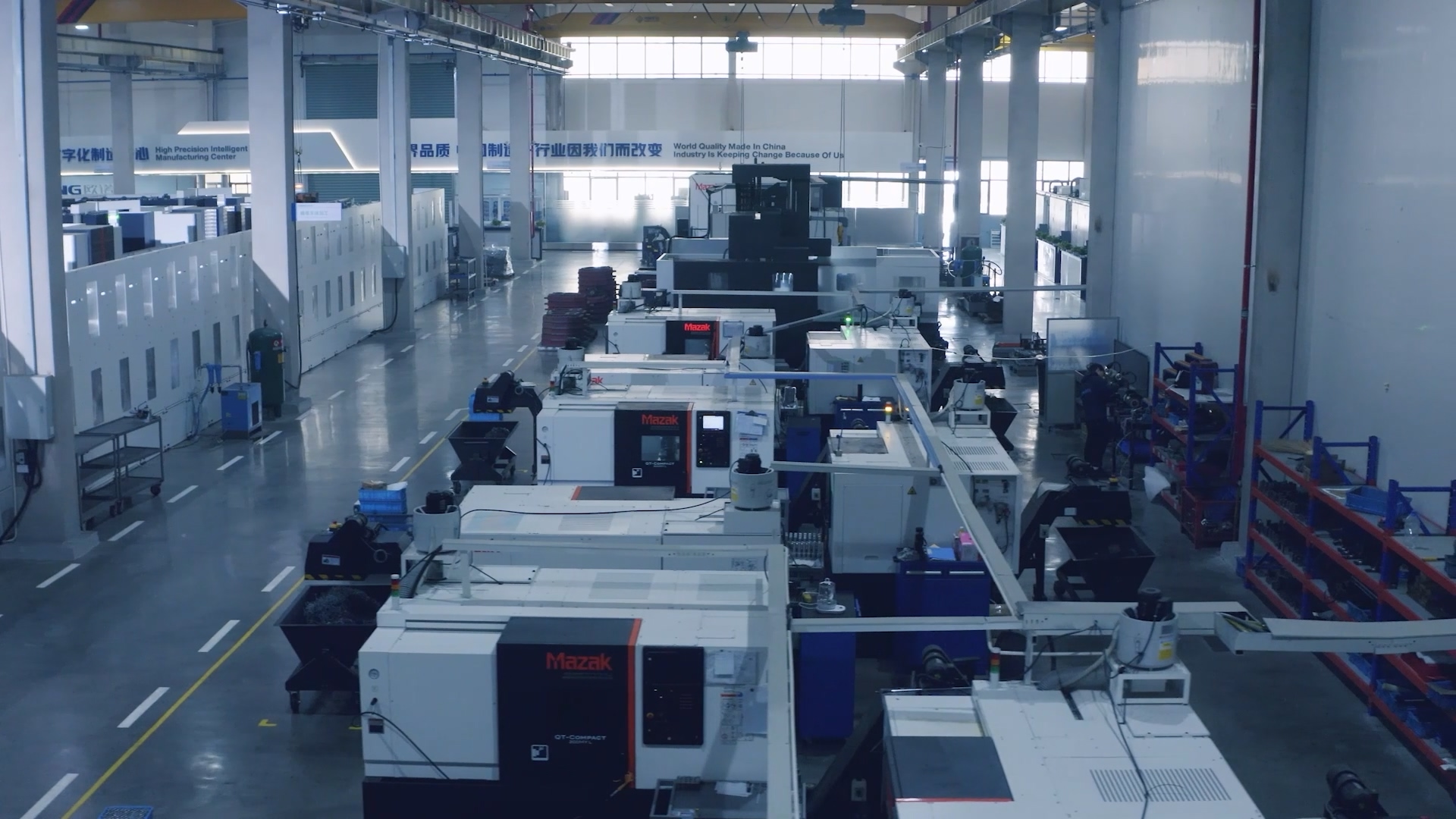
Figure 2: Heavy cast-iron machine side-frames and doctor blade guide tracks machined on Japanese MAZAK multi-axis lines to ≤ 0.015mm geometric tolerances.
All doctor blade mounting carriages and linear guide tracks are machined on Japanese MAZAK and OKUMA CNC centers to tolerances of ≤ 0.015 mm. This structural rigidity prevents doctor blade vibration chattering at 400 m/min, extending cylinder chrome life beyond 3,000,000 meters.
Technical Documentation: Review inking diagrams, drying airflow ratings, and electrical loads in the OYANG Rotogravure Printing Machine Solution Brochure (PDF).
Operational Video: Observe inking circulation and high-speed web tension stability: OYANG HONOR 4.0 Factory Running Video.
Related Printing & Converting Systems
Frequently Asked Questions (FAQ)
What type of ink is used for rotogravure printing?
Rotogravure printing uses low-viscosity fluid inks categorized into solvent-based inks (ester and alcohol soluble polyurethanes for plastic films and barrier foils), water-based inks (acrylic emulsions for paper and carton packaging), and energy-curable inks (UV and Electron Beam systems for high-barrier specialized packaging).
How much does rotogravure ink cost?
Bulk rotogravure ink costs between $3,500 and $5,500 USD per metric ton ($3.50 to $5.50 per kg) for standard solvent-based colors, $4,800 to $7,200 USD per metric ton for high-adhesion water-based film inks, and $9,000 to $14,500 USD per metric ton for specialized retortable polyurethane or UV-curable inks.
What is the standard ink viscosity for rotogravure printing?
The industrial standard operating viscosity for rotogravure printing is rigidly maintained between 14 and 18 seconds using a Ford Cup #4 at 25°C (or 18 to 22 seconds using a Zahn Cup #2), corresponding to a dynamic fluid viscosity of 25 to 45 mPa·s.
Why does rotogravure ink viscosity increase during production?
Ink viscosity increases during production due to continuous solvent evaporation from turbulent ink agitation, boundary layer air friction across the rotating cylinder, and heat transferred from high-velocity drying nozzles, requiring automatic solvent dosing controllers.
Can water-based inks replace solvent inks in rotogravure flexible packaging?
Water-based inks successfully replace solvent inks in porous paper bag converting and surface-treated films, but high-temperature retort pouches (121°C sterilization) and multi-ply aluminum barrier laminates still predominantly require ester-soluble polyurethane solvent systems for bond strength and heat resistance.