

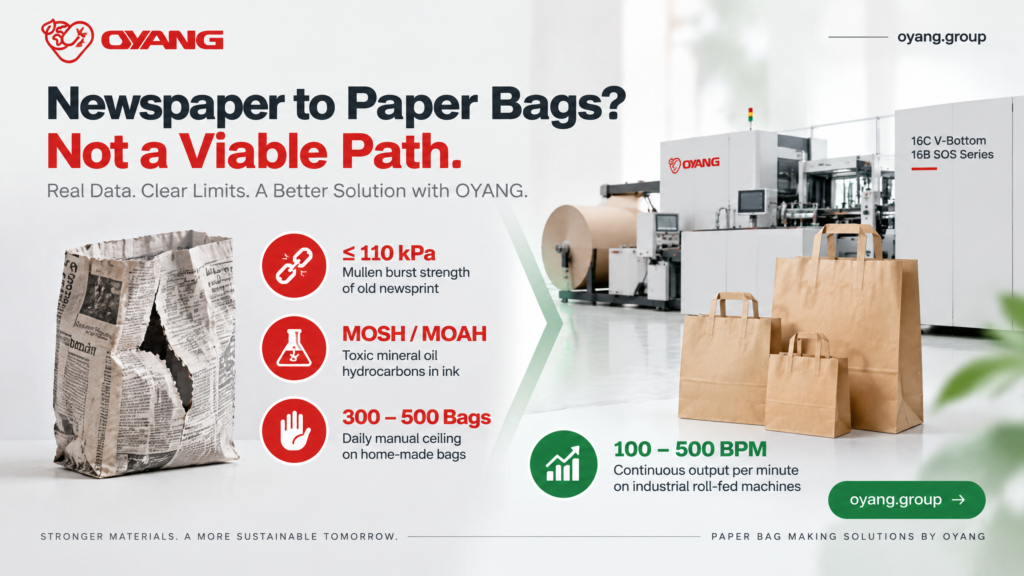
Evaluating a paper bag making machine from newspaper (frequently promoted across cottage industry forums as a newspaper bag machine, newspaper bagging machine, home made paper bag making machine, paper bag making machine at home, paper bags making machine at home, or simple paper bag making machine) reveals severe physical and regulatory bottlenecks that prevent commercial viability. Recycled mechanical newsprint (typically 40 to 48 GSM) possesses a critically low burst strength of only 80 to 110 kPa (compared to 320 to 450 kPa for virgin kraft), causing catastrophic web tearing when fed through continuous mechanical rollers. Furthermore, petroleum-based printing inks on old newspapers contain harmful MOSH/MOAH (Mineral Oil Saturated/Aromatic Hydrocarbons), legally prohibiting its use for food-contact packaging under FDA 21 CFR § 176.170 and EU 1935/2004. To build a scalable commercial packaging enterprise, converters must transition from manual sheet jigs to compact industrial roll-fed machines—such as the OYANG 16C V-Bottom or OYANG 16B SOS Series—running certified kraft reels at continuous rates of 100 to 500 bags/min.
The Physics of Substrate Failure: Mechanical Newsprint vs. Virgin Kraft
Online video tutorials frequently showcase hand-gluing discarded daily newspapers into novelty carrier sacks, suggesting that simple lever-operated wooden presses represent a viable commercial venture. However, from a mechanical and packaging engineering standpoint, recycled newsprint cannot support automated manufacturing:
- Short Mechanical Fibers & Web Rupture: Newsprint is manufactured from thermo-mechanical pulp (TMP) containing high lignin percentages and short wood fibers (< 1.0 mm). Unlike virgin chemical softwood kraft pulp (fiber length 2.5 to 3.5 mm), newsprint possesses virtually zero cross-directional tear resistance. When subjected to the 15 to 25 N web tension exerted by high-speed draw rollers, newsprint webs snap instantly.
- Porous Surface & Adhesive Bleed-Through: Newsprint features high porosity and low surface sizing (Cobb60 water absorption value > 120 g/m2). When standard water-based PVAc or starch adhesive is applied, water rapidly wicks through the paper sheet. This causes severe paper swelling, mechanical wrinkling, and adhesive bleed-through that glues the interior walls of the bag together.
- Structural Mullen Burst Deficit: A standard shopping bag carrying 3.0 kg of dry goods requires a Mullen burst rating of at least 280 kPa. Single-ply 45 GSM newsprint ruptures at approximately 95 kPa. Even when doubled into two plies, the glued sheet yields uneven elongation, leading to immediate bottom detachment under nominal dynamic loads.
To understand how paper fiber orientation, bursting index, and tensile energy absorption dictate bag durability, study our engineering analysis on kraft paper for paper bag making: GSM, tensile strength & bursting index guide.
Engineering Benchmark: Discarded Newsprint vs. Industrial Kraft Paper
The table below contrasts physical, chemical, and operational properties between recycled newspaper sheets and certified roll-fed industrial kraft paper:
| Physical / Chemical Property | Discarded Old Newsprint | Industrial Sack Kraft (Virgin/Recycled) |
|---|---|---|
| Basis Weight (GSM Range) | 40 – 48 GSM (Fragile, inconsistent) | 60 – 150 GSM (Calibrated ±1.5 GSM) |
| Mullen Burst Strength | 80 – 110 kPa (Ruptures under ≤ 1.5 kg load) | 320 – 520 kPa (Supports 8.0 – 15.0 kg loads) |
| Food-Safety Compliance | Failed: Heavy mineral oils (MOSH/MOAH), lead residues | Certified: FDA 21 CFR § 176.170 / BfR XXXVI Food Contact |
| Converting Automation | Zero automated roll feed; 100% manual hand assembly | Continuous roll-fed automation (100 – 500 bags/min) |
| Commercial Viability | Unsaleable in regulated commercial supply chains | High wholesale liquidity ($0.03 – $0.15 USD / bag) |
For mathematical models examining how paper grammage and trim margins influence production expenses, read our detailed analysis on how much does it cost to produce a paper bag: Cost calculation formulas.
Chemical Contamination: Why Old Newspaper Packaging is Legally Prohibited
In developing regions, cottage entrepreneurs often attempt to sell newspaper satchels to local street food vendors, bakeries, and vegetable markets. However, public health agencies worldwide enforce strict consumer protection laws that make commercial production of newspaper food bags illegal:
1. Mineral Oil Hydrocarbon Migration (MOSH & MOAH)
Commercial offset newspaper printing uses mineral-oil-based coldset inks containing Mineral Oil Saturated Hydrocarbons (MOSH) and Mineral Oil Aromatic Hydrocarbons (MOAH). When oily pastries, hot fried chicken, or warm bread contact printed newsprint, mineral oils migrate into the food within minutes. MOAH compounds are classified as carcinogenic and genotoxic, leading to widespread product seizures and substantial regulatory fines.
2. Heavy Metal Pigments & Pathogen Vectors
Discarded newspapers undergo uncontrolled storage, collecting ambient dust, moisture, and microbial mold spores. Furthermore, low-grade color pigments in older presses contain trace amounts of heavy metals including lead, cadmium, and cobalt. Certified commercial paper bag manufacturers utilize virgin or regulated recycled kraft paper bonded with non-toxic, food-grade water-based PVAc adhesives and printed exclusively with heavy-metal-free water-based flexographic inks.
For a structural comparison between simplified entry-level systems and high-tier automated packaging lines, consult our comprehensive report on semi-automatic vs. fully automatic bag machines: Labor vs. automation guide.
Engineering Video: The Industrial Reality — Continuous Roll-Fed Converting
Observe continuous roll unwinding, inline side-gluing, electronic draw tension, and high-speed rotary cutoffs on a certified food-grade packaging line:
Video 1: Commercial food-grade paper converting running on the certified OYANG C330 high-speed platform.
The Transition Roadmap: From Home-Made Jigs to Industrial Commercial Success
Many successful packaging enterprise owners began with an interest in small-scale bag conversion. However, moving from an experimental hobby to an enterprise that generates stable commercial cash flow requires retiring manual sheet presses and adopting a phased transition plan:
Phase 1: Abandon Newspaper Stock
Replace discarded newsprint with certified 45 to 60 GSM virgin brown or bleached kraft paper. Even when operating manual tabletop creasers or sheet gluer fixtures, switching to calibrated kraft allows bags to hold 2.0 to 3.0 kg and satisfy basic non-food boutique retail quality demands.
Phase 2: Transition to Roll-Fed Web Feeding
Manual sheet-by-sheet feeding caps output at 300 to 500 bags per operator per day, generating negative margins after accounting for minimum wage. Transitioning to a roll-fed unwinder feeds continuous paper reels, eliminating sheet picking and manual registration errors.
Phase 3: Deploy a Compact Industrial Line
Commission a compact entry-level converting machine such as the OYANG 16C V-Bottom ($18,000–$24,000 USD). This platform occupies just 20 m2 of floor space, runs on a standard 380V or single-phase 8.5 kW connection, and delivers 80,000+ certified food-grade pouches per shift.
For deeper insight into how continuous web feeds, draw rollers, and rotary knives synchronize mechanically, review our foundational guide on how does a paper bag machine work: Mechanics and workflow.
Related Technical Guides & Converting Resources
- → Kraft Paper for Paper Bag Making: GSM, Tensile Strength & Bursting Index Guide: Structural testing benchmarks, fiber orientation, and mechanical parameters for converting.
- → Semi-Automatic vs. Fully Automatic Bag Machines: Evaluating capital expenditure, format changeover agility, and direct labor allocation for packaging operations.
- → How Does a Paper Bag Machine Work? Mechanics & Workflow: Kinematic breakdown of roll unwinding, continuous tube formation, and rotary bottom folding.
- → How Much Does It Cost to Produce a Paper Bag? Cost Formulas: Practical formulas for calculating electrical consumption, trim margins, and adhesive application thicknesses.
Frequently Asked Questions (FAQ)
Can old newspapers be used in automatic paper bag making machines?
No. Discarded newspapers cannot be processed through automatic paper bag machines. Mechanical newsprint lacks the tensile web strength (bursting rating ≤ 110 kPa) needed to withstand continuous draw roller tensions, leading to immediate web tears. Additionally, old newspapers exist only as cut sheets, while high-speed converters require continuous roll reels.
Why are newspaper bags illegal for packaging food products?
Newspaper printing utilizes petroleum-based offset inks containing toxic Mineral Oil Saturated Hydrocarbons (MOSH) and Mineral Oil Aromatic Hydrocarbons (MOAH), as well as heavy metal pigments. These chemical compounds migrate into food products, directly violating FDA 21 CFR § 176.170 and EU 1935/2004 food-contact regulations.
What is the daily output capacity of a homemade paper bag making machine?
Homemade, manual, or wooden-press paper bag making setups typically yield between 300 and 500 hand-folded bags per operator per day. In comparison, a compact industrial roll-fed machine produces 80,000 to 120,000 bags per 8-hour shift, making home-made setups commercially unviable for volume supply contracts.
What is the most accessible industrial machine to transition from a home workshop?
The most cost-effective and space-efficient transition platform is a compact V-bottom roll-fed machine, such as the OYANG 16C series. Requiring only 20 m² of floor space and consuming 8.5 kW of power, it allows a small workshop to manufacture certified food-grade bakery and retail bags at speeds of 300 to 500 bags per minute.