

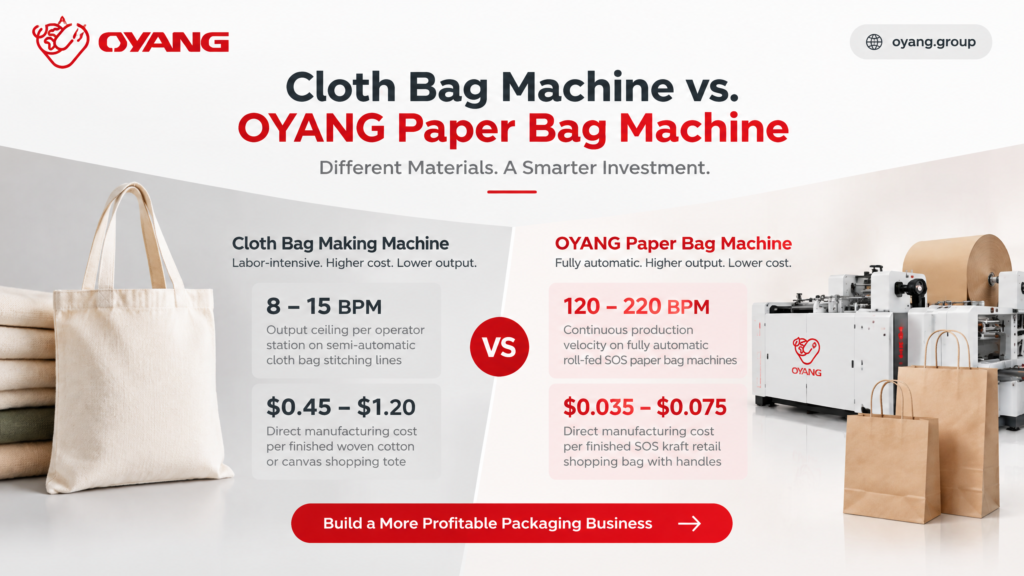
When establishing a commercial packaging manufacturing line, investors frequently compare a cloth bag making machine (broadly marketed across textile sectors as a cloth shopping bag making machine, cloth bag manufacturing machine, automatic cloth bag making machine, or fully automatic cloth bag making machine) against roll-fed kraft paper bag converters. While textile-based bags (cotton, canvas, calico, and jute) command premium retail prices, their fabrication depends on labor-intensive mechanical cut-and-sew operations (overlock stitching, needle thread tensioners, and manual handle top-stitching), capping semi-automatic output at 8 to 15 bags/min per operator with a finished manufacturing cost of $0.45 to $1.20 USD per bag. In contrast, an automated industrial paper bag line—such as the OYANG 16A SOS Line or SMART-17 High-Speed Line—converts unbleached kraft rolls continuously at 120 to 220 bags/min, dropping unit production cost to $0.035 to $0.075 USD per bag with just 1 to 2 machine operators.
Manufacturing Kinematics: Cut-and-Sew Textile vs. Continuous Web Converting
Understanding the fundamental mechanical differences between establishing a cloth bag manufacturing unit and commissioning a high-speed paper bag plant reveals why these technologies occupy distinct tiers in industrial manufacturing:
- Mechanical Cycle Bottlenecks (Reciprocating vs. Rotary Motion): Textile bag machines rely on reciprocating needle bars, bobbin hook thread loops, and feeding dogs. Even with automated ultrasonic or mechanical sewing fixtures, cycling speed cannot exceed 2,000 to 3,500 stitches/min without needle overheating and thread snaps. In contrast, paper bag machines employ continuous rotary kinematics: rotary shear cylinders, rotary scoring bars, and planetary folding drums that process paper webs smoothly at linear velocities exceeding 150 to 200 m/min.
- Direct Labor Dependencies & Skill Barriers: A textile cloth bag assembly workshop requires skilled operators to handle fabric alignment, overlock edge-finishing, and handle box-x stitching. Output scales linearly with headcount. Conversely, a roll-fed paper bag converter requires only 1 line operator and 1 bundling assistant to produce up to 80,000 bags per 8-hour shift.
- Raw Material Elasticity & Feeding Dynamics: Woven cotton, linen, and canvas fabrics possess high Poisson ratios and uneven warp/weft stretch, making continuous tension feeding prone to edge curling and wrinkling. Paper webs maintain predictable modulus of elasticity, allowing closed-loop active dancer arms and multi-axis servo loops to maintain web tension within ±1.5 N.
For detailed insight into labor overhead, format changeover times, and machine staffing requirements, review our technical comparison on semi-automatic vs. fully automatic bag machines: Labor vs. automation guide.
Technical Benchmark: Cloth Bag Machine vs. Roll-Fed Paper Bag Machine
The table below evaluates capital expenditure, production metrics, labor footprints, and unit economics for industrial packaging operations:
| Operational Metric | Industrial Cloth Bag Making Unit (Textile/Cotton) | OYANG 16A Automatic Paper Bag Line (Kraft Paper) |
|---|---|---|
| Forming Mechanism | Rotary fabric slitting → Mechanical overlock needle stitching → Manual hem turn. | Continuous roll unwinding → Water-based PVAc gluing → Rotary drum SOS fold. |
| Daily Output (8-Hr Shift) | 3,800 – 6,000 bags (Assumes 8 sewing workcells) | 65,000 – 85,000 bags (Single continuous converting line) |
| Operating Labor Needed | 8 to 12 Operators (Tailors, cutters, handle attachments) | 1 Operator + 1 Packing Helper (Total line staffing: 2 persons) |
| Direct Unit Cost (Ex-Factory) | $0.45 – $1.20 USD / bag (Fabric $0.35 + Labor $0.18 + Trim $0.05) | $0.035 – $0.075 USD / bag (Paper $0.038 + Glue/Twine $0.008 + Labor $0.003) |
| Primary Target Market | Boutique promotional merchandise, luxury totes (Reusable 50+ times). | Supermarkets, retail fashion chains, fast food delivery, pharmacies. |
| Machine Price Range (FOB) | $15,000 – $38,000 USD (Cloth bag machine price for multi-head stitching unit) | $115,000 – $145,000 USD (Complete automatic SOS line with handle pasting) |
For mathematical models examining raw paper grammage, slitting waste, and unit production cost structures, read our detailed analysis on how much does it cost to produce a paper bag: Cost calculation formulas.
CapEx vs. OpEx: The Commercial Payback Horizon
When comparing a cloth bag making machine price against a high-tier automatic paper bag line, packaging plant investors must look beyond initial machine purchase costs:
1. The Cloth Bag Unit Trap: High Labor Overhead
A commercial textile cloth bag workstation setup appears accessible with an entry CapEx of $15,000 to $35,000 USD. However, producing 1,000,000 bags requires roughly 1,300 to 1,600 labor hours. With operator wages rising across manufacturing hubs, labor accounts for 35% to 55% of direct operating expenses (OpEx). High personnel turnover and stitch-defect rates (typically 4% to 8%) constrain operating margins.
2. The Industrial Paper Bag Advantage: Capital Efficiency
Investing in an automatic roll-fed SOS line (such as the OYANG 16A at $115,000 to $145,000 USD FOB) represents a larger initial equipment commitment. However, producing 1,000,000 paper carrier sacks requires only 110 machine hours and 2 operators. Direct labor overhead drops to less than 5% of unit cost, and material scrap rates stay under 1.5%.
3. Scalability & Big-Retail Supply Contracts
Supermarket chains and grocery delivery brands consume packaging at enterprise volumes—demanding 500,000 to 2,000,000 bags monthly. A textile cloth bag manufacturing unit cannot service these contracts without maintaining hundreds of sewing workers. An industrial paper bag converter meets these volume requirements on a single machine running two daily shifts.
To budget ocean freight rates, wooden container crating, customs tariffs, and air compressor sizing, review our capital guide on how much does a paper bag making machine cost: Landed CapEx analysis.
Engineering Video: High-Speed Paper Bag Converting on the OYANG 16A
Examine continuous paper roll unwinding, inline handle formation, high-speed tube forming, and automated square-bottom closure running on the OYANG 16A:
Video 1: Commercial SOS retail paper bag converting running on the OYANG 16A automatic production line.
Precision Tooling & Heavy-Duty Machine Build Standards
Operating high-speed converting machinery for continuous 16-hour shifts requires heavy structural stability. Lightweight converting frames flex under continuous dynamic web pull, causing register drift and uneven glue application.
OYANG builds all machine side panels and core rotating cylinders from HT250 gray cast iron, stress-relieved and finished on Japanese MAZAK and OKUMA 5-axis CNC machining centers to a flatness tolerance of ≤ 0.015 mm. This structural rigidity maintains precision gear mesh and knife clearances, ensuring reliable 24/7 continuous production across millions of retail shopping bags.
For detailed facility layout templates, power drop sizing, and utility setups, explore our turnkey plant engineering guide on paper bag manufacturing plant cost: Factory setup & utility feasibility guide.
Related Technical Guides & Converting Resources
- → How Much Does It Cost to Produce a Paper Bag? Cost Formulas: Practical formulas for calculating electrical consumption, trim margins, and adhesive application thicknesses.
- → Semi-Automatic vs. Fully Automatic Bag Machines: Evaluating capital expenditure, format changeover agility, and direct labor allocation for packaging operations.
- → Paper Bag Manufacturing Plant Cost: Factory Setup & Utility Guide: Complete turnkey budget guide covering civil layout, 380V power drops, and air compressor piping.
- → How Much Does a Paper Bag Making Machine Cost?: Granular financial breakdown covering FOB factory costs, container shipping rates, import duties, and ancillary compressor sizing.
Frequently Asked Questions (FAQ)
What is the primary operational difference between a cloth bag making machine and a paper bag machine?
A cloth bag making machine uses mechanical sewing needles and thread to stitch woven fabric pieces (cotton, canvas, or jute) at speeds of 8 to 15 bags per minute per operator station. A roll-fed paper bag converter operates continuously from paper rolls, using water-based cold adhesive and rotary folding drums to produce finished bags at 120 to 220 bags per minute with just 1 to 2 machine operators.
How do unit production costs compare between cloth bags and kraft paper bags?
Manufacturing a standard shopping-size cloth bag costs between $0.45 and $1.20 USD due to expensive raw woven fabric and labor-intensive cut-and-sew operations. In contrast, producing an automatic SOS kraft paper carrier bag with handles costs approximately $0.035 to $0.075 USD, making paper packaging far more cost-effective for retail supermarket distribution.
What is the typical price range for a cloth bag machine versus an automatic paper bag machine?
Entry-level semi-automatic cloth bag stitching machines range from $15,000 to $38,000 USD (FOB), but multiple stations are required to build significant capacity. A fully automatic roll-fed SOS paper bag machine with inline twisted handle pasting (such as the OYANG 16A) ranges from $115,000 to $145,000 USD (FOB), delivering a single-line capacity of up to 85,000 bags per shift.
Which packaging machine investment offers a faster ROI?
For industrial converters serving retail grocery, food delivery, and fast-moving consumer goods, an automatic paper bag making machine offers a faster payback period (typically 10 to 14 months) because of low labor dependencies, low scrap rates (< 1.5%), and the capacity to service multi-million unit commercial supply contracts.