

Is It Cheaper to Make Plastic or Paper Bags? Industrial Economics, Profit Margins & Global Packaging Demand
The Cost Reality: Is It Cheaper to Make a Plastic or Paper Bag?
When plant managers evaluate unit cost economics, substrate mass and extrusion physics favor synthetic polymers. High-density polyethylene (HDPE) film can be blown to thicknesses of just 12 to 18 microns, meaning a standard grocery carrier bag consumes only 5 to 8 grams of resin ($1,100–$1,300 per metric ton).
In contrast, an equivalent square-bottom (SOS) paper carrier bag requires 60 to 80 GSM natural kraft paper, consuming 35 to 55 grams of cellulose fiber per unit. Even though kraft paper reels trade at a lower raw ton price ($750–$1,050 per metric ton), the 5-to-7 times heavier mass per unit results in higher raw material input cost per bag. To calculate exact GSM-to-unit weight conversions on converting lines, see our detailed engineering formula guide on how much does it cost to produce a paper bag.
Industrial Economics Matrix: Plastic vs. Paper Bag Manufacturing Benchmarks
Lower production cost does not translate to higher investment return. The table below compares the engineering and financial performance of high-volume plastic carrier lines against modern automated paper bag lines:
| Performance & Cost Dimension | Commodity Plastic Bag Line (HDPE Blown Film + Bag Maker) | Industrial Paper Bag Line (Roll-Fed SOS Servo System) |
|---|---|---|
| Unit Manufacturing Cost | $0.008 – $0.015 USD (Low raw mass) | $0.024 – $0.045 USD (Heavier fiber basis) |
| Wholesale Market Selling Price | $0.010 – $0.018 USD (Extreme price competition) | $0.045 – $0.075 USD (Plain SOS); $0.08–$0.14 (With handles) |
| Factory Gross Margin | 12% – 18% | 32% – 45% |
| Factory Net Profit Margin | 6% – 10% (Declining) | 15% – 28% (Sustained brand premium) |
| Regulatory Compliance Risk | High (Total bans, EPR penalties, plastic taxes in 100+ countries) | Zero (ESG favored, 100% recyclable, bio-degradable) |
| Capital Payback Period (ROI) | 24 – 36 months (Overcapacity squeeze) | 13 – 15 months (High-speed multi-servo lines) |
The Margin Paradox: Is Making Plastic Bags Profitable vs. Paper Bag Making?
Investors frequently ask, is making plastic bags profitable? Today, conventional plastic bag manufacturing is increasingly trapped in an overcapacity commodity cycle. Because film extrusion lines are widespread and technically simple, commercial buyers treat plastic t-shirt bags as a zero-value utility item, negotiating margins down to fractions of a cent. Furthermore, manufacturers face sudden operational shutdowns under Extended Producer Responsibility (EPR) legislation and strict single-use plastic levies.
Conversely, is paper bag making business profitable? Absolutely. Retail brands, fast-food delivery services, and supermarket chains view paper bags as a direct extension of their brand identity and corporate sustainability compliance. Customers routinely pay a substantial premium for kraft carriers with sharp side-gusset folds, flat or twisted handles, and high-definition flexo printing.
Converting plants utilizing high-speed roll-fed machines like the OYANG TECH-18 Line can produce up to 220 bags/min with size changeovers completed in under 2 minutes, enabling converters to switch profitably between long supermarket runs and short-run bespoke boutique orders. For a complete blueprint on plant establishment, review our guide on how to start a small paper bag business.
Regional Deep-Dive: Is Paper Bag Making Business Profitable in India?
In India, the enforceability of the Plastic Waste Management (PWM) Amendment Rules has made paper bag manufacturing one of the highest-growth B2B light-industrial investments. Plastic carry bags below 120 microns are strictly confiscated across commercial districts, driving unyielding demand from national food delivery portals (Zomato, Swiggy, Blinkit) and major organized retail hypermarkets.
Indian Plant Economics: Quick-Service Grocery vs. Fashion Retail
A standard grocery takeaway square-bottom bag produced from domestic recycled agro-kraft paper (55–70 GSM) costs ₹1.35 to ₹1.95 to manufacture and wholesales at ₹2.20 to ₹3.20, netting ₹0.65 to ₹1.10 per bag. Running a dual-shift plant on an automated roll-fed machine producing 140,000 bags daily generates over ₹90,000 ($1,080 USD) net operating profit per day, amortizing machinery within 13.5 months.
To examine how machines handle irregular recycled agro-kraft reels without web breaks, consult our technical analysis on how a paper bag machine works.
Global Industrial Landscape: Who Is the Largest Producer of Plastic Bags?
Historically, the largest producers of plastic carrier bags have been based in China, Southeast Asia (Vietnam, Thailand, and Malaysia), and North America. Global flexible packaging conglomerates—such as Berry Global, Novolex (Duro Bag), and Amcor—have produced hundreds of billions of plastic shopping bags annually.
However, the global packaging sector is undergoing a profound structural pivot. Faced with single-use plastic prohibitions across the European Union, Canada, Australia, and dozens of US states, these industry giants are reallocating capital toward sustainable alternatives:
- Automated Roll-Fed Paper Bag Lines: Tier-1 converters are installing high-output lines like the OYANG SMART-17 Line to supply multi-million bag grocery packaging contracts with 100% recyclable, biodegradable bags.
- Ultrasonic Nonwoven Eco-Bags: For heavy-duty multi-use carrier bags (15–20 kg payload), converters are deploying automated box bag systems like the OYANG 20 Nonwoven Box Bag Machine, combining high-speed automated production with durable 100% recyclable PP spunbond and RPET fabrics.
- Sheet-Fed Creaseless Luxury Packaging: High-end department stores and apparel houses have phased out synthetic shopping bags entirely, shifting to non-creased boutique paper bags made on systems like the Great 4.0 Supreme.
OYANG Engineering Practice: Military-Grade CNC Machining for 24/7 Line Stability
Converting paper web at speeds up to 220 bags/min generates heavy reciprocating mechanical stress. Unlike elastic plastic films, paper has minimal tensile elongation. Low-grade machine frames with minor machining tolerances suffer from micro-vibrations, leading to pitch misalignment, uneven glue application, and web snaps.
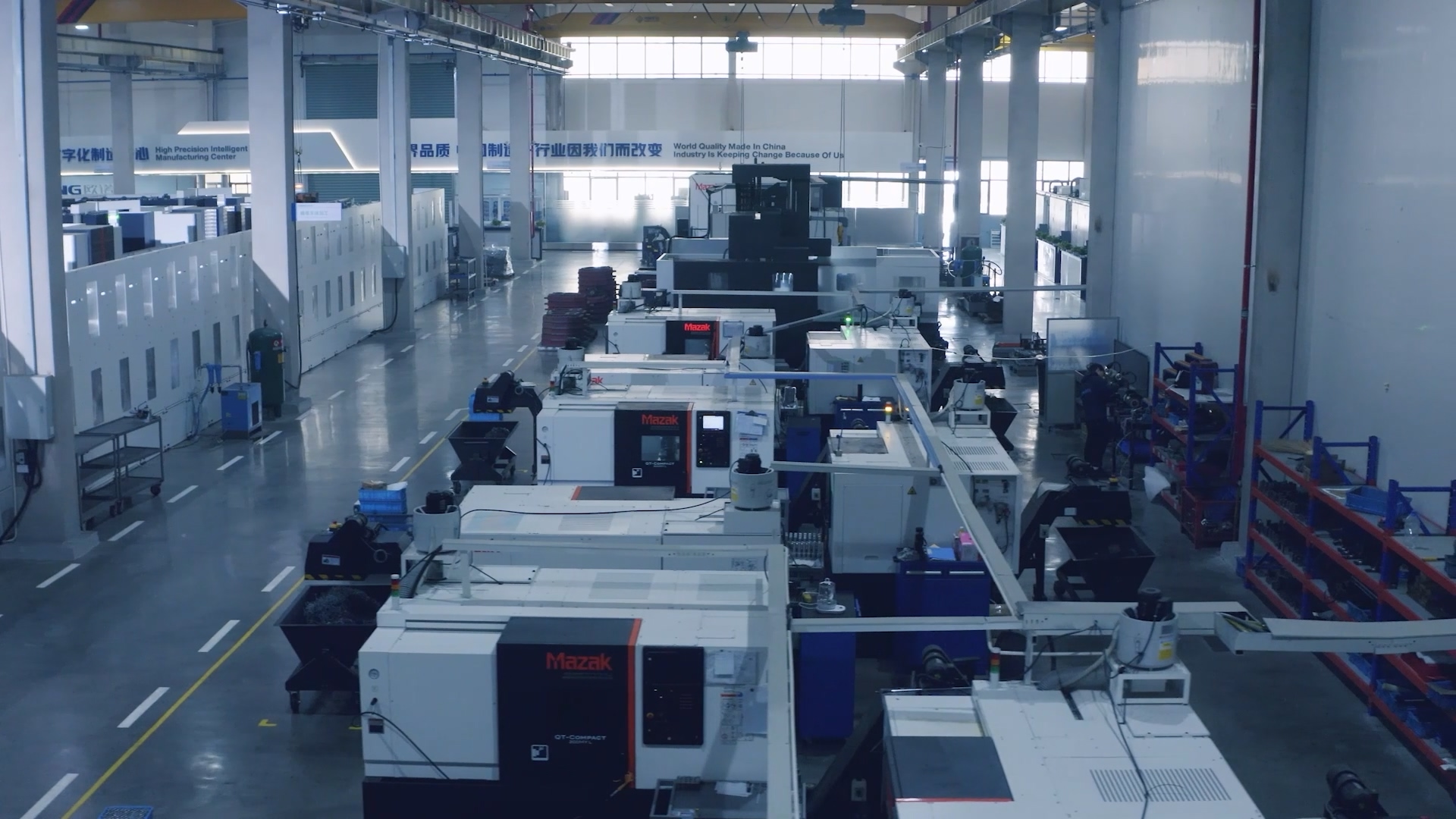
Figure 1: Japanese MAZAK multi-axis automated CNC flexible production line processing structural wall panels inside OYANG’s 130,000 m² manufacturing base.
Inside OYANG’s manufacturing center, all main machine side-wall panels, knife drive mandrels, and bottom folding cylinders are machined using Japanese MAZAK and OKUMA CNC multi-axis centers to tolerances of ≤ 0.015 mm. This structural parallelism, combined with multi-axis bus-controlled servo architecture, holds material scrap rates below 1.2% and protects long-term plant profitability.
Engineering Brochure: Review comprehensive mechanical footprints, speed ratings, and power requirements in the OYANG Paper Bag Machine Solution Brochure (PDF).
Video Demonstration: Watch automated high-speed roll converting and handle pasting: OYANG 16A Automatic Paper Bag Machine Factory Run Video.
Related Engineering Guides & Technical Resources
Frequently Asked Questions (FAQ)
Is it cheaper to make a plastic or paper bag?
It is cheaper to make a plastic bag on a per-unit basis, costing $0.008 to $0.015 USD for an ultra-thin HDPE bag compared to $0.024 to $0.045 USD for a paper bag, because plastic film is significantly thinner and consumes less raw material mass.
Is paper bag making business profitable?
Yes, paper bag making is highly profitable, delivering net profit margins of 15% to 28% and gross profit margins of 32% to 45%. Strong consumer demand, statutory plastic bans, and retail brand premiums enable converters to achieve rapid payback periods of 13 to 15 months.
Is making plastic bags profitable today?
Making plastic bags has become significantly less profitable due to global single-use plastic bans, resin price volatility, and heavy commodity overcapacity, compressing net margins down to 6% to 10% with substantial regulatory shutdown risks.
Is paper bag making business profitable in India?
Yes, paper bag making in India is exceptionally profitable due to strict enforcement of the nationwide ban on single-use plastics under the Plastic Waste Management Rules, creating massive demand from food delivery platforms and supermarkets for grocery SOS bags.
Who is the largest producer of plastic bags?
Historically, multinational packaging conglomerates like Novolex, Berry Global, and Amcor, alongside extensive manufacturing clusters in China and Southeast Asia, have been the largest producers of plastic carrier bags, though most are actively diversifying into paper and nonwoven converting lines.