350x97.png)
350x97.png)
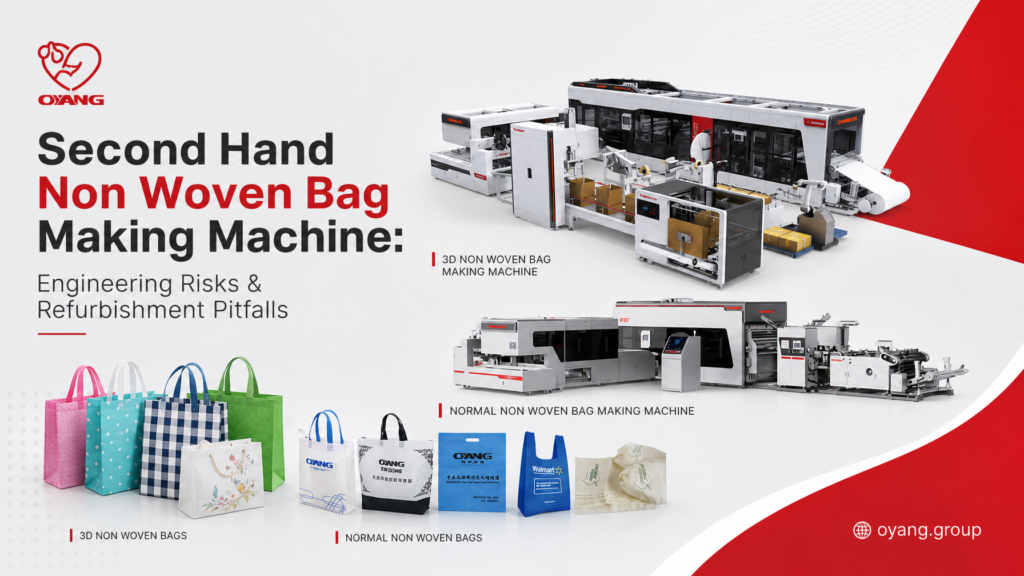
Second Hand Non Woven Bag Making Machine: Engineering Risks & Refurbishment Pitfalls
Procuring a second hand non woven bag making machine offers an upfront capital discount of 40% to 65% ($15,000–$35,000 USD vs. $45,000–$100,000+ USD new), but introduces high mechanical risk. Field diagnostics reveal that machines operating past 15,000 production hours suffer from ultrasonic piezo-ceramic transducer decay (30% amplitude loss), servo optical encoder drift (±1.5mm error), and linear guide backlash (>0.08mm). These hidden mechanical faults elevate fabric scrap rates to 8%–14%, eliminating projected initial Capex savings within 6 to 9 months of operation.
Ultrasonic amplitude power loss on used transducers after 2+ years of continuous shifts.
Material scrap rate on refurbished lines due to dynamic tension control instability.
Mechanical rail backlash wear causing sealing horn misalignment and anvil gouging.
OEE reduction resulting from unresolvable PLC bus timing errors and obsolete spares.
The Anatomy of Used Equipment Failure: 3 Critical Engineering Hazards
Used machinery listings frequently advertise units as “barely run” or “refurbished with fresh paint.” However, visual aesthetics disguise microscopic stress fatigue, thermal aging, and mechanical clearance erosion. In high-speed converting lines running at 60 to 100 cycles per minute, microscopic wear triggers compounding machine failures.
1. Piezoelectric Transducer Aging & Horn Resonance Detuning High Severity
Ultrasonic sealing modules utilize PZT-8 piezoelectric ceramic stacks clamped under mechanical pre-stress. Under continuous production (millions of high-frequency 20 kHz cycles), micro-cracks form within the ceramic rings, and thermal cycling causes dielectric depolarization. The output mechanical amplitude drops from 28μm down to 16–18μm. When this occurs, the machine can no longer achieve molecular chain entanglement on 70–100 g/m² polypropylene fabric. Operators routinely over-compensate by ramping up cylinder pneumatic pressure, which crushes the fabric fibers, accelerates anvil horn pitting, and burns out the ultrasonic generator within weeks.
2. Servo Optical Encoder Thermal Drift & Bus Asynchrony Diagnostic Trap
Second hand machines aged 4 to 7 years contain optical encoders whose internal glass reticles and photodiode arrays have degraded from oil mist, ambient factory dust, and heat dissipation inside the electrical cabinet. During cold startup, the machine may feed accurately. However, after 2 hours of operation as cabinet temperatures reach 45°C, encoder pulse drift causes feeding length deviations exceeding ±2.0mm. On automated box bag machines (such as 3D gusset or handle-looping units), this timing shift disrupts the bottom triangular folding knife cycle, resulting in jammed fabric mandrels and catastrophic mechanical collisions.
3. Linear Guide Backlash & Monolithic Frame Micro-Cracks Irreversible Wear
Budget bag machines constructed from welded commercial channel steel experience frame distortion due to internal welding stress relaxation over years of dynamic load cycles. Concurrently, recirculating ball bearings inside the linear guideways (used for bottom-punching and cross-sealing carriages) erode the hardened raceways. Normal operational guide clearance is ≤ 0.015mm; on used platforms, this clearance frequently widens to 0.08mm–0.15mm. This backlash causes the upper sealing tool to strike the bottom anvil at a compound angle, destroying the horn face parallelism and generating constant edge-cutting defects.
Used vs. New Bag Making Machine: 3-Year Total Cost of Ownership (TCO)
To accurately evaluate equipment capital allocation, factory controllers must balance initial equipment purchase prices against ongoing operational expenses (Opex), material scrap losses, and maintenance downtime. Below is a 3-year TCO comparison based on a continuous operation converting 80,000 bags per day (single machine cell):
| Financial & Engineering Metric | Used / Refurbished Line (5 Yrs Old) | New OYANG Industrial Line (e.g. 16S / XB700) | 3-Year Financial Impact |
|---|---|---|---|
| Initial Purchase Price (FOB) | $22,000 USD | $55,000 USD | +$33,000 USD Capex on new line |
| Average Production Speed | 45–55 bags/min (Limited by vibration) | 80–100 bags/min (Stable continuous) | +45% higher throughput capacity |
| Fabric Scrap Rate | 9.5% (Tension variation & seal tears) | 0.8% (Closed-loop servo control) | -$41,760 USD in fabric waste on new line |
| Component Overhaul & Replacement | $14,500 USD (Generators, horns, servos) | $1,800 USD (Routine consumables) | -$12,700 USD in replacement parts |
| Unscheduled Downtime (Hrs/Year) | 280 Hours / Year | 35 Hours / Year | 735 recovered production hours |
| Warranty & Engineering Support | None (Sold “as is”, third-party broker) | 12-Month factory warranty + remote MOM diagnostics | Zero commercial commissioning risk |
| Total 3-Year Net Operating Cost | $128,400 USD | $89,200 USD | New Line Saves $39,200 USD Net |
Engineering Inspection Protocol: 6-Step Checklist for Evaluating Used Lines
If purchasing a second hand non woven converting unit is mandatory due to extreme initial budget constraints, do not finalize wire transfers based on broker video recordings. Dispatch a certified mechanical engineer to execute this quantitative physical inspection protocol:
- Ultrasonic Resonant Impedance Test: Connect an ultrasonic impedance analyzer to each transducer horn assembly. Verify that dynamic resonant impedance ($$R_1$$) is under 25 Ω and mechanical quality factor ($$Q_m$$) exceeds 800. Any transducer exhibiting parasitic frequencies must be discarded.
- Linear Guideway Dial Gauge Measurement: Mount a magnetic base dial indicator on the main folding carriage. Apply 20 kgf of lateral force; any detected radial play or backlash exceeding 0.025mm mandates complete rail and carriage replacement.
- Thermal Profiling of Servo Drives: Run the machine dry for 45 minutes at maximum rated cycle speed. Use an infrared thermal imager to scan servo motor casings and drive bus terminals. A temperature differential greater than 15°C between identical axis drives indicates winding insulation degradation or failing bearing races.
- Wall Panel Perpendicularity Verification: Remove protective sheet metal covers. Measure the machine wall panel alignment using a precision precision level. Distortion exceeding 0.03mm per meter indicates irreversible structural frame fatigue.
- PLC Program & Controller Lockout Check: Confirm that the OEM system firmware is unlocked. Many legacy converters run proprietary encrypted PLC code; if the original builder is defunct, adapting the machine to new bag dimensions or repairing HMI touch errors is impossible.
- Adhesive & Pneumatic System Integrity: Inspect pneumatic cylinder rod seals for PTFE extrusion and score marks. Pressurize the main manifold to 0.6 MPa and shut off the compressor; system pressure drop must not exceed 0.02 MPa over 15 minutes.
Why New Industrial Platforms Outperform Refurbished Equipment
Rather than inheriting another converter’s deferred maintenance liabilities, forward-thinking packaging operations invest in newly fabricated machinery engineered with HT250 ductile cast-iron wall panels and high-reliability digital EtherCAT motion systems. Precision manufacturing on Japanese MAZAK machining centers ensures long-term operational repeatability:

OYANG 16S: High-Reliability Box Bag Line
The standard choice for operations seeking an affordable new box bag platform. Combines robust cast-iron frames with digital ultrasonic frequency tracking to eliminate startup defects.
- Operating Velocity: 60–80 bags/min
- Bag Formats: 3D box bag, flat handle shopping bags
- Reliability: Backed by factory direct warranty and global spares

XB700/800: Multifunctional 5-in-1 Line
Ideal alternative to buying used D-cut or flat bag machines. Produces flat bags, soft-loop handle bags, D-cut pouches, and drawstring bags on a single, rigid modular footprint.
- Operating Velocity: 40–100 bags/min
- Flexibility: Quick-change modular handle tooling
- Yield Benchmark: Consistent 99% production yield
Video Case Study: Modern Automated Nonwoven Converting Standards
Frequently Asked Questions (FAQ)
Consult with OYANG Engineers Before Buying Second Hand
Do not let hidden refurbishment expenses compromise your production margins. Contact our application engineering team to receive an equipment ROI feasibility calculation, comparing certified new machine options against used alternatives.
Download 2026 Machinery Brochure (PDF)