

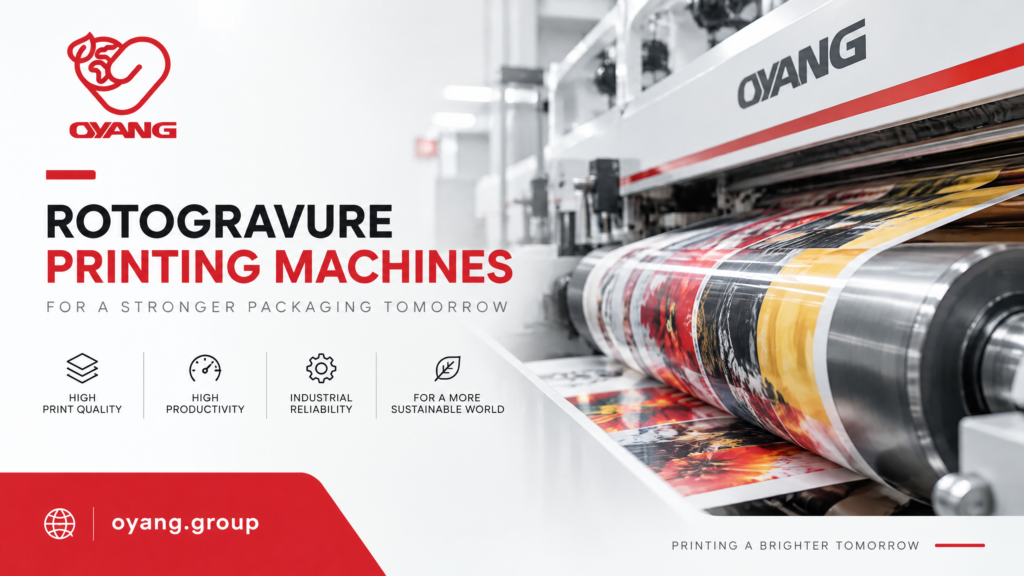
Selecting an industrial roll to roll printing machine requires matching ink transfer rheology, dried deposit thickness, plate durability, and web tension dynamics to specific paper and polymer substrates. While rotogravure provides unmatched optical density and durability on long-run barrier films (1.5–5.0 μm ink laydown at speeds up to 400 m/min), flexographic presses offer superior speed-to-cost ratios for sustainable kraft paper converting with photopolymer plates. Meanwhile, roll-to-roll screen printing supplies ultra-heavy ink deposits (10–30 μm) for tactile branding, and web offset delivers ultra-high resolution (> 200 LPI) for carton wraps. OYANG manufactures full-scale industrial platforms across rotogravure, CI/stack flexo, and roll-to-roll screen machinery, engineered with Japanese MAZAK and OKUMA 5-axis CNC structural tolerances held strictly to ≤ 0.015 mm.
Comprehensive Process Matrix: Gravure vs. Flexo vs. Web Offset vs. Rotary Screen
Converting engineers and packaging plant investors must evaluate technical performance parameters when determining the optimum continuous roll-fed printing technology:
| Process Parameter | Roll-to-Roll Gravure | Roll-to-Roll Flexo (CI/Stack) | Roll-to-Roll Web Offset | Roll-to-Roll Screen |
|---|---|---|---|---|
| Ink Transfer Mechanism | Intaglio recessed cells with oscillating steel doctor blade | Relief photopolymer plate fed by ceramic anilox roll | Planographic chemical balance (ink/water fountain) onto rubber blanket | Rotary nickel mesh squeegee extrusion |
| Dried Ink Film Thickness | 1.5 – 5.0 μm (High opacity & saturation) | 0.8 – 2.5 μm (Thin, fast-drying laydown) | 0.5 – 1.5 μm (Delicate tonal gradients) | 10.0 – 30.0 μm (Maximum tactile opacity) |
| Maximum Operating Velocity | 250 – 400 m/min | 180 – 350 m/min | 150 – 250 m/min | 30 – 80 m/min |
| Plate / Tooling Durability | 2,000,000 – 5,000,000+ m (Hard chrome steel) | 300,000 – 1,000,000 m (Elastomer/Photopolymer) | 100,000 – 300,000 m (Aluminum litho plate) | 50,000 – 150,000 m (Nickel screen stencil) |
| Tooling Cost per Unit | $350 – $550 USD (Engraved cylinder) | $80 – $180 USD (Flexo digital plate) | $25 – $45 USD (Offset CTP plate) | $60 – $120 USD (Rotary screen sleeve) |
| Optimum Substrate Scope | BOPP, PET, BOPA, PVC shrink film, AL foil, coated kraft | Kraft paper (40–180 gsm), corrugated liner, PE breathable film | Coated paperboard, bleached SBS, multi-wall sacks | PP spunbond nonwoven, thick PVC, synthetic vinyl, specialty textiles |
Deep Engineering Analysis: Mechanics, Rheology & Substrate Behavior
1. Rotogravure: The Heavy-Duty Continuous Production Benchmark
An industrial rotogravure paper printing machine or film press operates via direct intaglio cell evacuation. Because liquid solvent inks are drawn directly from microscopic cells into the web under impression nip pressures of 3.0 to 5.0 kg/cm², gravure eliminates the plate distortion and dot haloing inherent to relief printing. The steel cylinder base electroplated with copper and hard chrome resists chemical abrasion, guaranteeing identical color density across multi-million-meter runs. For total CapEx analysis and machine speed pricing, converters can review our comprehensive rotogravure printing machine price guide and CapEx breakdown.
2. Roll-to-Roll Flexo: Precision for Sustainable Paper Packaging
Modern roll to roll flexo printing machine engineering relies on precision ceramic anilox rollers engraved up to 1200 LPI to meter micro-droplets of water-based or solvent-based ink onto flexible photopolymer plates. Flexography delivers exceptional efficiency on absorbent paper webs, such as unbleached kraft and white coated paper used in automated SOS and flat-handle shopping bags. With lower pre-press plate investments and rapid wash-up cycles, flexography represents the premier economic choice for small-to-medium order batching.
3. Roll-to-Roll Screen Printing: Maximum Opacity & Nonwoven Integration
While offset and flexo achieve thin ink laydowns, roll to roll screen printing deposits ink layers up to 30 μm thick through electroformed nickel cylindrical stencils. As a specialized roll to roll screen printing machine manufacturer, OYANG integrates rotary screen units for applications requiring 100% solid opacity—such as metallic pigments, structural whites on dark spunbond nonwoven fabrics, and tactile safety labeling—where traditional relief or intaglio inks would appear washed out.
4. Hybrid Configurations: Flexo-Gravure & Combined Lines
Converters frequently investigate a flexo gravure printing machine or roto flexo printing machine (such as legacy designs popularized by regional builders like Mohindra Mechanical Works). In modern high-throughput packaging plants, this hybrid approach typically manifests as an ELS rotogravure line equipped with an inline flexographic or reverse-gravure station dedicated to registered cold-seal adhesive coating or solvent-free barrier varnishing.
Run Length Break-Even Model: Gravure vs. Flexo
Break-Even Metres = (Total Gravure Cylinder Cost − Total Flexo Plate Cost) ÷ (Flexo Unit Cost/Metre − Gravure Unit Cost/Metre)
Factory Benchmark: For an 8-color design, flexo photopolymer plates cost approximately $1,200 USD total, while engraved gravure cylinders cost approximately $3,600 USD. However, rotogravure operates with 8% to 12% lower solvent-ink consumption per unit area and experiences zero plate wear degradation. The financial crossing point sits at approximately 25,000 to 35,000 linear meters. Above this threshold, rotogravure delivers lower total cost per package; below it, flexography provides superior capital efficiency.
OYANG Engineering Foundation: Sub-0.015mm CNC Machining Across Converting Lines
Whether deploying high-speed gravure for multi-layer barrier pouches, flexography for kraft paper bags, or roll-to-roll screen for nonwoven fabrics, mechanical alignment across unwind, printing stations, and rewind determines final register integrity.
Across OYANG’s 130,000 m² smart manufacturing complex, structural machine frames for our HONOR 4.0 ELS Rotogravure Printing Machine, the OYANG YTC 4-Color CI Flexo Printing Machine, and the Single Color Roll to Roll Screen Printing Machine are processed on Japanese MAZAK and OKUMA 5-axis CNC machining centers.

Figure 1: The OYANG YTC-41200 Central Impression (CI) Flexo Press engineered for thin barrier films and kraft paper rolls with continuous drum web stabilization.
Video 1: Machine demonstration of OYANG’s roll-to-roll paper flexographic printing line, demonstrating synchronized web infeed, fine dot reproduction, and inline rewinding.
By boring central cylinder journals, side frames, and guide-roller mounting datums in a single automated chucking cycle, mechanical wall panel flatness is guaranteed strictly to ≤ 0.015 mm. This structural rigidity prevents frame resonance at line speeds up to 400 m/min, ensuring absolute color registration and preventing premature bearing wear.
Printed paper reels transition seamlessly into high-speed bag converting lines, including the TECH-18 Auto Size Change Paper Bag Machine and the SMART-17 High-Speed Paper Bag Production Line, while printed nonwoven webs integrate directly into our TECH-26 Automatic Nonwoven Box Bag Machine.
Related Technical Guides & Converting Resources
- → Rotogravure vs. Gravure vs. Rotary Printing: Definitive Mechanical Comparison: Detailed breakdown of doctor blade shearing mechanics, intaglio cell evacuation, and web tension dynamics on rotary presses.
- → Best Rotogravure Printing Machine in the World: Review of Bobst, Cerutti & Standards: Engineering benchmark comparing European tier-1 giants with modern Asian precision ELS platforms.
- → Rotogravure Printing Machine Manufacturers: Sourcing Guide for China & India: Essential factory audit checklist covering in-house CNC machining verification, dynamic balancing, and optical ELS bus speeds.
Frequently Asked Questions (FAQ)
What are the main differences between a roll-to-roll gravure press and a roll-to-roll flexo press?
Rotogravure uses recessed metal cylinders with a doctor blade to deposit thicker ink films (1.5–5.0 μm) at speeds up to 400 m/min, providing superior density on barrier films for long runs. Flexography uses flexible relief photopolymer plates fed by anilox rollers, achieving faster setup times, lower initial plate costs, and optimal efficiency on paper substrates.
When should a converter choose roll-to-roll screen printing instead of flexo or gravure?
Roll-to-roll screen printing should be selected when maximum ink thickness (10–30 μm) and opacity are required. It is ideal for heavy white laydowns on dark nonwoven fabrics, specialty tactile varnishes, metallic inks, and electronic conductive circuit printing that relief or intaglio processes cannot match.
Can a rotogravure press be used as a roll-to-roll paper printing machine?
Yes, rotogravure paper printing machines handle coated kraft paper, aseptic carton board, and liquid packaging webs. They provide exceptional image consistency and wear resistance across multi-million-meter runs where abrasive paper fibers would degrade softer flexographic plates.
What is a flexo-gravure or roto-flexo combination printing machine?
A flexo-gravure or roto-flexo line combines both intaglio and relief printing units on a single continuous web. In modern flexible packaging converting, this typically consists of multi-color rotogravure printing units paired with an inline flexographic station for full-coverage cold-seal adhesive coating or specialty barrier varnishing.