

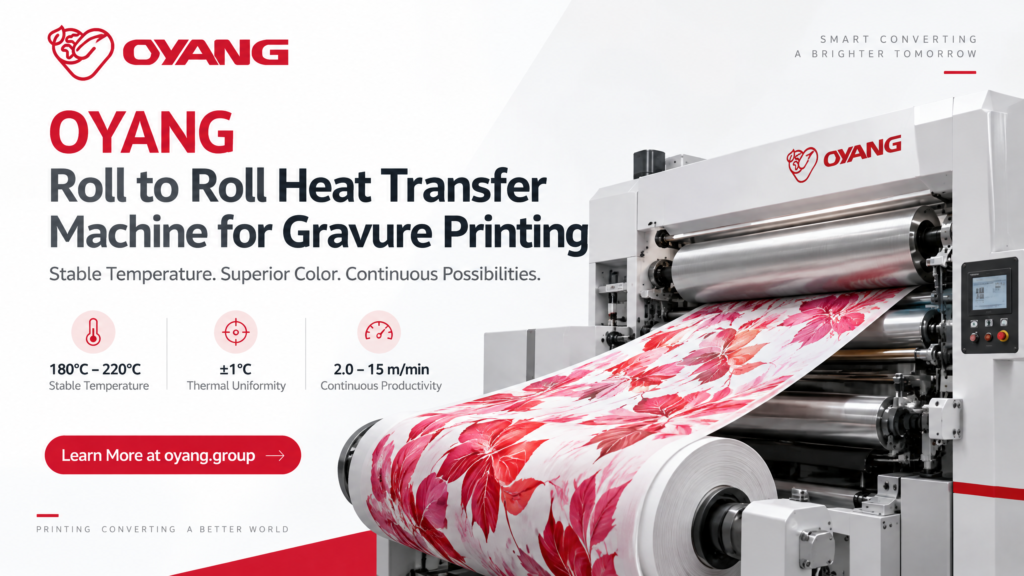
An industrial roll to roll heat transfer machine converts synthetic textiles, woven webbing, and narrow ribbons through continuous thermomechanical calender contact, maintaining surface temperatures between 180°C and 220°C with thermal deviation held strictly within ±1°C. By coordinating oil-jacketed heating cylinders with pneumatic blanket compression (3.0–6.0 bar) and synchronized servo tension control, high-precision systems eliminate thermal ghosting and lateral fabric shrinkage, running speeds from 2.0 to 15 m/min. In modern manufacturing ecosystems, OYANG backs continuous thermal converting equipment with Japanese MAZAK and OKUMA 5-axis CNC machining, ensuring sub-0.015 mm roller parallelism for multi-lane lanyard webbing and specialty nonwoven composites.
Continuous Thermal Conversion Dynamics: How Rotary Calender Sublimation Works
Unlike static flatbed heat presses that create batch bottlenecks and pressure gradients, a continuous roll to roll sublimation heat press utilizes rotary drum technology to achieve uniform dye fixation and polymer bonding:
1. Molecular Dye Vaporization Under Controlled Thermodynamic Dwell Time
During dye-sublimation transfer, high-tack sublimation paper printed with disperse dyes enters the calender in close contact with polyester or synthetic textiles. As the sandwich passes around the heated cylinder, the disperse dyes instantly sublimate from a solid directly into a gas at approximately 200°C. Simultaneously, synthetic fibers open their micro-pores, allowing dye molecules to penetrate into the polymer matrix. Upon exiting the heated zone, cooling seals the dyes permanently within the fiber structure, achieving wash-fast and scratch-resistant results.
2. Oil-Heated Drum vs. Electric Element Thermal Consistency
Entry-level transfer machines utilize direct electrical heating elements inside a dry hollow core. Over time, air stratification generates substantial temperature differentials across the roller face (frequently exceeding ±5°C to ±8°C), resulting in side-to-side color shading. Industrial-grade platforms utilize an oil-jacketed drum featuring continuous thermal oil recirculation and an expansion tank. This fluid layer distributes thermal energy across the cylinder circumference, restricting temperature variation to ≤ ±1.0°C across drum widths up to 3.2 meters.
| Machine Classification | Heating Architecture | Operating Speed | Thermal Uniformity | Target Products |
|---|---|---|---|---|
| Narrow-Web Ribbon / Lanyard Press | Oil-recirculated drum (210–420 mm dia.) | 1.5 – 6.0 m/min | ±0.8°C across width | Polyester lanyards, satin ribbons, pet leashes, elastic webbing |
| Wide-Format Textile Calender | Dual-chamber oil jacket (420–800 mm dia.) | 3.0 – 12.0 m/min | ±1.0°C across width | Sportswear apparel, soft signage banners, home furnishing upholstery |
| Industrial Continuous Fusing Machine | Infrared pre-heat + heated nip rollers | 5.0 – 18.0 m/min | ±1.5°C across width | Interlinings, hot-melt adhesive nonwovens, geotextile composites |
Critical Engineering Subsystems on High-Speed Continuous Presses
Achieving clean graphics without web distortion on a roll to roll sublimation printing machine or roll to roll lanyard printing machine relies on four mechanical control assemblies:
1. Nomex Seamless Blanket Tensioning & Auto-Tracking
The endless high-density Nomex blanket wraps around 70% to 75% of the heated drum’s circumference to exert uniform hydraulic or pneumatic pressure. If the blanket drifts laterally, web wrinkling occurs immediately. Industrial machines incorporate dual optical edge sensors coupled to a pneumatic proportional steering roller, keeping blanket tracking alignment within ±2.0 mm under continuous 200°C operation.
2. Multi-Lane Web Tension Isolation for Lanyard Processing
When running multi-lane narrow ribbons (such as 10 to 24 parallel lanyard channels simultaneously), slight variations in ribbon thickness or pre-tension create lane slip and ghosting. High-speed systems deploy independent torque-controlled rewind spindles with friction air shafts, ensuring each ribbon channel maintains independent, stable tension down to ±0.5 N.
3. Synchronized Protection Paper Rewind Dynamics
Disperse dyes emit gaseous vapor that can bleed onto the rear surface of the Nomex blanket, transferring ghost marks onto subsequent runs. To prevent contamination, disposable tissue protection paper (typically 20–30 gsm kraft or glassine) is continuously fed between the fabric and blanket. The rewind tension of both spent transfer paper and protection paper must be synchronized with main calender speed to prevent tensile tearing.
4. Cooling Outfeed & Separation Geometry
Separating the spent transfer paper from the hot printed substrate must occur immediately at the tangent point where the web departs from the heated drum. Any secondary contact or flutter while the synthetic fabric is hot causes residual dye transfer, visible as blurry edges (ghosting). Chilled water outfeed rollers rapidly lower substrate temperatures below the glass transition point (Tg), locking in edge sharpness.
Continuous Transfer Productivity Calculation
Hourly Ribbon Output (Metres) = Operating Line Speed (m/min) × 60 × Active Lanes × OEE Factor
Factory Benchmark: A rotary lanyard sublimation line running at a standard velocity of 4.5 m/min with 16 parallel ribbon channels operates at an 85% Overall Equipment Effectiveness (OEE). This delivers 3,672 meters of fully printed, heat-fixed lanyards per hour, outperforming manual flatbed shuttle heat presses by more than 12× while lowering per-unit electrical consumption by 35%.
OYANG Engineering Foundation: Sub-0.015mm CNC Machining for Continuous Thermal Rigidity
Whether transferring narrow ribbons or running composite converting lines, structural parallelism under continuous heat is crucial. When machine side walls experience thermal expansion, improper alignment creates roller deflection, uneven nip pressure, and substrate wrinkling.
Across OYANG’s 130,000 m² smart manufacturing base, all structural machine side panels, precision cylinder journal mounts, and synchronized roller assemblies are processed on Japanese MAZAK and OKUMA 5-axis CNC machining centers.

Figure 1: The OYANG Double Color Roll-to-Roll Screen Printing Machine engineered with MAZAK 5-axis CNC-machined frame rigidity, providing heavy-deposit printing prior to inline post-press thermal processing.
Video 1: Machine run of OYANG’s automated roll-to-roll continuous line, demonstrating synchronized web feeding, micro-registration control, and dynamic rewinding.
By boring structural bearing journals in a single clamping cycle, mechanical wall panel tolerances are held strictly to ≤ 0.015 mm. This structural foundation prevents dynamic thermal frame distortion and eliminates doctor blade or roller chatter marks during high-speed roll-to-roll converting operations.
In addition to web handling and screen systems, printed and fused synthetic rolls feed directly into high-throughput post-converting machinery, including our Nonwoven Fabric Slitting Machine XE1800 for precision ribbon separation, and the Automatic Soft Handle Ultrasonic Sealing Machine F700 for automated handle attachment.
Related Technical Guides & Converting Resources
- → Roll-to-Roll Printing Machine: Comparing Gravure, Flexo, Offset & Screen: In-depth engineering benchmark analyzing ink film thickness, tooling life, and operating speeds across flexible film and paper packaging webs.
- → Rotogravure Printing Machine Price Guide: CapEx Breakdown & Machine Cost Factors: Financial modeling covering continuous reel converting lines, drying energy requirements, and flying splice scrap payback equations.
- → Rotogravure vs. Gravure vs. Rotary Printing: Definitive Mechanical Comparison: Detailed breakdown of web handling tension, fluid shear, and rotary cylinder dynamics across industrial roll-fed machinery.
Frequently Asked Questions (FAQ)
What is the primary difference between a roll-to-roll heat transfer machine and a flatbed heat press?
A roll-to-roll rotary heat transfer machine uses a continuously rotating oil-heated calender cylinder and a synchronized Nomex blanket to process hundreds of meters of fabric or ribbons without interruption. A flatbed press operates in intermittent batches, which creates lower production rates and occasional pressure seams.
Why is an oil-heated drum superior to an electric-rod drum in a sublimation calender?
Oil-heated drums maintain temperature variations within ±1°C across the entire roller width because thermal fluid recirculates heat continuously. Electric element dry drums frequently experience temperature differences of ±5°C to ±8°C from edge to center, resulting in visible color shade differences across wide synthetic fabrics.
What causes image ghosting on a roll-to-roll lanyard printing machine?
Ghosting happens when transfer paper and ribbon slip relative to each other while the polyester fabric is still hot and porous. Industrial machines prevent this through independent servo-driven rewind friction tension shafts, pneumatic dancer rollers, and immediate separation geometry at the drum outfeed.
What is the function of a roll-to-roll fusing machine in nonwoven manufacturing?
A continuous roll-to-roll fusing machine activates heat-sensitive adhesives and thermo-bonds multi-layer synthetic nonwovens or garment interlinings under controlled heat and adjustable pneumatic calender pressure without melting delicate web structures.