350x97.png)
350x97.png)
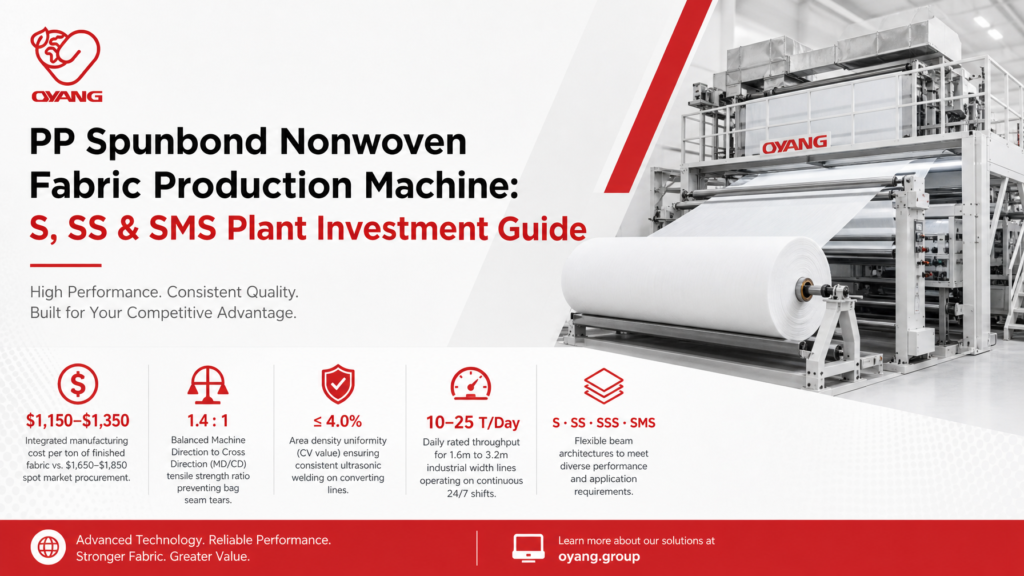
PP Spunbond Nonwoven Fabric Production Machine: S, SS & SMS Plant Investment Guide
An industrial PP spunbond nonwoven fabric production machine (covering S, SS, SSS, and SMS composite architectures) converts virgin polypropylene (PP) polymer granules (MFI 25–45 g/10min) into continuous nonwoven master rolls at linear line speeds up to 150–600 m/min. Integrating high-aspect-ratio single/twin screw extruders, high-precision planetary melt gear pumps, negative/positive aerodynamic drafting channels, and thermo-calendering embossing rollers, modern spunbond lines produce fabrics from 10 to 150 g/m² with a coefficient of variation (CV%) under ≤ 4.0%, lowering integrated roll manufacturing costs to $1,150–$1,350 USD per ton.
Integrated manufacturing cost per ton of finished fabric vs. $1,650–$1,850 spot market procurement.
Balanced Machine Direction to Cross Direction (MD/CD) tensile strength ratio preventing bag seam tears.
Area density uniformity (CV value) ensuring consistent ultrasonic welding on converting lines.
Daily rated throughput for 1.6m to 3.2m industrial width lines operating on continuous 24/7 shifts.
Extrusion-to-Bonding Engineering: The 5 Physical Processing Stages
Unlike simple film extrusion or textile weaving, the spunbond process combines polymer melt chemistry, aerodynamic filament attenuation, and continuous thermodynamic consolidation within a single unbroken automated loop:
- Melt Homogenization & Metering: Virgin polypropylene pellets (typically isotactic PP with a Melt Flow Index of 30 to 40 g/10min) are dried and fed into an electric-heated extruder barrel (L/D ratio 30:1 to 33:1). Seven independently regulated PID heating zones melt the polymer at 210°C–245°C. The melt passes through continuous hydraulic dual-plate screen changers into high-precision planetary metering gear pumps, maintaining volumetric delivery variations under ≤ ±0.5% across all spinneret orifices.
- Spinneret Micro-Extrusion: The molten resin enters the spin beam assembly containing thousands of laser-drilled capillary orifices (Φ 0.40mm–0.45mm). As the liquid polymer filaments emerge into the quench chamber, cross-flow conditioned air (16°C–18°C at 0.5–0.8 m/s) rapidly crystallizes the extruded strands.
- High-Speed Aerodynamic Drafting: Solidified filaments enter a narrow-gap venturi drafting slot. High-velocity compressed air streams accelerate the filament bundle to velocities exceeding 3,000 to 4,500 m/min. This extreme mechanical extension aligns the polypropylene macromolecular chains along the fiber axis, transforming coarse extrudates into high-tenacity microfilaments with fineness down to 1.5 to 2.2 denier.
- Electrostatic Charging & Suction Web Laydown: The drawn continuous filaments pass through an electrostatic corona neutralizer and are deposited randomly onto a continuous moving woven porous forming belt. A high-cfm under-belt vacuum suction box strips the drafting air away, pinning the filament web firmly against the wire mesh to guarantee a defect-free, uniform isotropic structure.
- Thermal-Bonding Calendering (Thermo-Calender): The loose fiber batt enters a dual-roll hot calender consisting of an upper induction-heated engraved pattern roller and a lower smooth mirror steel roller. Under oil-heated surface temperatures of 150°C–168°C and linear pneumatic nip pressures of 40–80 N/mm, diamond-shaped embossed points weld the crossing fibers via localized thermal fusion, imparting mechanical tensile rigidity.
Beam Architecture Comparison: S vs. SS vs. SSS vs. SMS Technology
The configuration of spinning beams dictates fiber deposition density, fabric softness, barrier hydrostatic resistance, and production capacity:
| Configuration Tier | Beam Layout & Process Topology | Filament Distribution & CV% | Tensile & Hydrostatic Traits | Primary Converting Application |
|---|---|---|---|---|
| Single Beam (S Line) | 1 Spunbond Extruder + 1 Spin Beam | Standard uniformity (CV 5.5%–7.5%); coarser web surface | Moderate tensile; zero liquid barrier protection | Commodity D-cut bags, inner linings, agricultural frost cloth |
| Double Beam (SS Line) | 2 Independent Extruders + 2 Spin Beams | High uniformity (CV 3.5%–4.8%); dense multi-layer laydown | High tensile (MD/CD ratio 1.4:1); enhanced softness | High-speed 3D box shopping bags, luxury retail packaging, furniture wrap |
| Triple Beam (SSS Line) | 3 Independent Extruders + 3 Spin Beams | Ultra-dense laydown (CV ≤ 3.0%); silk-like tactile hand-feel | Extreme tensile strength and puncture resistance | Premium hygiene top-sheets, medical drapes, high-speed bag converting |
| Composite (SMS Line) | 2 Spunbond Beams + 1 Meltblown Beam (Middle) | Spunbond exterior for strength + micro-fiber meltblown core | Waterproof & breathable (Hydrostatic head > 400 mm H₂O) | Medical surgical gowns, N95 mask layers, heavy-duty barrier sacks |
Tensile Symmetry: Engineering the Machine Direction / Cross Direction (MD/CD) Ratio
In high-speed automated nonwoven box bag converting (such as on the OYANG 16S or TECH 23 lines running at 80–100 bags/min), the most frequent cause of seam splitting during ultrasonic welding is anisotropic fabric strength. When filaments align solely along the machine direction, the fabric exhibits high longitudinal strength but splits cleanly when transverse stress is applied to the side gusset or handle root.
1. The Aerodynamic Air Turbulence Chamber
Cheap spunbond lines deposit filaments in parallel tracks, producing unacceptable MD/CD ratios of 3.0:1 or 4.0:1. OYANG spunbond lines incorporate an active oscillating aerodynamic diffuser at the outfeed of the drafting slot. Controlled micro-vortices introduce controlled transverse filament dispersion immediately before the web hits the suction forming table.
2. Optimized Calender Web Traction
By balancing the speed differential between the forming wire, intermediate transfer rolls, and the thermo-calender nip to within ±0.2%, longitudinal web stretching is minimized while fibers are in their unbonded state. This preserves diagonal filament orientation, locking in a balanced MD/CD tensile ratio of 1.4:1 to 1.8:1, ensuring the finished fabric withstands multi-axis handling loads on retail bags.
Comprehensive Feasibility & Cost Model: In-House Production vs. Buying Master Rolls
For converting operations processing over 80 tons of nonwoven fabric monthly, the capital expenditure (Capex) of an in-house S or SS spunbond line delivers rapid payback by eliminating middleman trading margins and freight premiums:
| Operational Expense (Opex) Parameter | Unit Input Basis | Consumption per Metric Ton of Fabric | Cost Contribution (USD / Metric Ton) |
|---|---|---|---|
| Virgin Polypropylene Resin (Homopolymer) | MFI 35–38 Granules @ $1,020 / Ton | 1,015 kg (Includes 1.5% melt volatilization) | $1,035.30 USD |
| Color Masterbatch & Calcium Filler | 2% Color / 10% CaCO₃ compound | Blending ratio optimization | $65.00 USD |
| Electrical Power Consumption | $0.10 / kWh (Industrial rate) | 750–850 kWh / Metric Ton | $80.00 USD |
| Direct Operating Labor | 4 Technicians per shift (3 Shifts) | 20 Tons daily throughput | $25.00 USD |
| Cooling Water, Compressed Air & Auxiliary | Closed-loop water chillers | Continuous pneumatic cycling | $15.00 USD |
| Machine Depreciation & Wear Parts | 10-Year straight line amortization | Calender re-grinding, spinneret sonic wash | $35.00 USD |
| Total Net In-House Production Cost | Ex-Factory Finished Master Roll | 1.0 Metric Ton (Any Color / Width) | $1,255.30 USD / Ton |
| Spot Market Fabric Purchase Price | Commercial distributor delivered price | 1.0 Metric Ton equivalent quality | $1,650.00 USD / Ton |
| Net Profit / Direct Savings per Ton | In-House Manufacturing Delta | Direct operational margin captured | $394.70 USD / Ton Saved |
Factory Infrastructure, Utility Requirements & Capex Planning
Establishing an upstream spunbond manufacturing plant requires dedicated civil and electrical planning to accommodate continuous high-throughput equipment:
1. Building Footprint & Ceiling Height Requirements
A standard 2.4-meter wide single/double beam spunbond line requires a manufacturing bay dimensions of at least 35m (Length) × 12m (Width) × 11m to 13m (Clear Ceiling Height). The vertical height is required to house the overhead gravity-fed resin blending silos, extruder platforms, spin beam assemblies, and the long vertical quench/drafting towers without sharp duct turns.
2. Electrical Substation & Compressed Air Capacity
Continuous thermal heating on extruders, melt pipes, and oil-heated calender rollers demands a dedicated 630 kVA to 1,250 kVA transformer substation. The pneumatic drafting and web laydown systems require a continuous screw compressor delivery of 12 to 18 m³/min at 0.8 MPa, accompanied by industrial refrigerated air dryers maintaining a dew point of -40°C to prevent moisture contamination in the aerodynamic drafting chambers.
Featured Platform: OYANG AW-SMS Spunbond & Composite Production Line
Engineered inside OYANG’s 130,000&mflat; CNC precision manufacturing base, our spunbond production lines utilize Japanese MAZAK and OKUMA 5-axis machining to ensure precision alignment across all heated calender and drafting surfaces:

OYANG AW-SMS PP Spunbond & Composite Production Line
The industrial flagship turnkey line for manufacturing medical-grade composite nonwovens and high-tenacity spunbond packaging fabrics from virgin PP pellets.
- Working Widths Available: 1,600mm / 2,400mm / 3,200mm
- Fabric Weight Range: 10–150 g/m² high-precision output
- Max Operating Velocity: Up to 400 m/min continuous web
- Calender Technology: High-precision thermal oil embossing rollers
Frequently Asked Questions (FAQ)
Integrate Your Supply Chain with Turnkey Spunbond Machinery
Eliminate volatile raw material supply chains and capture complete upstream manufacturing margins. Consult with OYANG extrusion engineering directors to receive factory layout drawings, electrical load specifications, and formal project feasibility quotations.
Download 2026 Machinery Brochure (PDF)